Global High Purity Alumina Market Overview
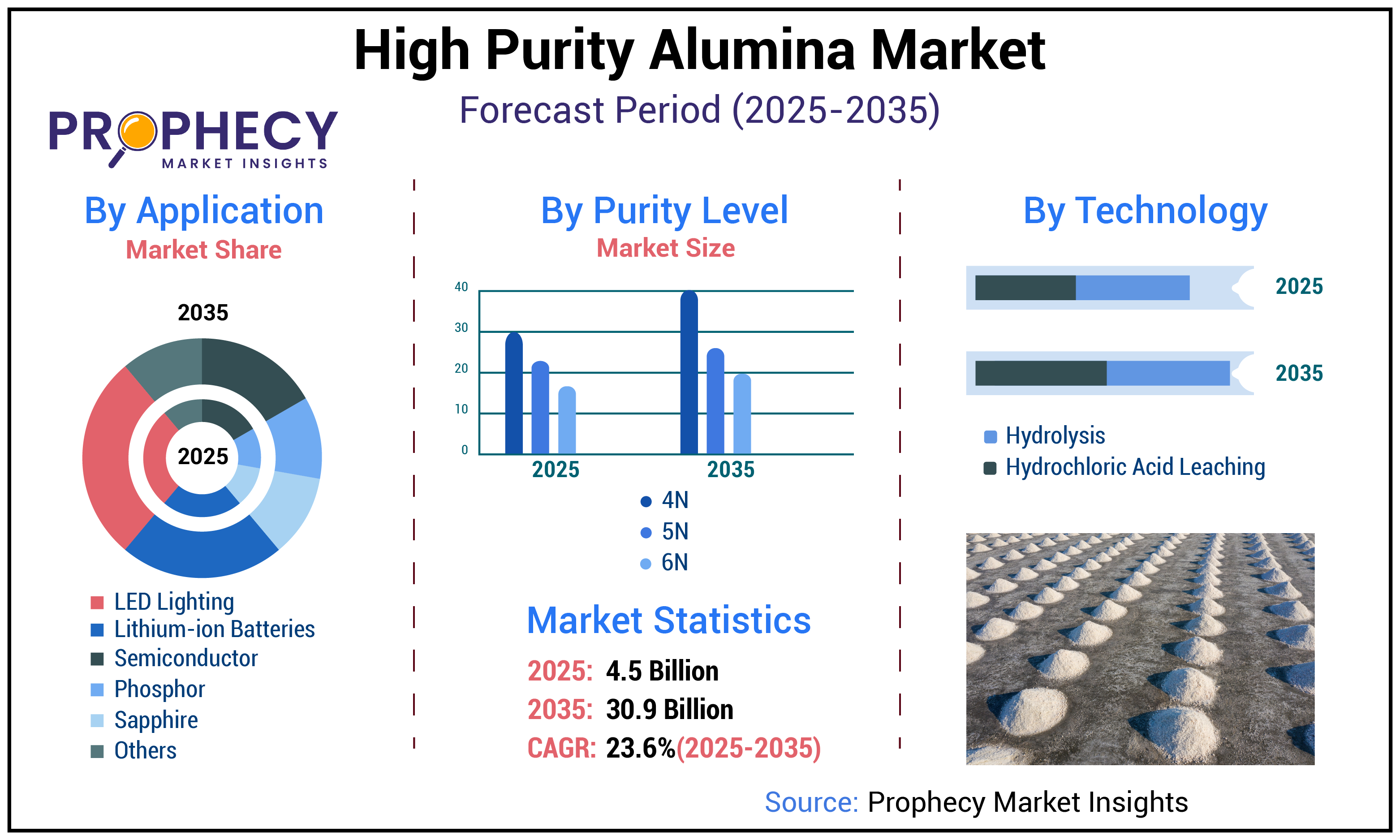
- By 2035, the high purity alumina market size is projected to develop at a rate of USD 30.9 Billion.
- In 2024, the market valuation was USD 3.8 Billion.
- High purity alumina market is mounting at a CAGR 23.6%.
High purity alumina is a highly refined form of aluminum oxide (Al?O?) that is produced to a very high level of purity, typically above 99.99%, which have 4N or 5N purity levels. It is primarily used in advanced manufacturing processes and is an essential material for several high-tech industries, including electronics, semiconductors, and energy storage. It holds the chemical and physical properties of alumina, such as excellent thermal stability, mechanical strength, and corrosion resistance. It also has high electrical insulation properties, making it valuable in electronic components. It is applied in LED manufacturing, semiconductors, battery technology and other industries.
The growing demand of high purity alumina in the production of LED substates, and increasing adoption of electric vehicles, the need of lithium-ion batteries for energy storage, is driving the high purity alumina market growth. Advancement in semiconductor substates, rapid growth in 5G, IoT devices, and rising demand for advanced ceramics, is projected to fuel high purity alumina market growth.
Technological advancement in high purity alumina production, expansion of renewable energy, energy storage, and growing investment in space, aerospace application, can significantly create opportunities for high purity alumina market growth. Development of high-performance lighting, displays, rapid growth in emerging markets, and strategic partnerships, is expected to pitch high purity alumina market growth.
Recession Risk & Tariff Analysis of High Purity Alumina Market:
- Reduced consumer spending on electronics and LED lighting, along with lower investments in electric vehicles and renewable energy technologies, could reduce demand for high purity alumina. The global supply chain disruptions and rising production costs during a recession could impact the availability and pricing of high purity alumina.
- Tariff analysis of the high purity alumina (HPA) market reveals that tariffs on HPA-related raw materials, such as bauxite or alumina, can impact the cost structure for manufacturers. Countries with high tariffs on imports of these materials may face increased production costs, which can be passed onto consumers.
Impact of Generative AI on High Purity Alumina Market:
- AI can significantly enhance market by enhancing production process, product development, market analysis, and supply chain management. Researchers and engineers can influence AI-powered models to simulate and predict the behavior of alumina under different conditions.
- AI algorithms can help to design new alloys or improve the purification processes, which allows for more efficient extraction and refinement methods. AI models can used to optimize production processes, by applying machine learning models and AI-driven simulations, manufacturers to improve process efficiency in the extraction and purification of alumina.
Global High Purity Alumina Market Drivers & Restraints
Key Drivers:
Growing Adoption of Electric Vehicles is Anticipated to Drive Target market Growth
High purity alumina is used as a coating material for battery separators, which are essential for enhancing thermal stability, safety and efficiency of lithium-ion batteries, which is key components in electric vehicles. As global governments and industries shifts toward decarbonization, the demand for electric vehicles is accelerating rapidly. Countries such as China, the U.S., and members of the European Union are offering subsidies, implementing regulations, and setting targets to phase out internal combustion engine vehicles.
This growing electric vehicles demand a higher need for high-performance, long-lasting batteries, thus increasing the consumption of high purity alumina. Battery manufacturers are ordering high-purity materials to ensure product safety and durability, especially under high-temperature conditions. High purity alumina has the ability to act as a protective layer in batteries reduces the risk of short circuits and thermal runaway, making it crucial for next-generation battery technologies, is anticipated to drive high purity alumina market growth.
- For instance, according to data published by, Virta Global, the global electric vehicle sale growing by 43% from 2019, and at the year 2021, electric vehicle sales doubled from 2020 to 6.75 million. In 2022, electric vehicles sale exceeded 10 million, in which 14% are electric cars. The global electric car sales reached around 14 million, which represented a 35% increase from 2022. This growth represents global electric fleet rise to 40 million in 2023. Electric vehicle adoption is rapidly increasing globally, with countries such as Norway 95%, Sweden 60%, and Netherlands 30% are adopting electric cars. In 2023, electric trucks and electric buses is growing by 35% from 2022.
Restraints:
Market Volatility and Supply Chain Disruptions can Hinder Market Growth
High purity alumina production depends on specific raw materials, such as bauxite and alumina, is coupled with the concentration of production in regions. The disruptions from geopolitical tensions, economic fluctuations, and natural disasters, can leads to supply chain disruptions. The volatility in raw material prices and production delays due to environmental factors can create volatility in the market, affecting supply consistency and pricing stability.
- Counterbalance Statements: Diversifying supply chains to reduce dependence on any single region, localizing production to mitigate logistical risks. Adopting advanced technologies such as AI to optimize inventory management and predict disruptions, this helps to manage supply chain management in the market. Increasing recycling of alumina and exploring alternative raw material sources can reduce reliance on mined bauxite, which offers more flexibility.
Opportunities & Trends:
Rapid Growth 5G and IoT Devices can Stimulate Market Augmentation
As 5G networks are deployed globally, the demand for faster, more efficient, and miniaturized electronic components is rising. High purity alumina is used in the production of sapphire substrates and ceramic insulators, which are critical in RF (radio frequency) filters, LEDs, and high-frequency chips needed for 5G infrastructure and IoT connectivity. Its high thermal conductivity, electrical insulation, and durability make high purity alumina an ideal material for these advanced applications.
These filters are essential in 5G devices for separating different frequency bands, as the crucial requirement for fast and clear signal transmission. As the number of mobile devices, base stations, and connected endpoints grows, the demand for sapphire-based components increases. Many IoT applications rely on sensors and semiconductors that operate in demanding environments, which is heavily based on high purity alumina, is contributing to high purity alumina market share.
- For Instance, according to the data published by ComputerWeekly.com, in April 2025, the global 5G connections is reaching 2.25 billion, this highlights 5G’s rapid adoption in wireless generations. The global mobile ecosystem continuous to expand, in which 1.5 connections per person globally is rises by the end of 2024. By 2029, the 5G connection is increasing by 8.3 billion, representing 59% of global wireless technologies.
- The Internet of Things (IoT) arena is expanding by 483 connections in 2024, brings total 3.6 billion globally. North America has 289 million 5G connections in 2024, which represents 67% growth by 2023. Also, the number of connected IoT devices is expected to increases at 30 billion units globally by 2030.
Global High Purity Alumina Market Segmentations & Regional Insights
The high purity alumina market is segmented into purity level, technology, application, and region.
By Purity Level:
Based on purity level, the high purity alumina market is divided into 4N, 5N, and 6N. The 4N purity segment is the largest segment in the market. This level of purity is sufficient for many industrial applications such as LED lighting, ceramics, and electrical insulators. The demand for 4N purity alumina is driven by its cost-effectiveness and its suitability for a variety of high-volume applications in which extreme purity is not required, resulting to propel segment growth in high purity alumina market share.
The 5N purity segment is the second largest in the market, as it is used in more advanced applications such as semiconductors and batteries. 5N purity alumina offers superior performance in high-precision technologies, making it essential for the electronics, energy storage industries, including lithium-ion batteries and high-end electronics, is contributing to segment’s development in high purity alumina market size.
By Technology:
On the basis of technology, the market is divided into, hydrolysis, and hydrochloric acid leaching. The hydrolysis process is the most dominant segment in the market. It involves the reaction of alumina with highly purified water under high temperature and pressure, which results in the formation of high-purity alumina. The hydrolysis method is commonly used for large-scale production of HPA, especially for industries such as LED manufacturing, ceramics, and semiconductors, is anticipated to drive segment growth in high purity alumina market share.
The hydrochloric acid leaching (HCL) method is the second dominant segment. This method uses hydrochloric acid to extract impurities from alumina and produce high-purity alumina. It is used for producing 5N and 6N purity alumina due to its ability to remove trace impurities to extremely low levels, is projected to impel segment’s expansion in high purity alumina market size.
By Application:
By application, the market is categorized into LED lighting, lithium-ion batteries, semiconductor, phosphor, sapphire, and others. The LED lighting segment is the largest and most dominant application in the market. High purity alumina is a key material in the production of LEDs, as it is used to produce the sapphire substrates on which the LEDs are mounted. The growing demand for energy-efficient lighting solutions and the ongoing adoption of LED technology in residential, commercial, and industrial sectors make this the leading segment in high purity alumina market share.
Lithium-ion battery is fastest growing segment in the market. High purity alumina is used as a coating material for cathodes and anodes in lithium-ion batteries, which are essential components in electric vehicles (EVs), renewable energy storage, and consumer electronics. With the rise of the electric vehicle market and the global push for sustainable energy solutions, the demand for high-quality lithium-ion batteries continues to grow, is estimated to fuel segment’s growth in high purity alumna market size.
Regional Insights:
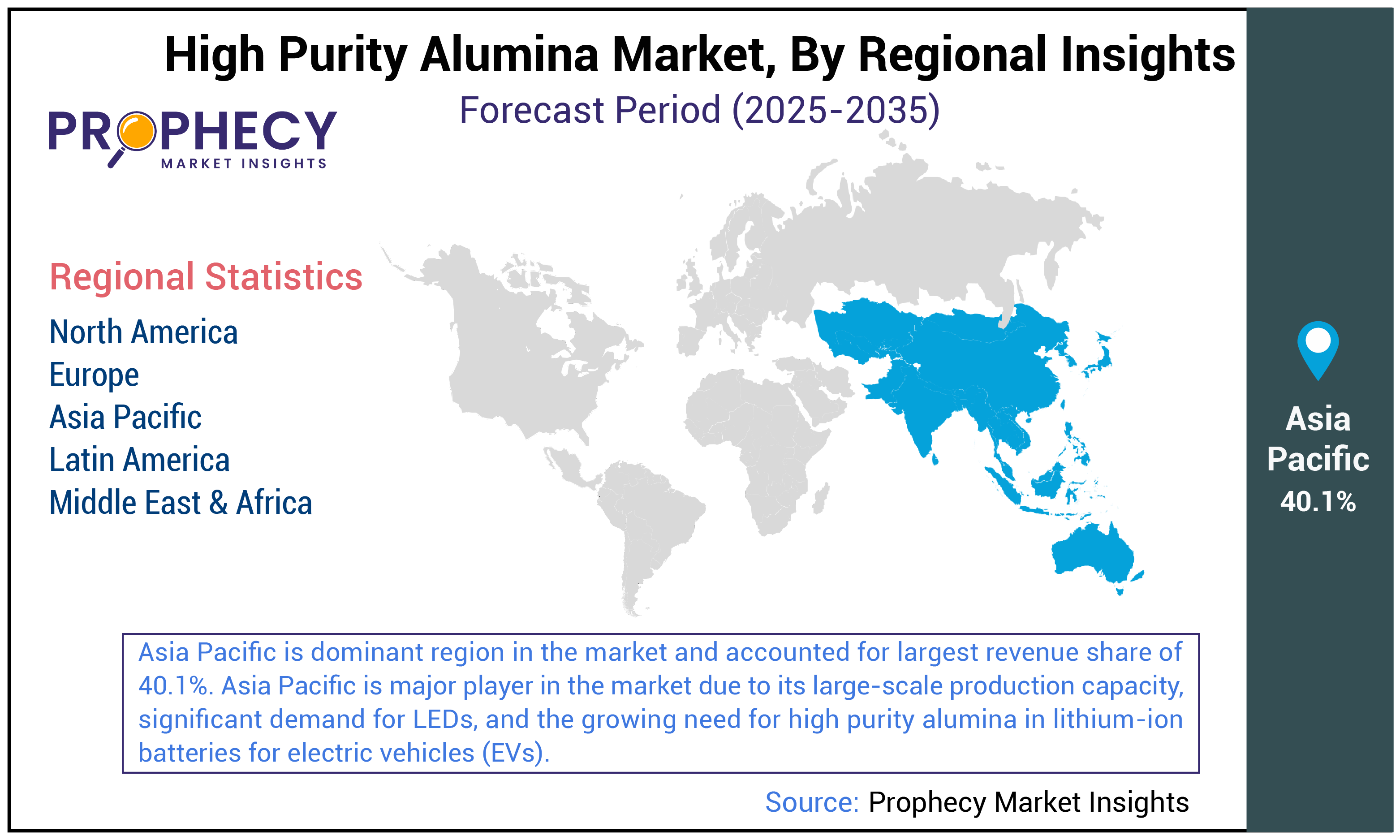
Geographically, the market is studied across North America, Europe, Asia Pacific, Latin America, and the Middle East & Africa.
Asia Pacific: This is dominant region in the market and accounted for largest revenue share of 40.1%. Asia Pacific is major player in the market due to its large-scale production capacity, significant demand for LEDs, and the growing need for high purity alumina in lithium-ion batteries for electric vehicles (EVs). It also has significant demand for high purity alumina due to their robust electronics and automotive industries, particularly in semiconductors and energy storage solutions, is contributing region’s expansion in high purity alumina market size.
- China High Purity Alumina Market Insights:
China is the dominant country in the Asia-Pacific region and the global leader in high purity alumina production and consumption. China is a major supplier of raw materials such as bauxite and alumina, and it is a large-scale producer of high purity alumina. The country’s LED lighting industry and electric vehicle market are significant drivers for high purity alumina market growth.
North America: This is the second dominant region in the market, driven by the demand for high purity alumina in lithium-ion batteries and semiconductors. The U.S. is a key player due to its advancements in battery technologies, semiconductor manufacturing, and LED lighting. The rise in electric vehicle adoption and renewable energy solutions has led to increased demand for high purity alumina in the region. There is growing investment in sustainable energy storage and clean energy technologies, is boost the demand for high-quality alumina in battery and electronics applications, is assessed to urge high purity alumina market share in following region.
- U.S. High Purity Alumina Market Insights:
The U.S. has one of the largest markets in the North America region. The country has significant demand for high purity alumina, driven by sectors such as semiconductors, lithium-ion batteries, and LED lighting. The automotive industry’s shift towards electric vehicles and the growing demand for clean energy storage solutions are key factors driving the demand for high-purity alumina in the U.S., resulting to boost high purity alumina market share.
Europe: This region is an emerging and significant market share, driven by increasing demand in LED lighting, semiconductors, and lithium-ion batteries. Key countries are contributing to the market growth, with the demand for sustainable energy solutions and rise in electric vehicles is anticipated to drive high purity alumina market growth. Europe's shift towards green energy and carbon neutrality has accelerated the need for HPA in battery technologies and electronics.
- Germany High Purity Alumina Market Insights:
Germany is the dominant country in Europe for the high purity alumina market . Germany is a leader in renewable energy solutions and battery technology, which require high-quality alumina. The country's industrial base in electronics, with its commitment to sustainability, makes it a significant player in the European high purity alumina market. The growing focus on carbon neutrality and green technology strengthens the demand for high purity alumina in energy storage and electronics applications, is drive the high purity alumina market growth.
High Purity Alumina Market Report Scope:
|
Attribute |
Details |
|
Market Size 2025 |
USD 4.5 Billion |
|
Projected Market Size 2035 |
USD 30.9 Billion |
|
CAGR Growth Rate |
23.6% (2025-2035) |
|
Base year for estimation |
2024 |
|
Forecast period |
2025 – 2035 |
|
Market representation |
Revenue in USD Billion & CAGR from 2025 to 2035 |
|
Regional scope |
North America - U.S. and Canada Europe – Germany, U.K., France, Russia, Italy, Spain, Netherlands, and Rest of Europe Asia Pacific – China, India, Japan, Australia, Indonesia, Malaysia, South Korea, and Rest of Asia-Pacific Latin America - Brazil, Mexico, Argentina, and Rest of Latin America Middle East & Africa – GCC, Israel, South Africa, and Rest of Middle East & Africa |
|
Report coverage |
Revenue forecast, company share, competitive landscape, growth factors, and trends |
Segmentation:
By Purity Level:
- 4N
- 5N
- Others
By Technology:
- Hydrolysis
- Hydrochloric Acid Leaching
By Application:
- LED Lighting
- Lithium-Ion Batteries
- Semiconductor
- Phosphor
- Sapphire
- Others
By Region:
- North America
- U.S.
- Canada
- Europe
- Germany
- U.K.
- France
- Russia
- Italy
- Spain
- Netherlands
- Rest of Europe
- Asia Pacific
- China
- India
- Japan
- Australia
- Indonesia
- Malaysia
- South Korea
- Rest of Asia Pacific
- Latin America
- Brazil
- Mexico
- Argentina
- Rest of Latin America
- Middle East & Africa
- GCC
- Israel
- South Africa
- Rest of Middle East & Africa
Global High Purity Alumina Market Competitive Landscape & Key Players
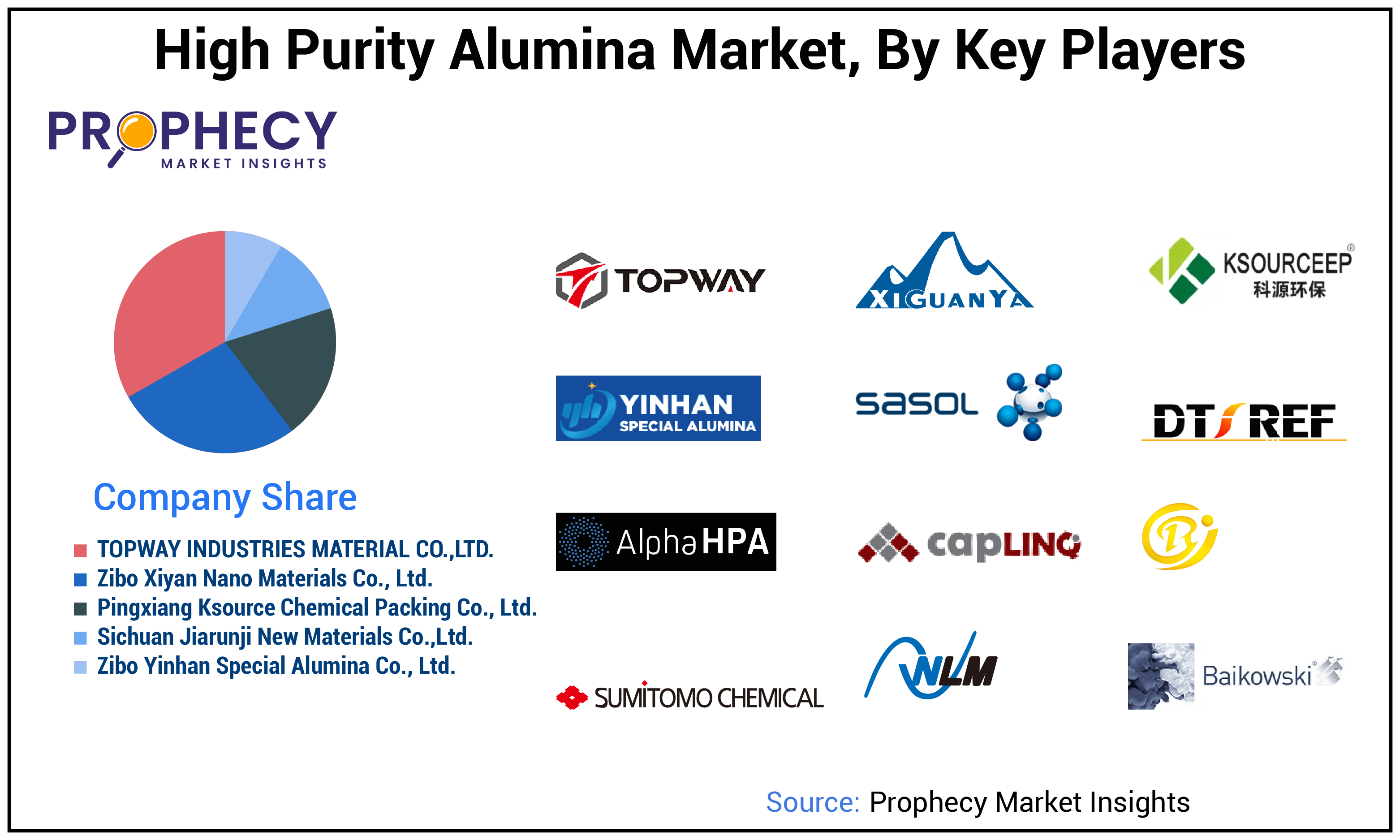
The major companies operating in the high purity alumina market are, TOPWAY INDUSTRIES MATERIAL CO.,LTD., Zibo Xiyan Nano Materials Co., Ltd., Pingxiang Ksource Chemical Packing Co., Ltd., and others. These firms are focusing on technological innovation, production efficiency, and the ability to meet the growing demand for high-purity alumina in LED lighting, electric vehicles, and semiconductor applications, through their collaboration or partnerships. Companies can optimize their supply chains, reduce production costs, and increase efficiency in raw material, which the collaboration with other region firms or through acquisition, is expected to pitch high purity alumina market growth.
High Purity Alumina Market Companies:
- TOPWAY INDUSTRIES MATERIAL CO.,LTD.
- Zibo Xiyan Nano Materials Co., Ltd.
- Pingxiang Ksource Chemical Packing Co., Ltd.
- Sichuan Jiarunji New Materials Co.,Ltd.
- Zibo Yinhan Special Alumina Co., Ltd.
- Sasol
- Nippon Light Metal Holdings Co., Ltd.
- Kaifeng Datong Refractories Co., Ltd.
- Alpha HPA
- CAPLINQ Corporation
- Norsk Hydro ASA
- CHALCO Shandong Co.,Ltd.
- Chongqing Research Better Science & Technology Co., Ltd.
- Baikowski SA
- Sumitomo Chemical Co., Ltd.
View an Additional List of Companies in the High Purity Alumina Market
Global High Purity Alumina Market Recent News
- In April 2025, ChemX Materials Ltd, advanced its HiPurA process for scalable high purity alumina production. This development was significant for ChemX’s operations, which focused on clean energy applications that potentially enhanced their market position and stakeholder value. HiPurA was aimed to produce high purity alumina, which is energy-efficient and can be implemented globally.
- In September 2024, The second stage of Alpha’s high-purity alumina facility in Gladstone, Queensland was under construction, which known as its HPA First Project to become one of the largest single site ultra-high-purity alumina refineries globally. This projected was funded by USD 400 million by Australian Government debt facility, and USD 180 million in equity with strong support from 5 per cent shareholder Orica.
- In October 2023, Advanced Energy Mineral (AEM) expand their plant for high purity alumina in Cap-Chat, Quebec, Canada. The plant expansion represents a major investment by AEM, which increases the plant’s capacity to produce high-value aluminum derivative products, such as high purity alumina. The plant was equipped with the latest technology and equipment to meet customer needs, and this plant expansion was align company’s production capacity with the growth of pipeline.
- In August 2023, Sumitomo Chemical produced pioneering ultra-fine α-alumina products, which creates new markets in, energy-saving and life science fields through technological innovations in inorganic materials. In FY2025 the company seeks to achieve a 30% increase in sales revenue in its ultrahigh purity alumina business compared to FY2023. The new products were mass-produced as NXA series products, which were ultra-fine grade of α-alumina products mainly used in industrial products.
Analyst View:
As the global push for clean energy, electric vehicles (EVs), and energy-efficient technologies intensifies, the need for high-purity materials is expected to expand, providing significant opportunities for market growth. Increasing demand for LED, rise in electric vehicle adoption, and technological advancement in high purity alumina production, contributes to high purity alumina market growth.
More Related Reports
High Power Charger for Electric Vehicle Market
High Content Screening Market
High-Temperature Gasket Materials Market
High Performance Composites Market
High Strength Steel Market
Global High Purity Alumina Market Company Profile
|
Company Name |
Sasol |
|
Headquarter |
Johannesburg, South Africa |
|
CEO |
Simon Baloyi |
|
Employee Count |
30,100 Employees |
Global High Purity Alumina Market Highlights
FAQs
High purity alumina market size was valued at USD 4.5 Billion in 2025 and is expected to reach USD 30.9 Billion by 2035 growing at a CAGR of 23.6%.
Purity level, technology, application, and region are the segmentation for the high purity alumina market.
North America, Asia Pacific, Europe, Latin America, and the Middle East & Africa. Asia Pacific is expected to dominate the market.
The key players operating in the high purity alumina market include TOPWAY INDUSTRIES MATERIAL CO.,LTD., Zibo Xiyan Nano Materials Co., Ltd., Pingxiang Ksource Chemical Packing Co., Ltd., Sichuan Jiarunji New Materials Co.,Ltd., Zibo Yinhan Special Alumina Co., Ltd., Sasol, Nippon Light Metal Holdings Co., Ltd., Kaifeng Datong Refractories Co., Ltd., Alpha HPA, CAPLINQ Corporation, Norsk Hydro ASA, CHALCO Shandong Co.,Ltd., Chongqing Research Better Science & Technology Co., Ltd., Baikowski SA, and Sumitomo Chemical Co., Ltd.