Global HVAC Market By Product Overview
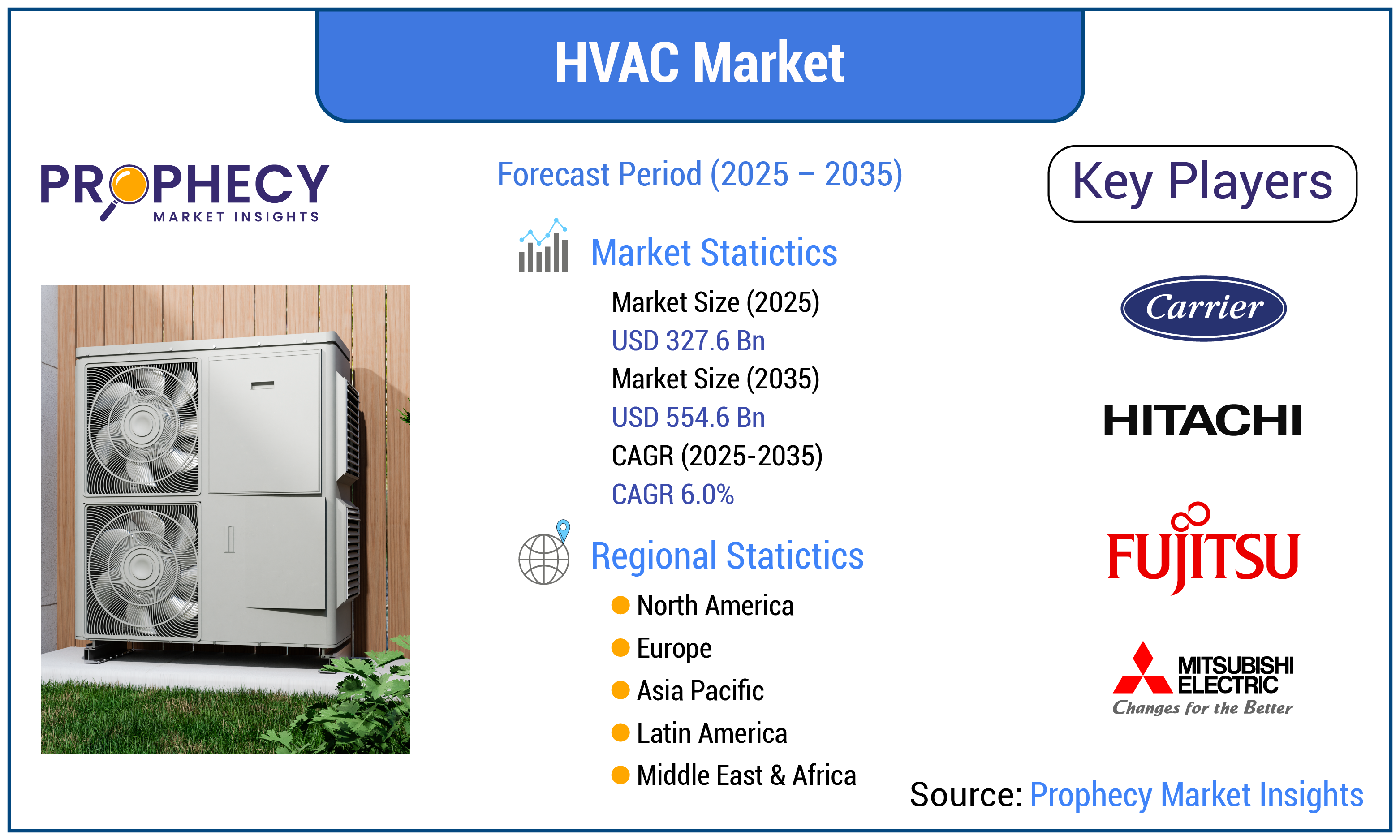
- By 2035, the HVAC market size is contemplated to enlarge at a valuation of USD 554.6 Billion.
- In 2024, the HVAC market valuation was USD 311.0 Billion.
- HVAC market is developing at a CAGR of 6.0%.
The term HVAC (Heating, Ventilation, and Air Conditioning) describes the technology that regulates humidity, temperature, and air quality to offer an inviting interior the atmosphere. HVAC systems and equipment provide ventilation, heating, cooling, as well as air purification for residential, commercial, and industrial buildings.
Major prominent growth factors fueling the HVAC market's expansion are growing urbanization, more residential and commercial building development, and a rising demand for energy-efficient systems. In order to ensure interior comfort, climate change and strong weather patterns are also driving up the use of advanced HVAC technology. Policies from the government promoting smart infrastructure and green buildings, as well as rising awareness of indoor air quality, are also driving investment in modernized HVAC systems across a number of industries. Smart thermostats and IoT integration under advancement in technology is further driving market growth.
IoT-enabled sensors, AI and ML-based analytics, and cloud platforms enable real-time monitoring, predictive maintenance, and optimum consumption of energy across all building types, driving an innovative shift in the HVAC industry. the phase?down of high?GWP refrigerants and greater integration of HVAC with renewable energy systems are due to regulatory pressures and sustainability trends that supports net-zero building goals.
Recession Risk & Tariff Analysis:
- The HVAC market counters moderate recession risks with construction slowdowns, reduced consumer spending, and delayed infrastructure spending are recession risks for the HVAC sector that can have an immediate impact on need for new deployments and significant remodelling.
- Reduced spending in the residential and commercial sectors due to economic downturn could lead premium systems to give way to more costly maintenance options. Additionally, inflationary pressures and geopolitical conflicts continue to have an impact on global supply chain disruptions and growing cost of materials.
Impact of Generative AI on HVAC Market:
- With enhancing energy optimization, predictive maintenance, and system design, generative AI has begun to change the HVAC sector. Engineers and manufacturers use AI-generated simulations to design improved HVAC layouts that are ideal for specific building requirements further integrating generative AI solutions in the design.
- The generative AI models are utilized in operations to forecast failures of equipment by analyzing immediate sensor data. It enables for proactive maintenance and reduces downtime. Generative AI also enhances good customer service along with automating troubleshooting and generating customized energy-saving advice. Given simulations reduce energy consumption and streamline operations efficiently with generative AI.
Global HVAC Market By Product Drivers & Restraints
Key Drivers:
Rising IAQ Awareness Fuels Surge in HVAC Adoption Across Residential and Commercial Sectors
Market is witnessing rising adoption of HVAC systems that can properly filter and purify air and improve occupants' comfort and health is increasing as a result of rising awareness and concern about indoor air quality. The shift is driven by greater vulnerability to airborne contaminants, allergies, and viruses, notably in the aftermath of the COVID-19 epidemic. For occupant safety and comply with regulations, commercial venues such as workplaces, schools, and healthcare facilities are investing in these methods in general driving more adoption of HVAC systems in the residential and commercial spaces.
- For Instance, according to World Health Organization, Household air pollution was responsible for an estimated 3.2 million deaths per year in 2020, including over 237 000 deaths of children under the age of 5.
Restraints:
Aging Infrastructure Slows HVAC Adoption Amid Growing Need for IAQ Upgrades
Having the old and outdated designs and structural restrictions, older buildings sometimes face significant challenges when it comes with improving indoor air quality. It is challenging to guarantee adequate air circulation and pollutant removal in many homes as they lack the infrastructure required to enable modern HVAC renovations or modern ventilation machines for implementing. This may be difficult and expensive to retrofit these regions with effective HVAC systems and enough air filtering, but doing so is becoming increasingly essential to satisfy modern environmental and health regulations and this slows down the adoption of HVAC systems.
- Counterbalance Statements: Retrofitting older buildings is becoming simpler and less costly because to developments in small and modular HVAC systems, despite the difficulties caused by outdated designs and structural constraints. Portable air purification equipment, energy-efficient heat pumps, and new ductless systems enable flexible installation without needing significant structural modifications for the older design of buildings further propelling the adoption of HVAC systems for older buildings.
Opportunities & Trends:
Smart Tech and Sustainability Trends Unlock New Growth Opportunities in the HVAC Sector
Opportunities consist of integration smart technology, sustainable building practices, and increased attention to indoor air quality are all driving significant potential for the HVAC sector. HVAC systems have developed to become cost efficient and user-responsive due to trends such as IoT integration, AI-powered predictive maintenance, and smart thermostats. Demand for sustainable refrigerants and HVAC systems with integrated renewable energy is fueled by the trend toward sustainable buildings and more stringent environmental regulations. Mentioned trend provides growth potential for organizations that emphasize innovation and energy efficiency.
Global HVAC Market By Product Segmentations & Regional Insights
Product type, ventilation systems, end use, and region are the divisions of the HVAC market.
By Product Type:
Heating systems, ventilation systems, air conditioning systems are product type on which HVAC market is segmented. The HVAC market is ruled by air conditioning systems among the many product kinds. Rising worldwide temperatures, urbanization, and the growing demand for indoor cooling solutions in the commercial, industrial, and residential sectors are the primary factors of this control. The shift towards electrification and heating systems integration with renewable energy sources are main factors for HVAC market growth.
Heating systems are the second most popular product category in the HVAC industry, particularly in colder locations such as North America and Europe. Seasonal needs and increasing focus on energy conservation have maintained an ongoing need for effective air conditioning systems, such as heat pumps, furnaces, and boilers. Adoption is also being accelerated by government incentives and regulations to promote the use of energy-efficient and low-emission heating technological devices.
By Implementation Type:
On the basis of implementation systems, HVAC market is categorized into new constructions, retrofits. The HVAC market's predominant implementation type is new construction which is fueled by expanding infrastructure projects, urbanization, and the demand for buildings with reduced energy consumption globally. In developing countries this trend is strong where smart-cities and housing development on large-scale is rapidly growing.
The HVAC industry's second most popular implementation type is retrofits, which are growing more common as property owners want to update outdated systems for better indoor air quality and energy efficiency. The requirement for adjusting older residential, commercial, and industrial buildings is being driven by aging infrastructure in developed countries as well as more stringent ethical standards.
By End Use:
The HVAC market on the account of End Use is categorized into commercial, residential and industrial. The Growing demands to deploy efficient temperature control systems in office buildings, retail centers, hospitals, educational institutions, and data centers has led to the commercial sector the HVAC market's major end-user. The need for HVAC systems continues to rise with major businesses prefer energy efficiency and indoor air quality. Moreover, green building certifications are pushing commercial establishments to invest in air purification technologies.
The residential sector is the second-highest end-user in HVAC market share, driven by factors as growing urbanization, growing disposable incomes, and increased awareness of indoor air quality and comfort. To maintain higher living standards and save the cost of utilities, homeowners are increasingly spending more on smart thermostats, energy-efficient HVAC systems, and air purification technology.
Regional Insights:
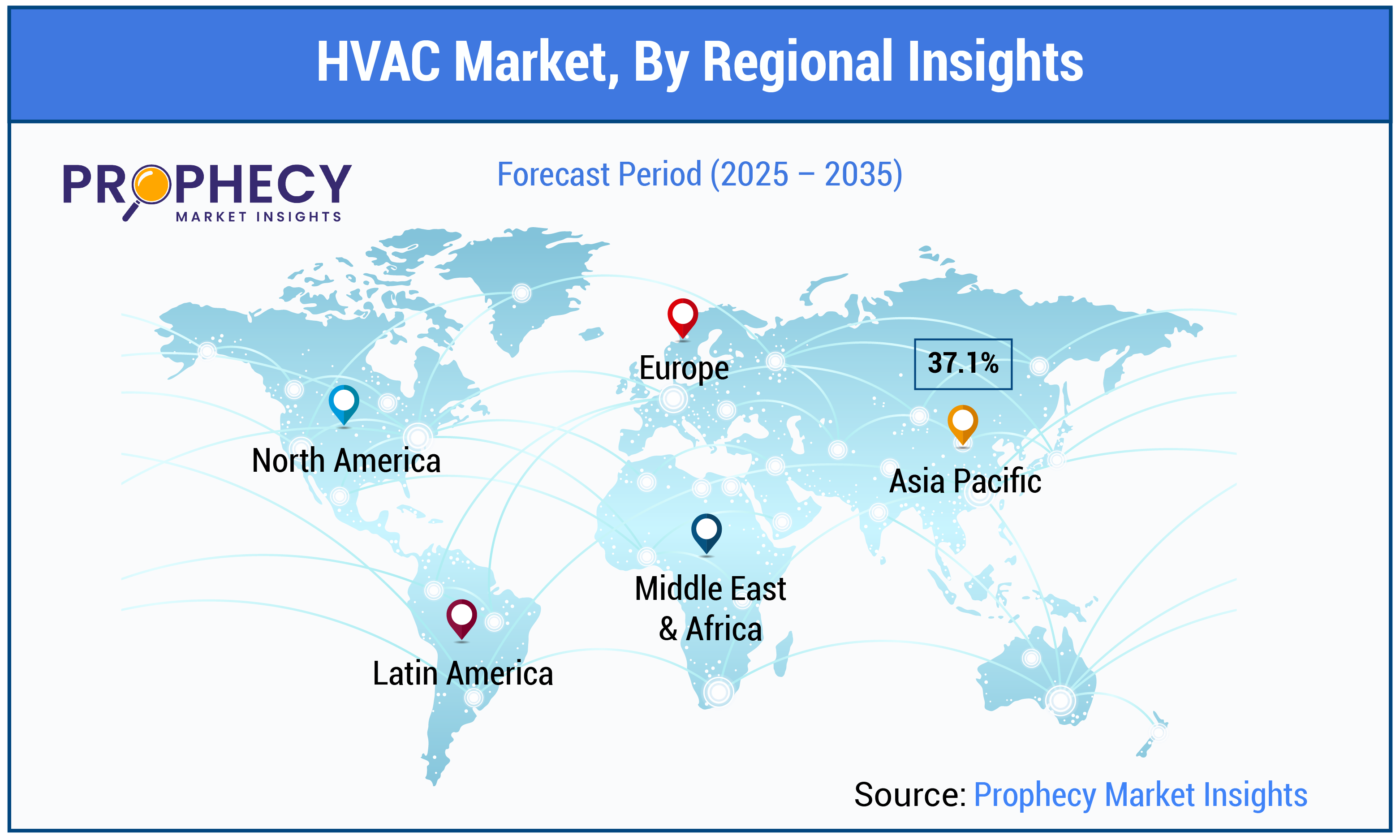
Geographically, the HVAC market is studied across North America, Europe, Asia Pacific, Latin America, and the Middle East & Africa.
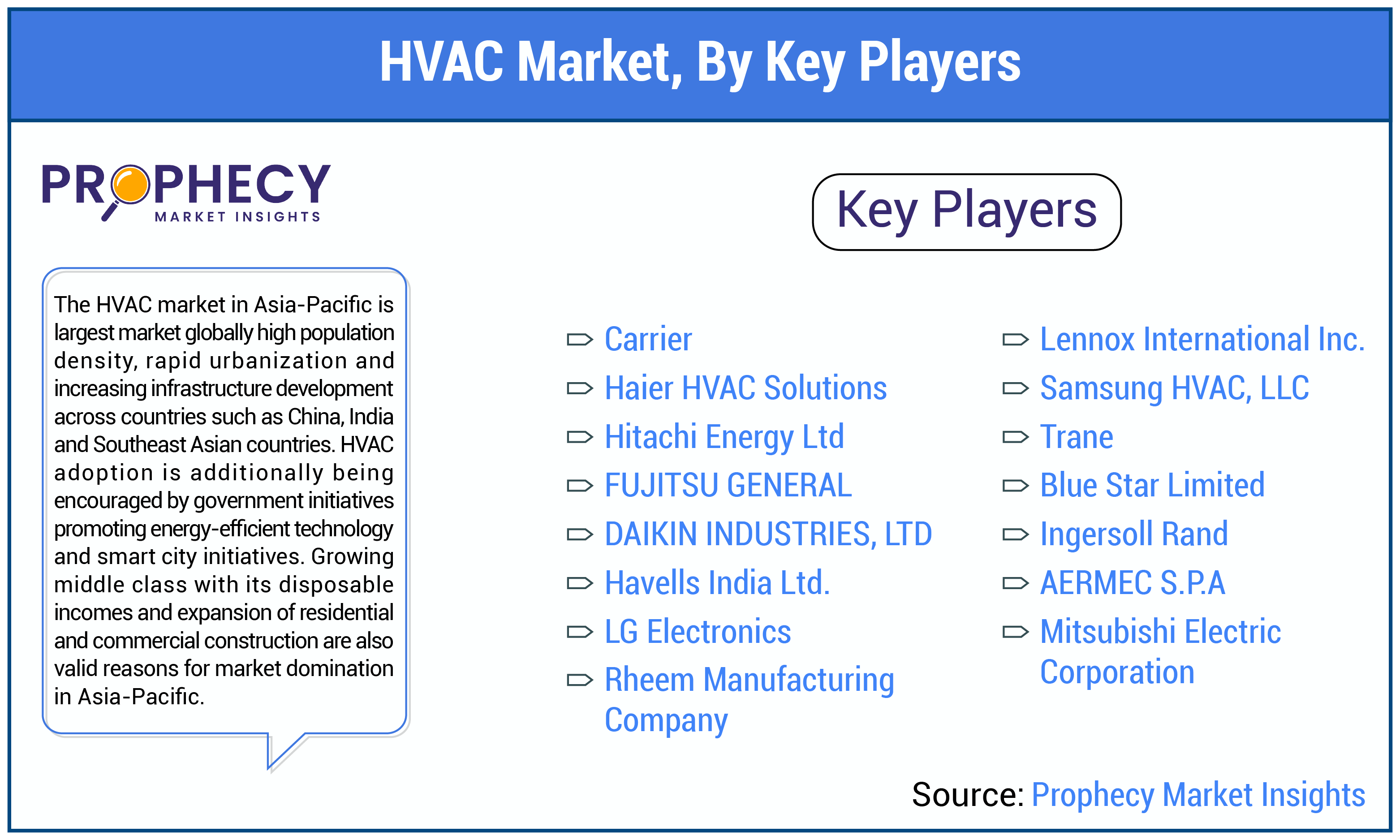
Asia Pacific: The HVAC market in Asia-Pacific is largest market globally high population density, rapid urbanization and increasing infrastructure development across countries such as China, India and Southeast Asian countries. HVAC adoption is additionally being encouraged by government initiatives promoting energy-efficient technology and smart city initiatives. Growing middle class with its disposable incomes and expansion of residential and commercial construction are also valid reasons for market domination in Asia-Pacific.
- China HVAC Market Insights:
The Asia-Pacific HVAC market is governed by China, which holds a significant market share due to its huge population, rapid urbanization, and significant residential, commercial, and industrial building. Green building technologies and strong manufacturing base further fuel the HVAC demand in the region.
North America: Factors consist of need for energy-efficient systems, a developed building sector, and high interior comfort standards have made North America the second-most important region in the global HVAC market. HVAC installation, maintenance, and retrofitting are constantly required due to the region's established infrastructure, particularly across the US. The heating and cooling systems during summers and cold winters along with seasonal weather extremes are in regular demand further fueling more HVAC adoption.
- U.S. HVAC Market Insights:
The rising demand for comfort and energy efficiency among consumers, the vast scale of residential and commercial buildings, and the extreme seasonal changes in the climate all lead to the United States' dominance in the North American HVAC sector. With regular upgrades and retrofits that fulfill new energy regulations and sustainability goals, the country has a constant supply for HVAC system.
Europe: This region represents a significant and steadily growing market for HVAC systems, driven by increasing emphasis on energy efficiency, sustainability, and indoor comfort. More strict construction regulations and environmental laws are being enforced in countries around the region, which is promoting the adoption of high-efficiency HVAC systems and renewable cooling agents. North and Western Europe has growing demand of heat pumps fueling more adoption of HVAC heating systems.
- Germany HVAC Market Insights:
Germany is the HVAC market leader in Europe due to strong construction sector and advanced manufacturing capability. Germany has progressive energy policies that drives the adoption of HVAC systems in commercial and residential settings. The country is leader in green building standards and energy integration along with high adoption of HVAC systems.
HVAC Market Report Scope:
|
Attribute |
Details |
|
Market Size 2025 |
USD 327.6 Billion |
|
Projected Market Size 2035 |
USD 554.6 Billion |
|
CAGR Growth Rate |
6.0% (2025-2035) |
|
Base year for estimation |
2024 |
|
Forecast period |
2025 – 2035 |
|
Market representation |
Revenue in USD Billion & CAGR from 2025 to 2035 |
|
Regional scope |
North America - U.S. and Canada Europe – Germany, U.K., France, Russia, Italy, Spain, Netherlands, and Rest of Europe Asia Pacific – China, India, Japan, Australia, Indonesia, Malaysia, South Korea, and Rest of Asia-Pacific Latin America - Brazil, Mexico, Argentina, and Rest of Latin America Middle East & Africa – GCC, Israel, South Africa, and Rest of Middle East & Africa |
|
Report coverage |
Revenue forecast, company share, competitive landscape, growth factors, and trends |
Segmentation:
By Ventilation Systems Type:
- Heating Systems
- Boilers
- Furnaces
- Heat Pumps
- Others
- Ventilation Systems
- Air Filters
- Air Handling Units (AHUs)
- Ventilation Fans
- Others
- Air Conditioning Systems
- Split Air Conditioners
- Chillers
- Variable Refrigerant Flow (VRF) Systems
- Others
By Implementation Type:
- New Constructions
- Retrofits
By End Use:
- Commercial
- Residential
- Industrial
By Region:
- North America
- U.S.
- Canada
- Europe
- Germany
- U.K.
- France
- Russia
- Italy
- Spain
- Netherlands
- Rest of Europe
- Asia Pacific
- China
- India
- Japan
- Australia
- Indonesia
- Malaysia
- South Korea
- Rest of Asia Pacific
- Latin America
- Brazil
- Mexico
- Argentina
- Rest of Latin America
- Middle East & Africa
- GCC
- Israel
- South Africa
- Rest of Middle East & Africa
Global HVAC Market By Product Competitive Landscape & Key Players
The key players operating in the HVAC market include, Carrier, Haier HVAC Solutions, Lennox International Inc., DAIKIN INDUSTRIES, LTD, Rheem Manufacturing Company, and others. With a range of marketing techniques, HVAC companies are concentrating on objectives including growing their market share, expanding out into new service regions, increasing system revenue, and improving revenue.
HVAC Market Companies:
- Carrier
- Haier HVAC Solutions
- Hitachi Energy Ltd
- FUJITSU GENERAL
- DAIKIN INDUSTRIES, LTD
- Rheem Manufacturing Company
- Havells India Ltd.
- LG Electronics
- Lennox International Inc.
- Mitsubishi Electric Corporation
- Samsung HVAC, LLC
- Trane
- Blue Star Limited
- Ingersoll Rand
- AERMEC S.P.A
View an Additional List of Companies in the HVAC Market
Global HVAC Market By Product Recent News
- In June 2025, the new generation airH2O air-to-water heat pump range was introduced by Hitachi Cooling & Heating where this pump features two models, airH2O 800 R290 (monobloc and hydrosplit) and airH2O 600 R32 (refrigerant split). Sustainable and low-carbon heating are fulfilled by the given pumps across the region.
- In March 2025, Q1 2025 updates were announced by Trane that consist of expanded Modular Self?Contained Units (20–110?tons) specifically produced for easy installation through standard doorways, and the CoolSense DOAS with variable?speed fans and low?GWP R?454B refrigerant.
- In Feb 2025, LG introduced new lineup of HVAC inverter heat pumps—including a cold?climate model certified to operate down to –35?°C—and unveiled its Oil?Free Inverter Centrifugal Chiller that is energy-efficient and uses low-GWP refrigerants such as R513A and R1234ze
Analyst View:
The economic obstacles including supply chain vulnerabilities, labor shortages, and rising equipment costs, but these are counterbalanced by positive macrotrends including government incentives, regulations regarding the environment, and the smart technology integration. In general, analysts see the HVAC sector as robust and dynamic. In coming forecast period, it is anticipated that measures including decarbonization regulations, indoor air quality standards, and the shift to intelligent, connected systems will promote industry expansion and profit.
More Related Reports
Commercial Insulation Market
HVAC Services Market
HVAC Rental Equipment Market
Biomass Heating Plant Market
Commercial and Corporate Cards Market
Global HVAC Market By Product Company Profile
|
Company Name |
LG Electronics |
|
Headquarter |
Seoul, South Korea |
|
CEO |
William Cho |
|
Employee Count |
74,000 Employees |
Global HVAC Market By Product Highlights
FAQs
HVAC market size was valued at USD 327.6 Billion in 2025 and is expected to reach USD 554.6 Billion by 2035 growing at a CAGR of 6.0%.
Product type, Implementation Type, End Use, and region are the segmentation for the target market.
North America, Asia Pacific, Europe, Latin America, and the Middle East & Africa. North America is expected to dominate the market.
The key players operating the HVAC market include Carrier, Haier HVAC Solutions, Hitachi Energy Ltd., FUJITSU GENERAL, DAIKIN INDUSTRIES, LTD, Rheem Manufacturing Company, Havells India Ltd., LG Electronics, Lennox International Inc., Mitsubishi Electric Corporation, Strahl & Pitsch Inc, Trane, Blue Star Limited, Ingersoll Rand, and AERMEC S.P.A.