Global Fish Sauce Market By Overview
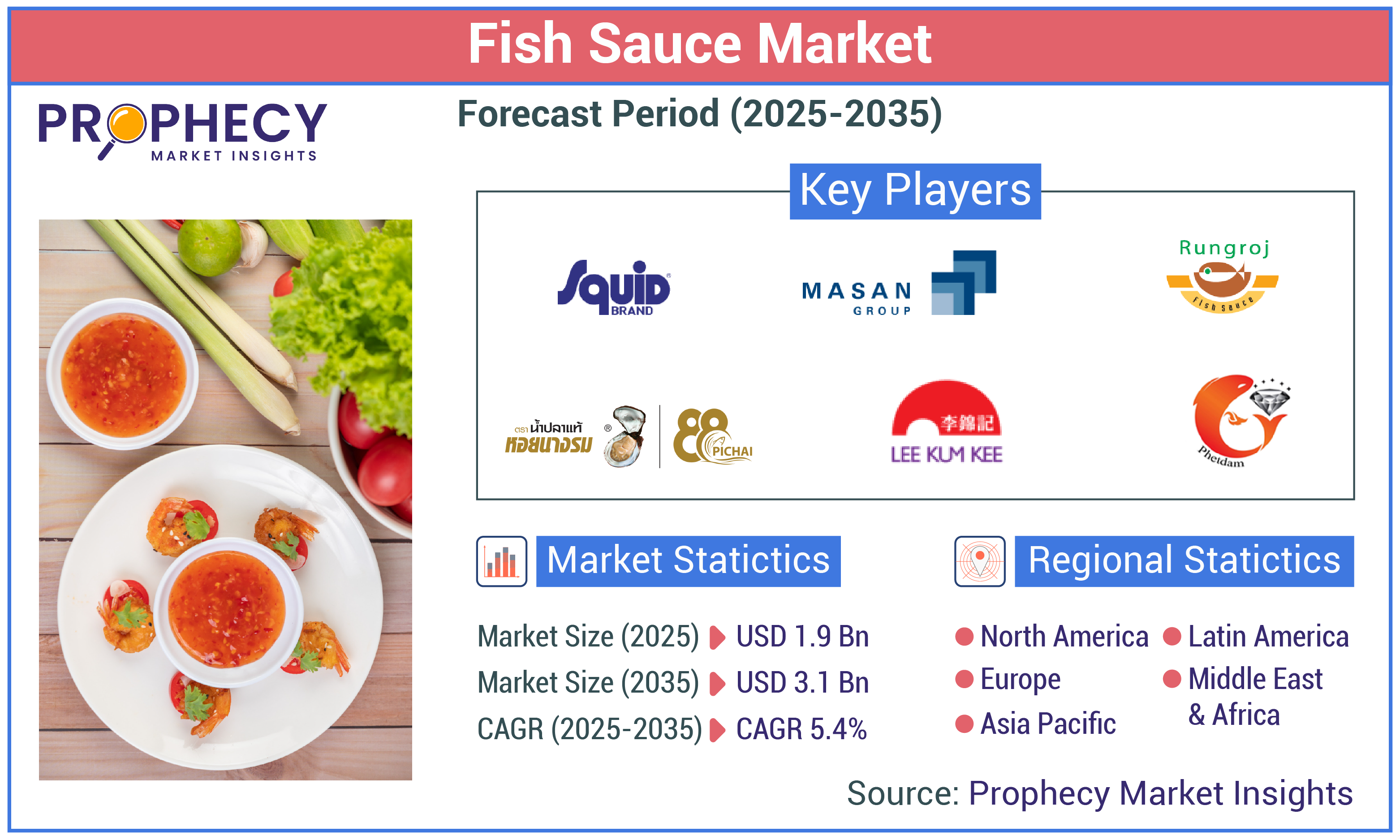
- Fish sauce market size is expected to increase at a rate of USD 3.1 Billion, by 2035.
- In 2024, the target market valuation was USD 1.8 Billion.
- Fish sauce market is growing at a CAGR 5.4%.
Fish sauce is a salty, savory liquid condiment made by fermenting small fish, such as anchovies with salt over a long period, typically several months to a year. Fish sauce is produced through a natural fermentation process, which involves small fish such as anchovies, mackerel, or sardines. Fish sauce is known for its strong aroma, salty taste, and deep savory (umami) flavor. Although it smells pungent straight from the bottle, it blends subtly into dishes when cooked, enhancing the overall taste without crushing other ingredients. Fish sauce is extremely versatile and used in seasoning, marinades, dipping sauce base and table condiment.
The increasing globalization of food culture of the Southeast Asian dishes, and growing number of Asian immigrants across North America and Europe, supports the demand for traditional condiments, such as fish sauce, resulting to drive fish sauce market growth. Fish sauce offers natural umami, and health-conscious consumers prefer natural fermented flavoring agents, pushing demand for traditional fermentation-based fish sauce, contributes to the fish sauce market growth. Expansion of foodservice sector, ready-to-eat products, and chefs are incorporating fish sauce into non-Asian dishes, is expected to pitch fish sauce market growth.
Companies are focusing on developing vegan fish sauce, growth in online platforms, and direct-to-consumer strategies, can help to impel fish sauce market growth. Development of eco-friendly, portion-controlled packaging, can significantly create opportunities for fish sauce market growth.
Impact of Generative AI on Fish Sauce Market:
- AI can simulate consumer preferences, regional taste profiles, and ingredient combinations to help producers develop new flavors, lower-sodium variants, or plant-based fish sauce alternatives. By analyzing massive datasets on food trends, dietary habits, and nutritional feedback, AI can assist R&D teams in creating products tailored to local markets or dietary needs.
- AI-driven content generation enables brands to create customized marketing campaigns, recipes, videos, and social media posts across multiple languages and platforms. AI-generated virtual assistants and chatbots can provide personalized recipe suggestions, product recommendations, and pairing ideas based on dietary restrictions. This can enhance customer engagement and loyalty, especially in e-commerce and direct-to-consumer channels.
Global Fish Sauce Market By Drivers & Restraints
Key Drivers:
Rising Global Interest in Asian Cuisine is Contributing to Market Expansion
As consumers around the world become more adventurous in their food choices, dishes from countries such as Vietnam, Thailand, Korea, and the Philippines have gained popularity. These cuisines often rely heavily on fish sauce as a key ingredient, which directly translates to a surge in demand for this traditional condiment. The increased interconnectedness of cultures through travel, media, and migration, which leads to the widespread adoption of Asian flavors in Western markets.
Restaurants, food trucks, cooking shows, and social media platforms have introduced millions of consumers to dishes such as pad Thai, pho, kimchi, and adobo, which incorporate fish sauce. The popularity of fusion cuisine, which mixtures Asian ingredients with Western culinary techniques, has also raised the demand of fish sauce in gourmet and fine-dining settings. Recipe videos and food reviews often highlight fish sauce's unique ability to add depth and umami, making it an attractive to various types of dishes, which contributes to the fish sauce market growth.
- For instance, according to Marriott International released its new comprehensive report, The Future of Food 2025, which highlights the transformative power of the Asia Pacific region in shaping global culinary and dining trends. The Asia Pacific region is projected to grow to USD 6.2 trillion by 2033 in food and dining industry. The fusion of Japanese aesthetics into French cuisine and the rising influence of Korean flavors to the innovative use of traditional spices and techniques from India and Mainland China reforming Western standards, which makes Asia Pacific as a culinary export powerhouse.
Restraints:
Strong Odor and Acquired Taste can Hinder Market Growth
Fish sauce has a distinctive, pungent aroma and a very salty, umami-forward flavor, which can be off-putting to consumers unacquainted with it, especially in Western markets. Traditionally made by fermenting fish and salt over extended periods, fish sauce develops a distinctive aroma that many find unpleasant or overpowering, resulting to limits market growth.
- Counterbalance Statements: Growing consumer interest in authentic global cuisine, increased use of fish sauce in fusion dishes and fine dining is helping to introduce the flavor in more palatable and familiar contexts. Brands are also marketing milder variants and offering usage tips and recipes to ease new users into it.
Opportunities & Trends:
Growing E-commerce Sector can Surge Market Growth
The growing e-commerce sector presents a significant opportunity for the fish sauce market, enabling brands to expand their reach, diversify consumer bases, and boost sales outside traditional retail environments. E-commerce platforms allow fish sauce producers, especially by offering authentic, artisanal, or regional variants to access international consumers that may enable to find such products in local supermarkets.
Platforms such as Amazon, Walmart.com, and specialty food sites have become essential channels for connecting Asian food brands with displacement communities and culinary enthusiasts globally. This model supports smaller producers and premium brands to build loyalty and offer storytelling-driven marketing highlighting traditional production methods, sourcing, and sustainability. As consumers increasingly hold online grocery shopping and home cooking, and the growing e-commerce sector offers a powerful growth for the fish sauce, resulting to impel fish sauce market growth.
- For Instance, according to the data published by SellersCommerce, with over 33% of the world’s population shopping online, eCommerce is now a USD 6.8 trillion industry and will reach the USD 8 trillion mark by 2027. 2.77 billion people around the globe are making online purchases from dedicated eCommerce platforms or social media stores. There are over 28 million eCommerce stores globally, in which 52% of online shopper are looking for international products, 34% of shopper shop online at least once a week. The number of online shoppers will increase to 2.86 billion in 2026, reflecting the boost in e-commerce due to the increased internet penetration and convenience.
Global Fish Sauce Market By Segmentations & Regional Insights
The fish sauce market is segmented into fish type, processing methods, viscosity, application, distribution channel, and region.
By Fish Type:
On the basis of fish type, the fish sauce market is classified into, anchovy, mackerel, squid, shrimp, and others. The market is predominantly led by the anchovy segment, as it is widely preferred for traditional fish sauce production. The small size, high oil content, and availability of anchovies make them ideal for long fermentation, resulting in a clear, aromatic, and high-quality sauce that is in demand both in domestic and international markets, resulting to drive segment’s expansion in fish sauce market size.
The mackerel segment is the second most dominant in the market. Mackerel is used especially in regions where anchovy supply may be limited or local taste preferences favor stronger, more pungent flavor, is expected to pitch fish sauce market growth in following segment.
By Processing Method:
Traditional, and industrial, are categorized based on processing method for market. The traditional segment is the largest and most dominant segment in the market, due to traditional fish sauce is highly valued for its authentic production methods. Traditional fish sauces are considered premium products due to their rich umami flavor, complexity, and purity, making them popular in both local and international markets, contributing to segment’s growth in fish sauce market share.
Industrial is fastest growing segment in market. These sauces are more affordable than traditional varieties and are produced in large quantities for mass consumption, which found in supermarkets globally. As it is cost-effective and widely available, is anticipated to boost growth of segment in fish sauce market size.
By Viscosity:
Based on viscosity, the market is segmented into light, medium, and thick. The market is dominated by light viscosity segment. Light viscosity fish sauces are most commonly used in cooking due to their ease of mixing and versatility in various applications such as marinades, dips, dressings, and soups. The light viscosity variants are preferred for their ability to blend flawlessly with other ingredients without altering the texture, is estimated to propel segment’s development in fish sauce market share.
By Application:
Under application, the market is classified into food & beverages, household, hotels & restaurants, and others. In the fish sauce market, the dominant segment under application is food & beverages. Fish sauce is a key ingredient in many soups, dips, marinades, dressings, and other cooking applications, making it a staple in both home cooking and commercial food production, is projected to fuel growth of segment in fish sauce market share.
By Distribution Channel:
Hypermarkets & supermarkets, specialty stores, online stores, and others are classified by distribution channel for target market. The hypermarkets & supermarkets segment is the dominant distribution channel. Hypermarkets and supermarkets provide a broad consumer base and are convenient for shopping, which providing competitive pricing, promotional offers, and the availability of different types of fish sauce, which drives their dominance in the fish sauce market share.
Regional Insights:
Geographically, the market is studied across North America, Europe, Asia Pacific, Latin America, and the Middle East & Africa.
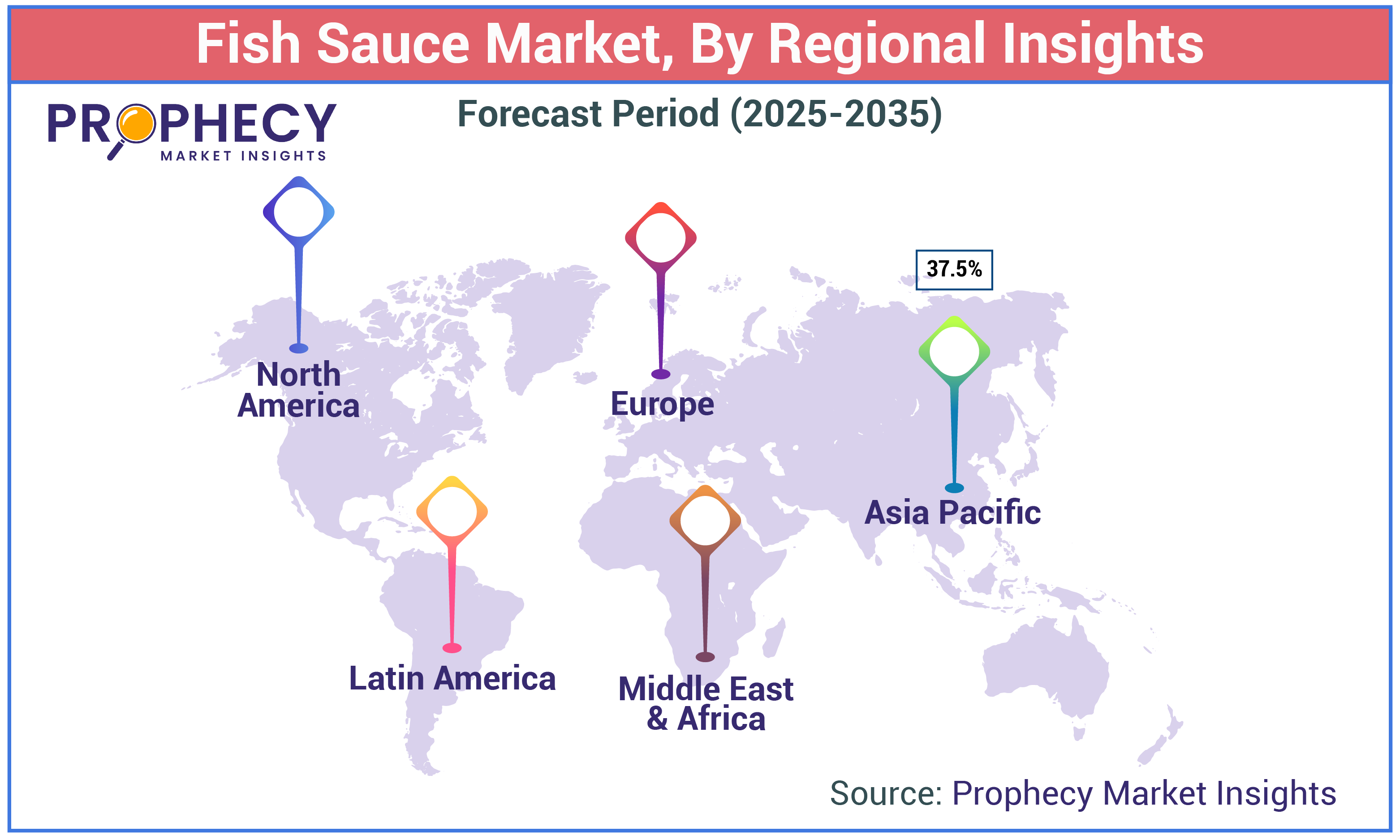
Asia Pacific: This region dominates the global fish sauce market, holding a share of 37.5%. The countries have long-standing tradition of using fish sauce in their culinary cultures, making it an essential ingredient in everyday cooking. The demand for fish sauce is driven by local consumption, growing exports of authentic fish sauces to international markets, and presence of both largest producer, consumer of fish sauce, responsible to drive region’s expansion in fish sauce market share.
- Vietnam Fish Sauce Market Insights:
Vietnam is the dominant country in the Asia-Pacific region for fish sauce. It is the largest producer and consumer of fish sauce globally, with the product being an essential part of Vietnamese cuisine. Vietnamese fish sauce is highly valued for its depth of flavor and traditional production methods, making it a key player in the global fish sauce market.
North America: This region is growing at highest CAGR for target market. The growing trend of Asian cuisine and ethnic food in North American markets is driving the demand for fish sauce. As more consumers explore international flavors, fish sauce is becoming widely used in food ingredients, is anticipated to propel fish sauce market growth.
- U.S. Fish Sauce Market Insights:
The U.S. is principal country in North America region for the market. The growing popularity of Asian cuisines, such as Thai, Vietnamese, and Filipino, has significantly increased the demand for fish sauce. Fish sauce is increasingly found in American kitchens, both in restaurants and home cooking, as people explore ethnic flavors, as the high demand for both traditional fish sauce and plant-based fish sauce, is predictable to boost fish sauce market size.
Europe: This region for the fish sauce market is experiencing steady growth, driven by several factors such as increasing interest in Asian cuisine, greater consumer awareness of ethnic foods, and the rising trend of sustainable and natural ingredients. The increasing concerned about the quality, origin of ingredients, and expansion of specialty stores, online platforms, is expected to pitch region growth in fish sauce market share.
- U.K. Fish Sauce Market Insights:
U.K. is the dominant country in Europe for the market. The U.K. has seen a growing interest in Asian food cultures and ethnic cuisines, which has driven the demand for fish sauce. The growing health, suitability awareness, and presence of diverse population, is anticipated to impel fish sauce market growth.
Fish Sauce Market Report Scope:
|
Attribute |
Details |
|
Market Size 2025 |
USD 1.9 Billion |
|
Projected Market Size 2035 |
USD 3.1 Billion |
|
CAGR Growth Rate |
5.4% (2025-2035) |
|
Base year for estimation |
2024 |
|
Forecast period |
2025 – 2035 |
|
Market representation |
Revenue in USD Billion & CAGR from 2025 to 2035 |
|
Regional scope |
North America - U.S. and Canada Europe – Germany, U.K., France, Russia, Italy, Spain, Netherlands, and Rest of Europe Asia Pacific – China, India, Japan, Australia, Indonesia, Malaysia, South Korea, and Rest of Asia-Pacific Latin America - Brazil, Mexico, Argentina, and Rest of Latin America Middle East & Africa – GCC, Israel, South Africa, and Rest of Middle East & Africa |
|
Report coverage |
Revenue forecast, company share, competitive landscape, growth factors, and trends |
Segmentation:
By Fish Type:
- Anchovy
- Mackerel
- Squid
- Shrimp
- Others
By Processing Method:
- Traditional
- Industrial
By Viscosity:
- Light
- Medium
- Thick
By Application:
- Food & Beverages
- Household
- Hotels & Restaurants
- Others
By Distribution Channel:
- Hypermarkets & Supermarkets
- Specialty Stores
- Online Retail
- Others
By Region:
- North America
- U.S.
- Canada
- Europe
- Germany
- U.K.
- France
- Russia
- Italy
- Spain
- Netherlands
- Rest of Europe
- Asia Pacific
- China
- India
- Japan
- Australia
- Indonesia
- Malaysia
- South Korea
- Rest of Asia Pacific
- Latin America
- Brazil
- Mexico
- Argentina
- Rest of Latin America
- Middle East & Africa
- GCC
- Israel
- South Africa
- Rest of Middle East & Africa
Global Fish Sauce Market By Competitive Landscape & Key Players
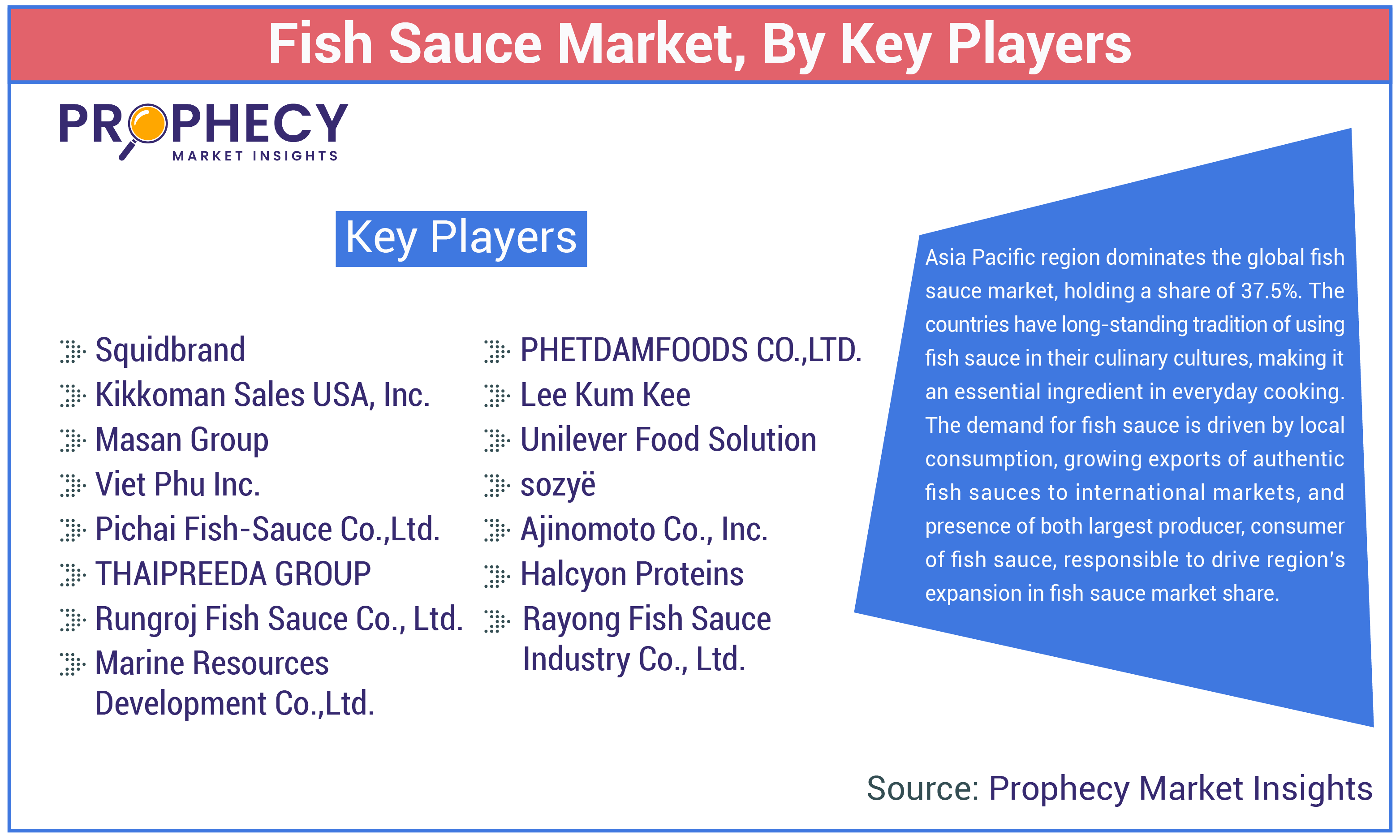
The major companies are active in the Squidbrand, Rayong Fish Sauce Industry Co., Ltd., Marine Resources Development Co.,Ltd., and others. Companies are increasingly adopting sustainable fishing practices and environmentally friendly production processes to address concerns over overfishing and environmental degradation, through their strategic partnership or collaboration. These companies are increasingly emphasis of product innovation and e-commerce expansion, through their acquisition, is projected to fuel fish sauce market growth.
List of Key Players in the Market:
- Squidbrand
- Rayong Fish Sauce Industry Co., Ltd.
- Marine Resources Development Co.,Ltd.
- Masan Group
- Viet Phu Inc.
- Pichai Fish-Sauce Co.,Ltd.
- THAIPREEDA GROUP
- Rungroj Fish Sauce Co., Ltd.
- PHETDAMFOODS CO.,LTD.
- Lee Kum Kee
- Unilever Food Solution
- sozyë
- Ajinomoto Co., Inc.
- Halcyon Proteins
- Kikkoman Sales USA, Inc.
View an Additional List of Companies in the Fish Sauce Market
Global Fish Sauce Market By Recent News
Recent Developments:
- In September 2024, Charoen Pokphand Foods Public Company Limited (CP Foods) launched an innovative initiative focused on the value-added utilization of Blackchin tilapia, transforming it into three commercial food products, such as cooked fermented fish sauce, crispy fish flakes, and seasoned fish powder. Cooked fermented fish sauce can be adapted for various popular dishes, and crispy fish flakes are ideal for developing a range of chili pastes.
- In August 2024, Vietnamese fish sauce producer SEAGULL Co. Ltd. exported its first batch of fish sauce products to the U.S., including vegan fish sauce. The first batch of fish sauce products exported to the U.S. included 24,000 bottles, with 12,000 vegan fish sauces. These Vietnamese products were widely sold at store and supermarket chains in Asia and on e-commerce platforms. Although the apogen anchovy sauce, which comes in ceramic bottles, was designed for special events or as a high-end gift, the gray anchovy sauce, which was recognized for its strong traditional taste, was marketed to Vietnamese customers living abroad.
- In April 2024, Profand launched fish-flavored churros at Seafood Expo Global in Barcelona, Spain. Profand's churros are made from fish flour derived from salmon and cod, replaced the grain base with a protein-rich alternative. The cod churros come with a sweet pepper sauce or a sweet red pepper sauce. The salmon churros were paired with tartar sauce for a classic seafood complement. The company aimed to reduce food waste through upcycling fish parts into value-added products.
Analyst View:
The fish sauce market is honorable for steady growth due to demand for traditional condiments, such as fish sauce in western markets. The rising global demand for Asian cuisine, growing emphasis on e-commerce, retail penetration, and companies are launching premium products, is anticipated to drive target market growth. Expansion of foodservice industry, trend towards clean label, transparent sourcing, and focus on health-conscious product development, is expected to boost fish sauce market growth.
More Related Reports
Fish Processing Market
Fish Oil Omega-3 Market
Fish Finders & Depth Finders Market
Carbon Fishing Rod Market
Pasta Sauce Market
Global Fish Sauce Market By Company Profile
|
Company Name |
Masan Group |
|
Headquarter |
Minh City, Vietnam |
|
CEO |
Danny Le |
|
Employee Count (2024) |
35,878 Employees |
Global Fish Sauce Market By Highlights
FAQs
Fish sauce market size was valued at USD 1.9 Billion in 2025 and is expected to reach USD 3.1 Billion by 2035 growing at a CAGR of 5.4%.
Fish type, processing method, viscosity, application, distribution channel, and region are the segmentation for the Fish sauce market.
North America, Asia Pacific, Europe, Latin America, and the Middle East & Africa. Asia Pacific is expected to dominate the market.
The key players operating in the fish sauce market include Squidbrand, Rayong Fish Sauce Industry Co., Ltd., Marine Resources Development Co.,Ltd., Masan Group, Viet Phu Inc., Pichai Fish-Sauce Co.,Ltd., THAIPREEDA GROUP, Rungroj Fish Sauce Co., Ltd., PHETDAMFOODS CO.,LTD., Lee Kum Kee, Unilever Food Solution, sozyë, Ajinomoto Co., Inc., Halcyon Proteins, and Kikkoman Sales USA, Inc.