Global Fibre Reinforced Polymer Market Overview
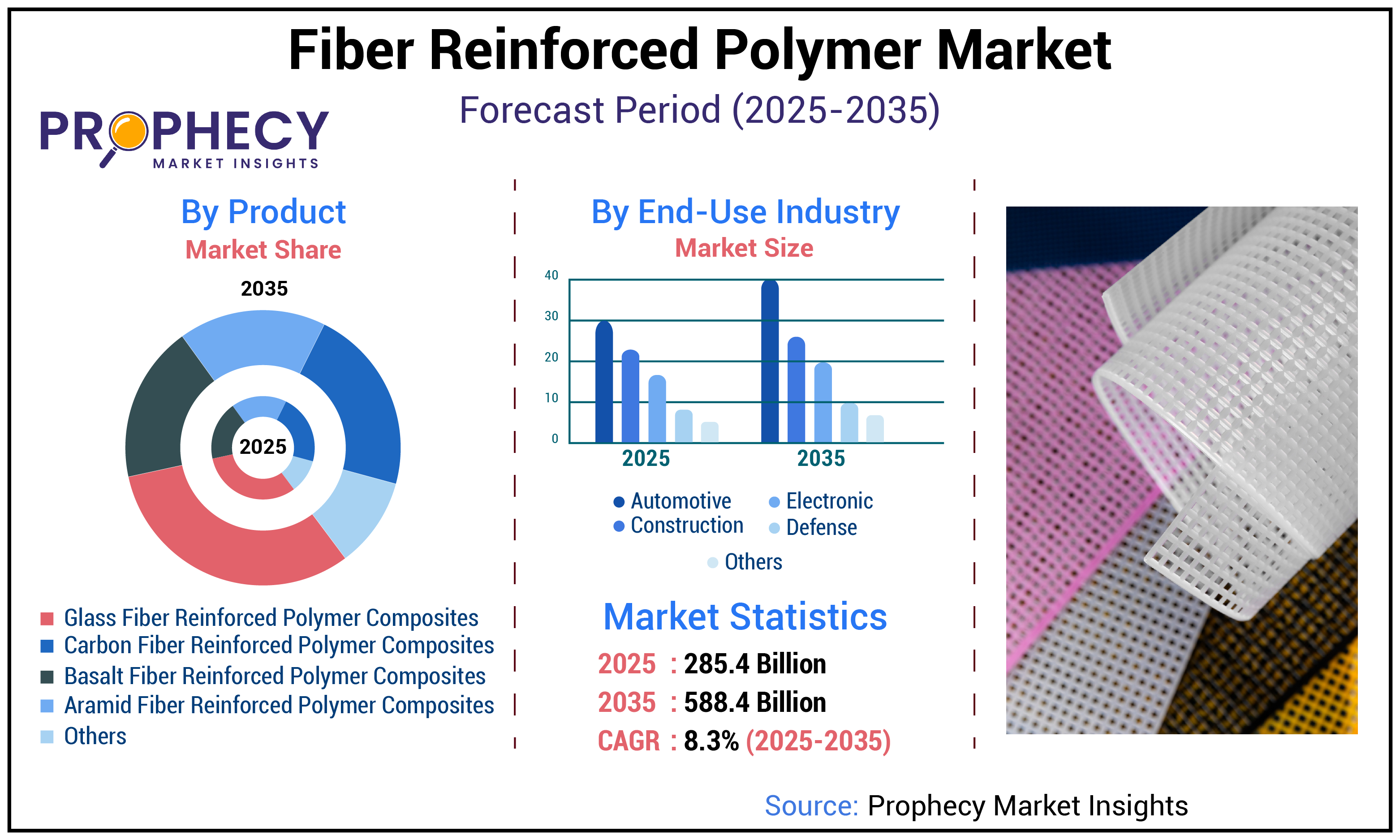
- Fiber Reinforced Polymer Market size is expected to expand at a rate of USD 588.4 Billion, by 2035.
- In 2024, Fiber Reinforced Polymer Market valuation was USD 260.0 Billion.
- Fiber reinforced polymer market is growing at a CAGR of 8.3%.
Fiber reinforced polymer (FRP) is a composite material made by embedding strong fibers within a polymer matrix. The fibers, such as glass, carbon, or aramid, enhance the polymer's strength and stiffness, creating a material with high strength-to-weight ratio. It offers several advantages over traditional materials such as steel and concrete, primarily due to its high strength-to-weight ratio, corrosion resistance, and ease of installation. FRP is lightweight, strong, durable, and requires minimal maintenance.
Fiber reinforced polymer (FRP) market is primarily driven by the increasing demand for lightweight and strong materials across various industries, particularly in the automotive and construction sectors, the rapidly rising urbanization and industrialization, the rising shift towards electric vehicles (EVs) and the need for durable, corrosion-resistant components, and the increasing use of renewable energy sources.
The market’s expansion is also pitched by improvements in FRP manufacturing techniques and processing technologies are leading to lower costs and improved performance characteristics, environmental regulations and government incentives promoting sustainable practices are driving the adoption of FRP in various sectors, and a growing awareness of the benefits of FRP, including its durability, strength, and corrosion resistance.
Recession Risk and Tariff Analysis:
- Reduced infrastructure expenditure, slower building, and postponed industrial projects pose economic threats to the fiber reinforced polymer market. Economic downturns may affect revenue streams and innovation investment by reducing the market for FRP composites in industries including construction, automotive, and aerospace.
- For manufacturers, tariffs on fiber reinforced polymer (FRP) materials, especially those imported from China, have raised manufacturing costs. Global competitiveness may be weakened by these increased costs, which frequently lead to lower profit margins and higher consumer pricing. The FRP industry's strategic planning and investment decisions are made more difficult by the unpredictability of trade policies.
Impact of Generative AI on Fiber Reinforced Polymer Market:
- Fiber reinforced polymer (FRP) market is changing as a result of generative AI's ability to speed up material design, streamline production, and shorten development cycles. It makes it possible to forecast material performance under different situations, find the best fiber-matrix combinations, and facilitate simulation-driven innovations.
- AI improves quality control and flaw identification in composite manufacture, increasing the dependability of the final product. Furthermore, it facilitates the development of lightweight design solutions for aerospace and automotive applications. In the dynamic FRP market environment, generative AI promotes innovation, cost-effectiveness, and competitiveness by optimizing R&D and manufacturing.
Global Fibre Reinforced Polymer Market Drivers & Restraints
Key Drivers:
Rapidly Rising Urbanization is Stimulating the Market Augmentation
Growing urbanization greatly accelerates the expansion of the fiber reinforced polymer (FRP) market by raising the need for strong, lightweight, and corrosion-resistant materials for infrastructure and building projects. FRPs are preferred for cladding, improving seismic resistance, and reinforcing concrete as cities grow as it provides longer structural lifespans and lower maintenance costs. Additionally, due to the demand for affordable and sustainable solutions, urban expansion in regions such as Asia Pacific is speeding up the implementation of FRP in public infrastructure and transportation.
- For instance, according to the data published by World Bank Group, in order to fulfill the World Bank's purpose of eradicating poverty and promoting shared prosperity on a habitable world, more livable cities must be built. Currently, 4.4 billion people, or more than half of the world's population, reside in urban areas. This trend is predicted to continue, with nearly seven out of ten people living in cities by 2050, when the urban population is predicted to more than quadruple.
Restraints:
Limited Recyclability of Fiber Reinforces Polymer is Obstructing the Market Expansion
The fiber reinforced polymer (FRP) market has several drawbacks, including low environmental effect and recyclability. Since the majority of FRP composites are thermoset, it is challenging to recycle or dispose of it in an environmentally responsible manner. This limits the sustainability of using FRP in large-scale applications and adds to long-term waste management problems. Furthermore, the absence of environmentally suitable disposal techniques deters adoption in areas with stringent environmental laws, which presents a problem for market expansion in a world that is becoming more and more concerned with sustainability.
- Counterbalance Statements: Environmental issues can be resolved by encouraging the creation and use of FRPs based on recyclable thermoplastics. Sustainability will be improved by funding research into environmentally friendly polymers and composite recycling methods. In the market for fiber reinforced polymers, producers may be encouraged to switch to more environmentally friendly options by means of industry cooperation and legislative incentives that might further spur innovation.
Opportunities & Trends:
Advancements in Fiber Reinforced Polymer is Unlocking Growth Opportunities for the Impending Years
Technological developments in fiber reinforced polymer (FRP) have the potential to greatly propel market expansion in the future. By enabling precise fiber orientation, innovations such as customized fiber placement (TFP) improve structural performance and cut down on material waste. The use of quantum dots and carbon nanotubes into FRP composites is enhancing its electrical conductivity, mechanical qualities, and thermal stability. These improvements broaden the range of industries that may use FRP, including renewable energy, automotive, and aerospace. Furthermore, sustainability issues are addressed by the creation of recyclable thermoplastic-based FRPs, which support international environmental objectives and further drive market growth.
For instance, according to the data published by Elsevier, FRP composites are manufactured using well-known processes such as hand lay-up, compression molding, pultrusion, and cutting-edge technologies such as additive manufacturing, all of which have greatly enhanced the development of these composites. Furthermore, by improving mechanical strength, interfacial bonding, and energy absorption, the use of nanoparticles has revolutionized FRP composites. Applications in helmets, body armor, and aviation equipment, in particular, are showcasing developments that improve military protection without sacrificing mobility.
Global Fibre Reinforced Polymer Market Segmentations & Regional Insights
The fiber reinforced polymer market is segmented into product type, end-use industry, and region.
By Product Type:
According to product type, the market is sub-segmented into glass fiber reinforced polymer composites, carbon fiber reinforced polymer composites, basalt fiber reinforced polymer composites, aramid fiber reinforced polymer composites, and others. The glass fiber reinforced polymer composites segment is attributed to lead the fiber reinforced polymer market share. This is due to its broad applicability across industries such as construction, automotive, and aerospace, and its favorable properties such as high strength-to-weight ratio, corrosion resistance, and design flexibility.
The carbon fiber reinforced polymer composites segment is the second leading product type, in the fiber reinforced polymer market. This is due to its exceptional strength-to-weight ratio, stiffness, and growing demand across various industries, especially aerospace, automotive, and construction.
By End-Use Industry:
Appertaining from end-use industry, the market is pigeonholed into automotive, construction, electronic, defense, and others. The automotive industry is the dominating end-use industry, in the fiber reinforced polymer market. This is due to the increasing demand for lightweight and durable materials in the automotive sector to improve fuel efficiency, reduce emissions, and enhance safety. FRP composites are used in various automotive applications, including body panels, underbody shields, and structural components.
The construction segment is the second dominating end-use industry, in the fiber reinforced polymer market. This is due to the material's superior properties, including, corrosion resistance, durability, and lightweight nature. FRP offers a strong-to-weight ratio, making it suitable for various structural applications, including strengthening and repairing existing infrastructure, building new structures, and creating lightweight components such as bridge decks and walkways.
Regional Insights:
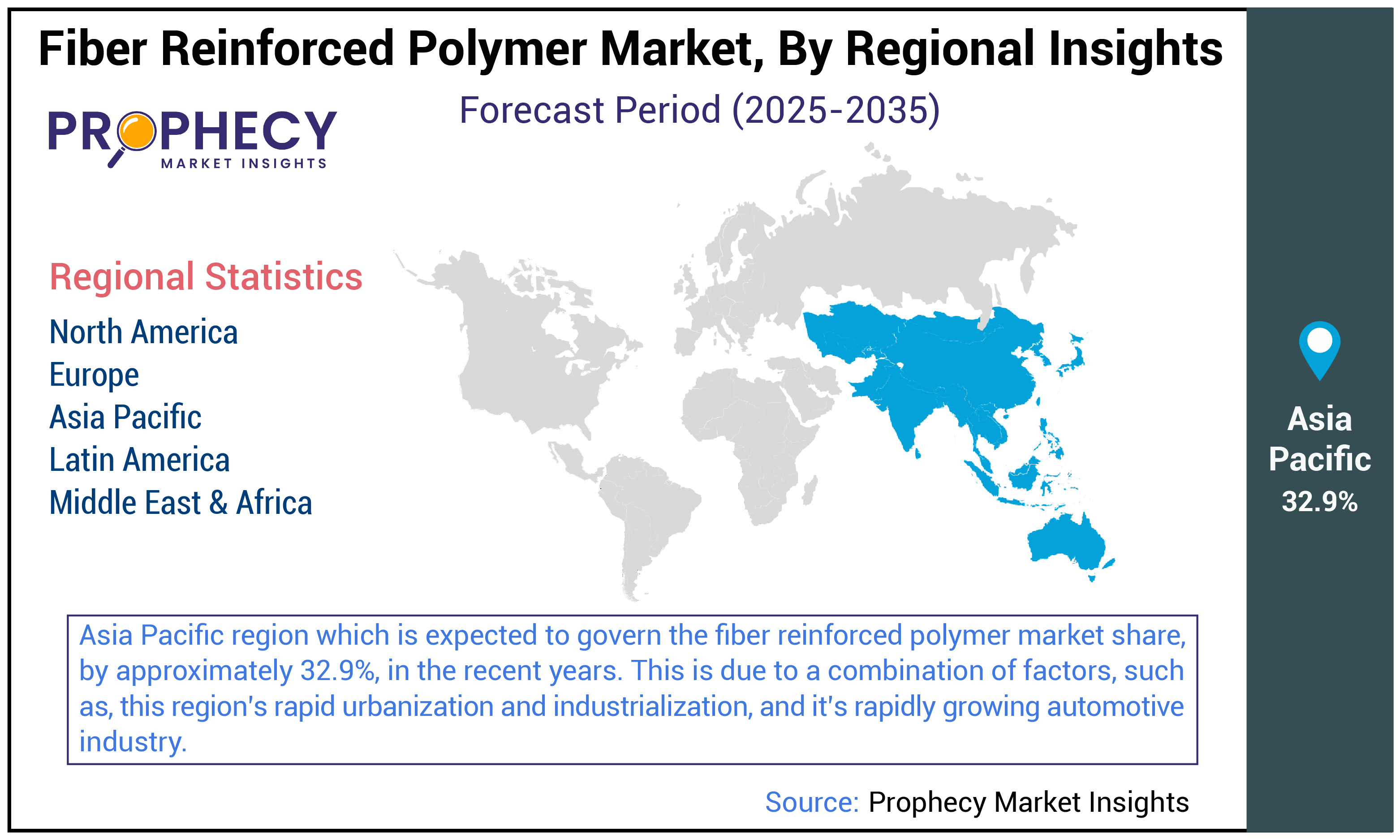
Geographically, the market is studied across North America, Europe, Asia Pacific, Latin America, and the Middle East & Africa.
Asia Pacific: This is the region which is expected to govern the fiber reinforced polymer market share, by approximately 32.9%, in the recent years. This is due to a combination of factors, such as, this region’s rapid urbanization and industrialization, and it’s rapidly growing automotive industry. In addition to this, the region's significant population and economic growth fuel demand for lightweight, fuel-efficient vehicles and infrastructure development, which in turn drives the need for FRP composites in various applications.
- China Fiber Reinforced Polymer Market Insights:
The fiber reinforced polymer market in China is the most influential market, in the recent years. This is due to this country’s well-established manufacturing base and a strong presence in industries that heavily utilize FRP composites, rapidly growing automotive industry, construction industry, and aerospace industry. Additionally, China's developed manufacturing sectors allow companies to manufacture and expand its market presence, leveraging the country's strong supply chain.
North America: This is the region which has the fiber reinforced polymer market, growing with the fastest growth rate, during the forecast period, in the recent years. This is due to a confluence of factors, such as, this region’s robust aerospace and defense industry, increasing adoption of FRP by the automotive industry, ongoing investments on construction industry, technological advancements and innovative applications across the automotive, aerospace, and construction sectors, and increasing support for sustainable materials.
- U.S. Fiber Reinforced Polymer Market Insights:
The fiber reinforced polymer market in the U.S., is the market growing with the highest CAGR, during the forecast period, in the recent years. This is due to this country’s strong automotive industry which heavily utilizes FRP composites for weight reduction and performance improvement, wide use of FRP in the aerospace industry, sustainable infrastructure developments, robust manufacturing base, enabling the efficient production and utilization of FRP composites in various industries, and environmental regulations to incentivize the adoption of sustainable and lighter materials such as FRP composites.
Europe: The region which has the fiber reinforces polymer market experiencing significant amount of growth, in the recent years, is Europe. This is due to a number of factors, such as, this region’s strong established industries, a focus on sustainability, and technological advancements. Key drivers include the automotive, aerospace, and wind energy sectors, which have a high demand for lightweight materials to improve efficiency and reduce emissions. The region's emphasis on sustainable materials and manufacturing, particularly in renewable energy and construction, further contributes to market growth.
- Germany Fiber Reinforced Polymer Market Insights:
The fiber reinforced polymer market in Germany is the market which is experiencing considerate amount of growth, in the recent years. This is due to this country’s robust industrial base, particularly in the automotive and aerospace sectors, along with strong research and development activities. Germany's automotive industry is a major consumer of FRP, and the country also leads in the development of new applications for FRP in the aerospace and construction industries. Moreover, the German government supports the growth of the FRP industry through various policies and initiatives.
|
Attribute |
Details |
|
Market Size 2025 |
USD 285.4 Billion |
|
Projected Market Size 2035 |
USD 588.4 Billion |
|
CAGR Growth Rate |
8.3% (2025-2035) |
|
Base year for estimation |
2024 |
|
Forecast period |
2025 – 2035 |
|
Market representation |
Revenue in USD Billion & CAGR from 2025 to 2035 |
|
Regional scope |
North America - U.S. and Canada Europe – Germany, U.K., France, Russia, Italy, Spain, Netherlands, and Rest of Europe Asia Pacific – China, India, Japan, Australia, Indonesia, Malaysia, South Korea, and Rest of Asia-Pacific Latin America - Brazil, Mexico, Argentina, and Rest of Latin America Middle East & Africa – GCC, Israel, South Africa, and Rest of Middle East & Africa |
|
Report coverage |
Revenue forecast, company share, competitive landscape, growth factors, and trends |
Segmentation:
By Product Type:
- Glass Fiber Reinforced Polymer Composites
- Carbon Fiber Reinforced Polymer Composites
- Basalt Fiber Reinforced Polymer Composites
- Aramid Fiber Reinforced Polymer Composites
- Others
By End-Use Industry:
- Automotive
- Construction
- Electronic
- Defense
- Others
By Region:
- North America
- U.S.
- Canada
- Europe
- Germany
- U.K.
- France
- Russia
- Italy
- Spain
- Netherlands
- Rest of Europe
- Asia Pacific
- China
- India
- Japan
- Australia
- Indonesia
- Malaysia
- South Korea
- Rest of Asia Pacific
- Latin America
- Brazil
- Mexico
- Argentina
- Rest of Latin America
- Middle East & Africa
- GCC
- Israel
- South Africa
- Rest of Middle East & Africa
Global Fibre Reinforced Polymer Market Competitive Landscape & Key Players
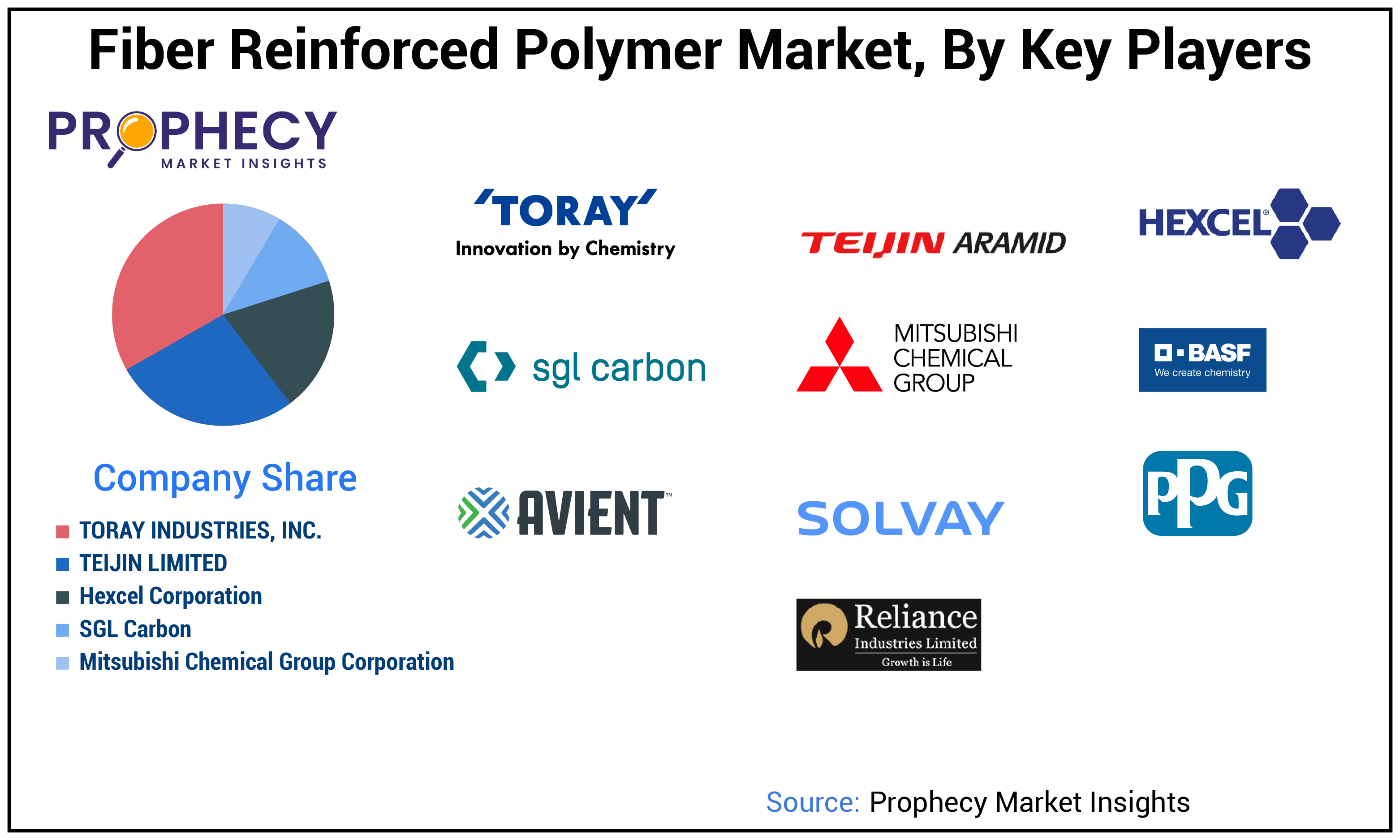
The key players operating in the market include, TORAY INDUSTRIES, INC., TEIJIN LIMITED, Hexcel Corporation, and others. These key players are focusing on strategies such as product innovation, strategic acquisitions, and partnerships to expand its market share and address the growing demand for lightweight and high-performance materials. Specifically, these are leveraging the increasing adoption of FRP composites in the transportation and construction industries, and the growing need for sustainable solutions in recycling and manufacturing, for driving Fiber Reinforced Polymer Market growth.
Fiber Reinforced Polymer Market Companies:
- TORAY INDUSTRIES, INC.
- TEIJIN LIMITED
- Hexcel Corporation
- SGL Carbon
- Mitsubishi Chemical Group Corporation
- Solvay
- Owens Corning
- Avient Corporation
- BASF
- PPG Industries, Inc.
- Nippon Electric Glass Co., Ltd.
- Present Advanced Composites Inc.
- Reliance Industries Limited
- Johns Manville
- SAERTEX
View an Additional List of Companies in the Fiber Reinforced Polymer Market
Global Fibre Reinforced Polymer Market Recent News
Recent Developments:
- In April 2025, Glass Fibre Reinforced Polymer (GFRP) Rebar was introduced by Olectra, a MEIL Group company, as a substitute for concrete steel reinforcement. Olectra formally entered the construction sector with the launch. In addition to guaranteeing minimal maintenance and cost savings, GFRP rebar greatly extends the life of constructions. Its uses included bridge decks, pavements, and industrial floors.
- In November 2024, Glass fiber-reinforced polymer (GFRP) product producer and supplier GFRP Tech opened the first industrial facility of its sort in South Africa. The factory would produce GFRP bends, GFRP mesh, and GFRP rebar. It is located in Linbro Park, Gauteng. Furthermore, GFRP Tech's signature EnviraBar and EnviraMesh alternatives to conventional steel rebar will be manufactured, tested, and supplied at the multi-million-rand facility.
- In July 2024, Glass-fiber reinforced polypropylene (PP) compound Borcycle GD3600SY, which contains 65% post-consumer recycled (PCR) polymer, is introduced by Borealis. In a historic initiative done in collaboration with Plastivaloire, a thermoplastic injection expert and Tier 1 supplier to the automotive industry, and Stellantis, an OEM and the owner of 14 automotive brands, it will be utilised for the first time in automobile interiors. The Borcycle M line of mechanically recycled polyolefins for demanding applications includes the Borcycle GD3600SY.
- In May 2024, Global carbon fibre reinforced polymer developer Xenia Materials unveiled a new line of PVDF-based compounds for pellet-fed 3D printing applications. When high performance and chemical resistance are required, this new class of materials ensures the qualities of carbon fibre combined with the remarkable PVDF features, creating new prospects for additive manufacturing production.
- In April 2021, the largest producer of polyolefin in the Americas and the world's top producer of biopolymers, Braskem, recently announced the addition of new, cutting-edge carbon fiber reinforced polypropylene filament for 3D printing ("CF-PP") ("FL900PP-CF") to its lineup of 3D printing products. This innovative filament offers low warpage, superior mechanical and thermal properties, and more. With the use of Braskem's carbon fiber reinforced polypropylene filament, customers were able to 3D print lightweight, very robust parts for a variety of high-end applications, including sporting goods, automotive, aerospace, and marine.
Analyst View:
The fiber reinforced polymer (FRP) market is largely driven by the growing need for strong, lightweight materials in a variety of industries, especially the construction and automotive sectors; the fast industrialization and urbanization of the world; the growing trend towards electric vehicles (EVs) and the demand for long-lasting, corrosion-resistant parts; and the growing use of renewable energy sources.
The market's growth is also fueled by advancements in FRP processing and manufacturing methods that result in reduced costs and better performance attributes, government incentives and environmental regulations that encourage sustainable practices, and a growing understanding of the advantages of FRP, such as its strength, durability, and resistance to corrosion.
More Related Reports
Biaxially Oriented Polyethylene Terephthalate (BOPET) Films Market
Nitrile Butadiene Rubber (NBR) Latex Market
Grafted Polyolefins Market
Conductive PAolymers Market
Carbon Fiber Reinforced Polymer Market
Global Fibre Reinforced Polymer Market Company Profile
|
Company Name |
TORAY INDUSTRIES, INC. |
|
Headquarter |
Chuo City, Tokyo, Japan |
|
CEO |
Mr. Akihiro Nikkaku |
|
Employee Count (2024) |
48,140 Employees |
Global Fibre Reinforced Polymer Market Highlights
FAQs
Fiber reinforced polymer market size was valued at USD 285.4 Billion in 2025 and is expected to reach USD 588.4 Billion by 2035 growing at a CAGR of 8.3%.
Product type, end-use industry, and region are the segmentation for the fiber reinforced polymer market.
North America, Asia Pacific, Europe, Latin America, and the Middle East & Africa. Asia Pacific is expected to dominate the market.
The key players operating in the fiber reinforced polymer market include TORAY INDUSTRIES, INC., TEIJIN LIMITED, Hexcel Corporation, BASF, SGL Carbon, Mitsubishi Chemical Group Corporation, Solvay, Owens Corning, Avient Corporation, PPG Industries, Inc., Nippon Electric Glass Co., Ltd., Present Advanced Composites Inc., Reliance Industries Limited, Johns Manville, and SAERTEX