Global Eco Friendly Food Packaging Market Overview
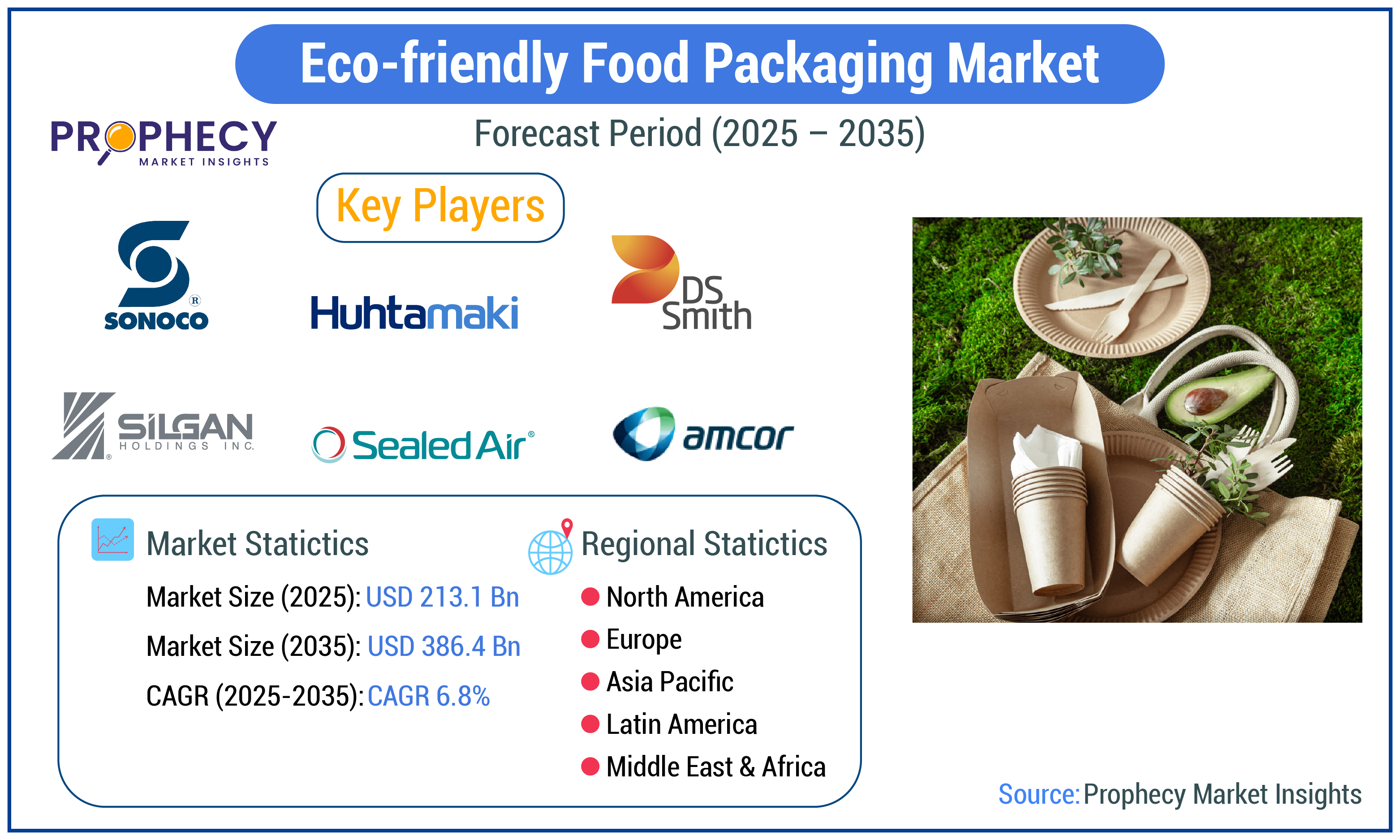
- By 2035, Eco-friendly Food Packaging Market size is contemplated to enlarge at a valuation of USD 386.4 Billion.
- In 2024, the Eco-friendly Food Packaging Market valuation was USD 201.4 Billion.
- Eco-friendly Food Packaging Market is developing at a CAGR of 6.8%.
Eco-friendly food packaging refers to sustainable packaging options from materials that are recyclable, biodegradable, compostable, or reusable. These packaging options are meant to limit environmental impact and waste generation while sustaining food safety and shelf life. As there is a growing concern regarding plastic pollution as well as issues surrounding environmental sustainability, both businesses and consumers are making a change toward greener packaging and materials, thus using design and material innovations to balance environmental needs and regulatory needs.
Eco-friendly food packaging has been gaining traction for reasons related to growing environmental concerns, strict government regulation of plastic use, and growing appetite for sustainable products by consumers. Many companies are even investing in biodegradable materials and new packaging technologies to meet sustainability goals. Similarly, global food chains and retailers are adopting eco-friendly packaging, both to improve their brand image and to foster customer loyalty, given that they are also under consumer pressure for sustainability. Increased acceptance of and preference for packaged food offerings in favor of in-person food produce in dense urban areas also alloy to the market, both offensively and defensively.
The future of eco-friendly food packaging will be in smart sustainable materials that perform without harming the planet by producing food safe packaging. Innovations, governmental improvements, and increasing awareness of environmental sustainability will move the eco-food packaging industry toward circular packaging models, removing single use options to make eco-friendly options the default for the poorest company on the planet.
Recession Risk & Tariff Analysis:
- Business and consumer focus typically shifts towards cost cutting compared to environmental sustainability in poor economic periods, and this diminishes demand for more expensive environmentally-friendly packaging alternatives. Production companies may decrease innovations into more sustainable alternatives, or switch both sail and products to cheaper and more traditional packaging approaches, thus moderating or potentially temporarily stalling the adoption of more sustainable product packaging alternatives.
- Tariffs on imported raw materials used in environmentally-sustainable packaging (biodegradable corn-based polymers or recycled paper) can complicate production and pricing competitiveness. Regulatory trade restrictions on sustainable raw materials that can be used in the production of eco-friendly packaging or the finished good of sustainable packaging, can hinder global supply chains, thus impacting sustainable packaging viability, access and affordability, particularly for small and mid-size packaging producers.
Impact of Generative AI on Eco-friendly Food Packaging Market:
- Generative AI is helping manufacturers create more efficient and sustainable packaging systems, including simulating materials while taking the least amount of materials possible, and optimizing structural integrity. This technology allows manufacturers to speed product development, enhance progress towards circular economy goals, and support the development of eco-packaging with reduced material and carbon emissions.
- Generative AI improves forecast accuracy and inventory planning in the eco-food packaging industry. It enables manufacturers to evaluate market and consumer trends, leading to improved overproduction, decreased materials waste and improved efficiency in logistics meeting both sustainability outcomes while improving profitability.
Global Eco Friendly Food Packaging Market Drivers & Restraints
Key Drivers:
Rising Government Regulations on Single-Use Plastics is leveraging the market
Around the world governments are implementing more stringent limitations on single-use plastic and as such, the time taken to implement sustainable food packaging will be quicker than prior. These policies will be largely focused on cutting down plastic pollution while promoting packaging alternatives to the businesses and people with sustainable alternatives such as compostable, recyclable, or biodegradable packaging. The food manufacturers have agreed to adopt the solutions and place their order for compliant packaging thereby increasing demand within the market. The people are actively becoming aware of their usage of packaging and with regulatory measures in place forces businesses to innovate and create sustainable packaging and we have entered an era of the eco-friendly food packaging industry which is growing tremendously as a product to both consumers and producers.
- For instance, according to the United Nations Environment Programme (UNEP), lobal demand for plastics is projected to double by 2050, there are over 180 countries have implemented policies to manage and influence plastic pollution and with the amounts of bans and taxes on single-use plastic it has caused a surge in sustainable packaging demand.
Restraints:
High Production Costs and Limited Infrastructure repels market growth:
One of the major challenges in the green food packaging industry is the relative cost of the raw materials and processes associated with eco-friendly packaging when compared to traditional plastic packaging. The limited recycling and composting infrastructure in many areas can also impede proper disposal and reuse, therefore impacting the overall adoption rate. The relative increase in cost and logistical limitations make it more difficult for small to mid-sized companies to fully transition to sustainable packaging, which gains a stronger hold in the market the more quickly larger chains adopt eco-friendly packaging.
- Counterbalance Statements: Although cost and infrastructure constraints exist, governmental incentives, technological advancement, and consumers demand signals for sustainable options allow to contemplate closing disparities. Further investments into green innovation and circular economy initiatives will continue to drive lower costs and infrastructure investment and broader adoption of food and products made from eco-friendly food packaging.
Opportunities & Trends:
Rise of Bioplastic Innovations and Consumer-Conscious Branding is a rising trend
The sustainable food packaging market is generating more and more opportunities for supply since of the development of bioplastics from renewable materials such as corn starch, algae and sugarcane. These to some extent perform the same function as plastics but have a lower sustainability impact. There is also recognition among food brands that more and more consumers, urban and health-conscious consumers, want to see packaging align with sustainability goals, and they want to use eco-packaging as one of the marketing messages to attract consumers who care about sustainability.
Global Eco Friendly Food Packaging Market Segmentations & Regional Insights
Product Type, Material, Application, End-User and region are the divisions of the Eco-friendly Food Packaging Market.
By Product Type:
Based on the product type, the eco-friendly food packaging market is divided into bags, boxes & cartons, bottles & jars, others. Cartons and Boxes dominate the eco-friendly food packaging sector as they are ubiquitous, as they are used in takeaway, bakery, and dry food packaging. Cartons and boxes are also made of renewable materials (i.e., paperboard), which may allow for better branding possibilities and not to mention they are biodegradable. Their balance of functionality, cost-effectiveness, and sustainability has made cartons and boxes the most popular food packaging choice across various segments in food.
Bags are second dominating product type in market. Bags are used heavily for grocery stores, produce packaging, and food delivery. Bags may be made from compostable or recycled material, and offer a lightweight, flexible and environmentally friendly option. Increasing plastic bag bans encourage a movement toward sustainable bag options in many areas.
By Material:
Based on Material, the market is segmented into biodegradable, recyclable, compostable. biodegradable material dominates the eco-friendly food packaging market. Biodegradable materials occupy the foremost position in the eco-marketed food packaging category since they can decompose naturally without being deliberately disposed of in landfills. Biodegradable products are being widely applied in the food service and retail sectors, as they are able to meet sustainability targets.
The second largest market share belongs to recyclable packaging, supported by recycling infrastructure and awareness. It serves as a practical replacement for companies seeking to eliminate single-use plastic applications and replace them with recyclable materials, particularly in regions with favorable recycling policies. Recyclables are attractive notwithstanding challenges associated with contamination and segregation, and remain in demand across all packaged food areas.
By Application:
Bakery & Confectionery, Dairy Products, Fruits & Vegetables, Meat, Poultry & Seafood, Ready-to-Eat/Takeaway Food, Others are application of the eco-friendly food packaging market. Eco-friendly food packaging is dominated by the bakery and confectionery segment, which has a higher consumption rate with higher packaging frequency. In other words, significantly more wrappers, trays, and boxes are used in this segment than any other category. Due to frequent demand for sustainable packaging by consumers, the focus in this segment is lightweight, biodegradable materials to meet their sustainable goals and provide consumers with the product they prefer.
Dairy is second, as it requires safe, moisture barrier, temperature stable packaging. The packaging shift towards eco-friendly alternatives that include bio-based cartons, compostable films, and others is taking the place of common plastic. In this segment the speed of the sustainability shift is fueled by increased consumer preference for sustainable dairy brand choosing, and pressure from regulators for consumers to use less plastic.
By End-Users:
Food Manufacturers, Restaurants & Cafés, Catering Services, Supermarkets/Hypermarkets, Online Food Delivery Services, Others are end-users of the eco-friendly food packaging market. Food manufacturers dominate the market for eco-friendly food packaging as they are moving hopefully large-scale adoption of sustainable materials across multiple product lines. The rise in consumer demand for green packaging, alongside regulatory pressure, is encouraging food manufactures towards recyclable and compostable products that help reduce environmental impact and present a positive brand image to buyers in increasingly competitive retail settings.
Supermarkets and hypermarkets rank second, and their position can be largely attributed to their ongoing role as a major point of distribution for packaged food. These retailers are also more frequently going towards eco-friendly packaging solutions ultimately as part of their larger goals of sustainability that matches consumer demand for environmentally-friendly options while fulfilling requirements related to product packaging regulations.
Regional Insights:
Geographically, the Eco-friendly Food Packaging Market is studied across North America, Europe, Asia Pacific, Latin America, and the Middle East & Africa.
North America:
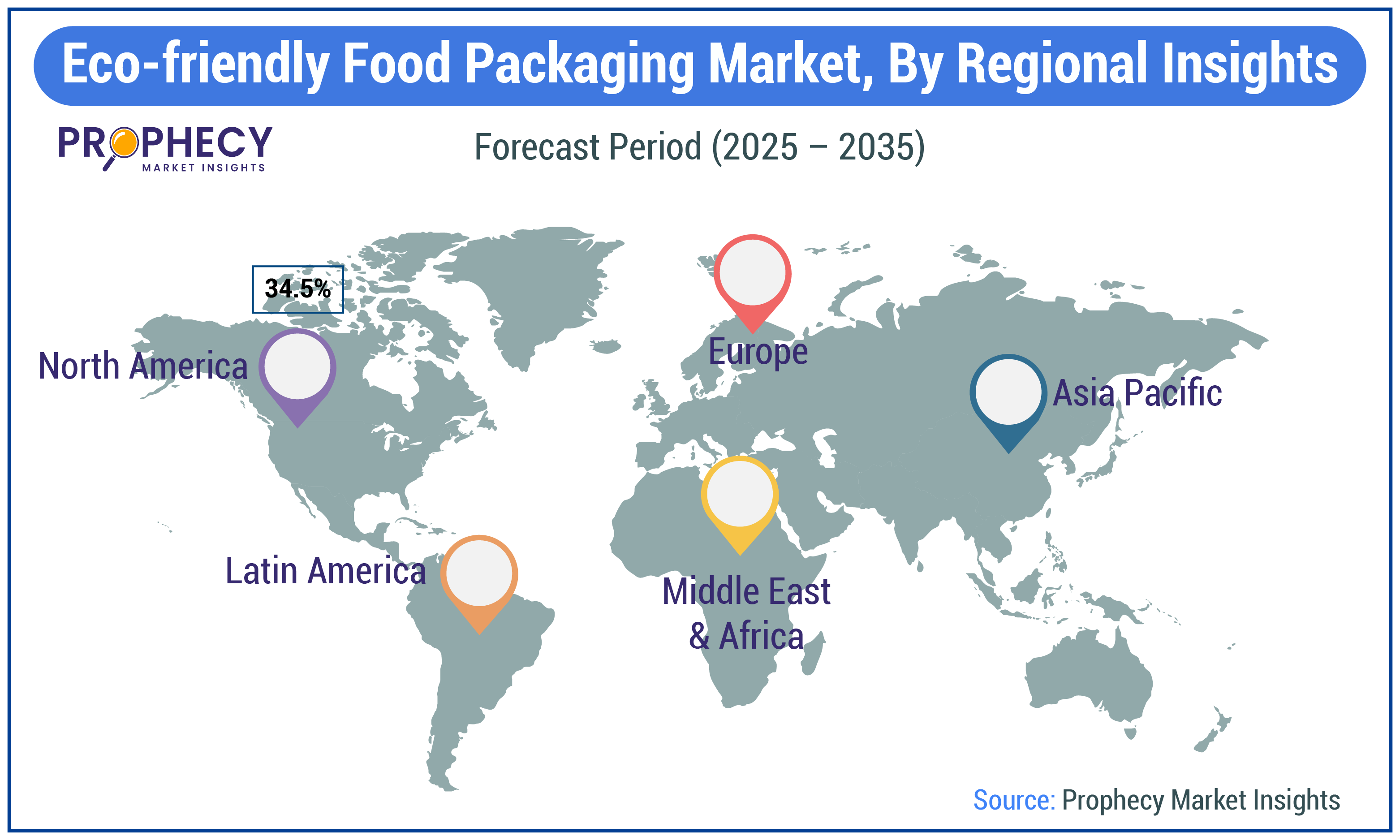
North America dominates the eco-friendly food packaging market. The area is flourishing in part thanks to stronger regulatory protections for the environment, rising consumer awareness, and corporate commitments toward sustainability. The region is also home to a mature food industry with innovative laboratory solutions for producing biodegradable packaging. Retailers and food service companies also continue to embrace sustainable packaging and invest heavily in ways to not only quell sophisticated consumers but also improve the adaptation of an eco-friendly product mix.
- United States Eco-friendly Food Packaging Market Insights:
The United States leads North America's environmentally sustainable food packaging market, largely due to advanced manufacturing technologies, broad-based sustainable practices adoption, and strong government oversight support. Increased consumer demand and major food companies adopting recyclable and biodegradable materials for sustainable packaging will drive sustainable market growth and innovation in the United States.
Europe:
Europe is in a second place and continue to develop within the confines of the tougher EU directives on single-use plastics and their EU directives for the circular economy. In the region, there is high adoption of recyclable and compostable packaging among retail and foodservice companies. Consumers also prefer products with eco-labels and sustainable packaging. Government initiatives also encourage the production of labelled food products in this sector allowing for the continuation of alternatives to both recyclable and compostable packaging solutions throughout the continent.
- Germany Eco-friendly Food Packaging Market Insights:
Germany is Europe’s leader in eco-friendly food packaging and is the only country in the region with increasingly strong environmental policies, together with significant existing recycling infrastructure that is recognized globally. The country has long emphasized sustainable production practices, and consumers are increasingly looking for packaging that is good for the environment.
Asia Pacific:
Asia Pacific, as the exporting region is subject to fast urbanization, rising foodservice industries, and a growing, more natural environmentalism are changing the game. Although regulations vary across the region there is ground-level pressure in Japan, China and India to adopt more intentioned eco-friendly packaging by having awareness campaigns and enacting bans on plastic usage are building quite a lot of momentum for future regional growth.
- China Eco-friendly Food Packaging Market Insights:
China dominates the eco-friendly food packaging market within the Asia Pacific region, due to its rapidly evolving regulations. The Chinese government is promoting alternative products to single-use plastics as part of its push to ban these products and shifting the development and use of in other sectors to biodegradable, compostable and recyclable food packaging, particularly in the foodservice segment.
Eco-friendly Food Packaging Market Report Scope:
|
Attribute |
Details |
|
Market Size 2025 |
USD 213.1 Billion |
|
Projected Market Size 2035 |
USD 386.4 Billion |
|
CAGR Growth Rate |
6.8% (2025-2035) |
|
Base year for estimation |
2024 |
|
Forecast period |
2025 – 2035 |
|
Market representation |
Revenue in USD Billion & CAGR from 2025 to 2035 |
|
Regional scope |
North America - U.S. and Canada Europe – Germany, U.K., France, Russia, Italy, Spain, Netherlands, and Rest of Europe Asia Pacific – China, India, Japan, Australia, Indonesia, Malaysia, South Korea, and Rest of Asia-Pacific Latin America - Brazil, Mexico, Argentina, and Rest of Latin America Middle East & Africa – GCC, Israel, South Africa, and Rest of Middle East & Africa |
|
Report coverage |
Revenue forecast, company share, competitive landscape, growth factors, and trends |
Segmentation:
By Product Type:
- Bags
- Boxes & Cartons
- Bottles & Jars
- Others
By Material:
- Biodegradable
- Recyclable
- Compostable
By Application:
- Bakery & Confectionery
- Dairy Products
- Fruits & Vegetables
- Meat, Poultry & Seafood
- Ready-to-Eat/Takeaway Food
- Others
By End-Users:
- Food Manufacturers
- Restaurants & Cafés
- Catering Services
- Supermarkets/Hypermarkets
- Online Food Delivery Services
- Others
By Region:
- North America
- U.S.
- Canada
- Europe
- Germany
- U.K.
- France
- Russia
- Italy
- Spain
- Netherlands
- Rest of Europe
- Asia Pacific
- China
- India
- Japan
- Australia
- Indonesia
- Malaysia
- South Korea
- Rest of Asia Pacific
- Latin America
- Brazil
- Mexico
- Argentina
- Rest of Latin America
- Middle East & Africa
- GCC
- Israel
- South Africa
- Rest of Middle East & Africa
Global Eco Friendly Food Packaging Market Competitive Landscape & Key Players
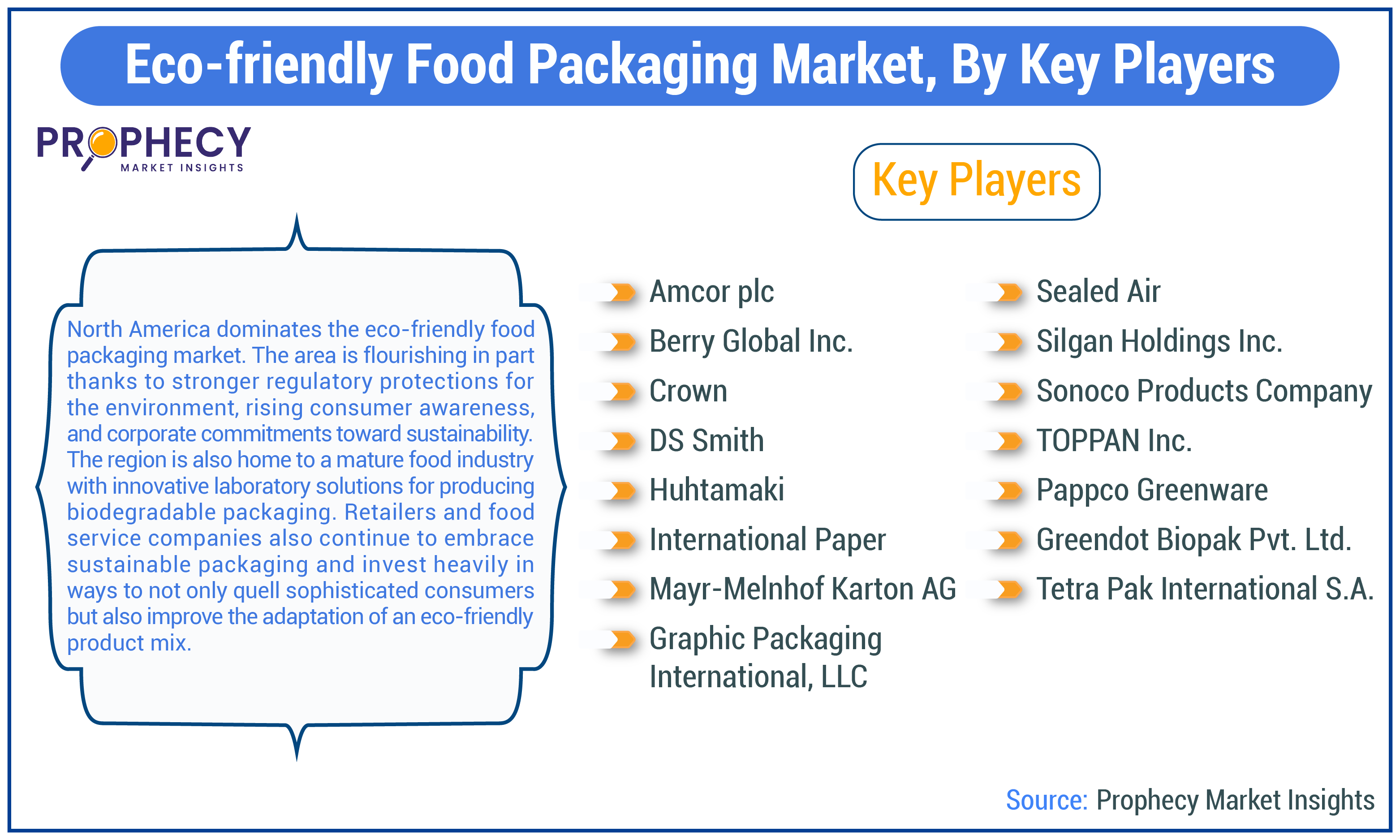
The prominent players operating in the market include, Amcor plc, Berry Global Inc., Crown, DS Smith, Graphic Packaging International, LLC, Huhtamaki, International Paper, and others. Leveraging research and development, circular economy, marketing, and embracing sustainability will be a key strategy for Eco-friendly Food Packaging organizations in order to drive growth, innovation, and sustainability.
Eco-friendly Food Packaging Market Companies:
- Amcor plc
- Berry Global Inc.
- Crown
- DS Smith
- Graphic Packaging International, LLC
- Huhtamaki
- International Paper
- Mayr-Melnhof Karton AG
- Sealed Air
- Silgan Holdings Inc.
- Sonoco Products Company
- TOPPAN Inc.
- Tetra Pak International S.A.
- Pappco Greenware
- Greendot Biopak Pvt. Ltd.
View an Additional List of Companies in the Eco-friendly Food Packaging Market
Global Eco Friendly Food Packaging Market Recent News
- In November 2024, Greif introduced EnviroRAP, a reusable, recycled barrier-coated paperboard for the food industry. EnviroRAP is suitable for packing oily or greasy foods since of the resilience to oil and grease. The water-based coating, which is recyclable, shows less impact on the atmosphere and allows a smooth recycling process. The launch of the new product confirms Greif's commitment to sustainable packaging solutions.
- In January 2024, SEE introduced its biodegradable protein packaging tray at the International Product & Processing Expo (IPPE). This innovative tray is being marketed under the CRYOVAC brand and is designed to replace traditional expanded polystyrene (EPS) trays. It is made from a biobased resin that is food-contact grade, has 54% biobased content generated from renewable wood cellulose, and is USDA certified.
Analyst View:
Numerous growing environmental concerns; the desires of consumers for sustainable goods; government regulations are advancing the growth of the eco-friendly food packaging segment. Here the bulk of the market share is shifting towards new trends such as biodegradable films, compostable containers, reusable packaging etc. several significant developments are driving partnerships between food brands and provider of green packaging and increasing research and development funding for sustainable material use. There are challenges associated with high production costs, and ratio of recycling infrastructure which is restrictive to circularity. More than 75% of respondents in a survey from IFT stated they are planning a sustainability program, or are currently implementing a program in the next year. Growing a global awareness, government regulations, and consumer desire will drive eco-friendly packaging for create new opportunities. Sustainability can now be seen not only as an ethical decision, but it can provide a competitive advantage in the market.
More Related Reports
Asia Pacific Ethnic Food Market
Food Fiber Market
Food Safety Testing Market
Baby Food Market
Eco-Friendly Household Cleaning Products Market
Global Eco Friendly Food Packaging Market Company Profile
|
Company Name |
Amcor plc |
|
Headquarter |
Zürich, Switzerland |
|
CEO |
Peter Konieczny |
|
Employee Count |
41,000 Employees |
Global Eco Friendly Food Packaging Market Highlights
FAQs
Eco-friendly Food Packaging Market size was valued at USD 213.1 Billion in 2025 and is expected to reach USD 386.4 Billion by 2035 growing at a CAGR of 6.8%.
Material, Product Type, Application, and region are the segmentation for the Eco-Friendly Food Packaging market.
North America, Asia Pacific, Europe, Latin America, and the Middle East & Africa. North America is expected to dominate the market.
The prominent players operating in the market include, Amcor plc, Berry Global Inc., Crown, DS Smith, Graphic Packaging International, LLC, Huhtamaki, International Paper, Mayr-Melnhof Karton AG, Sealed Air, Silgan Holdings Inc., Sonoco Products Company, TOPPAN Inc., Tetra Pak International S.A., Pappco Greenware, Greendot Biopak Pvt. Ltd.