Global Carbon Capture And Storage Overview
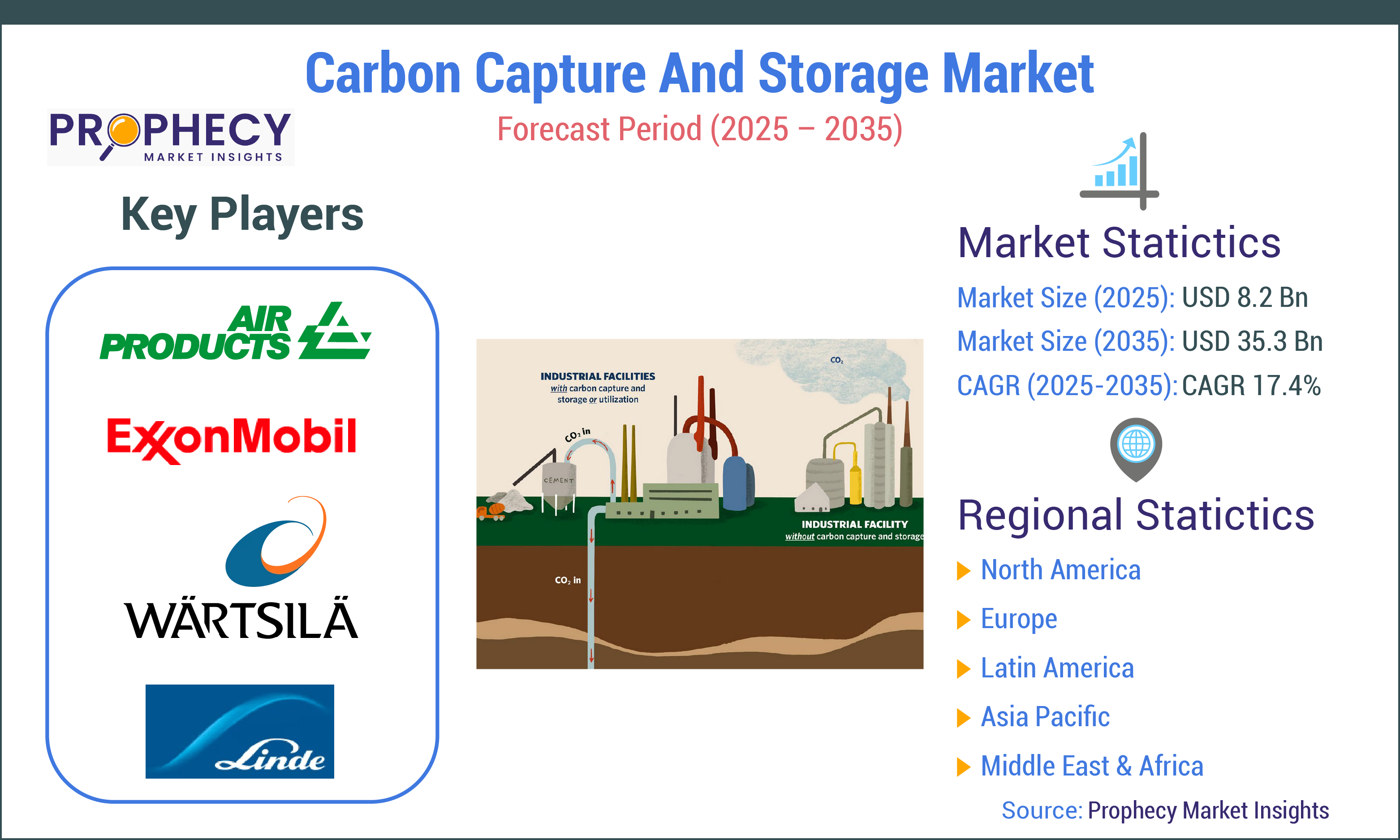
- Carbon capture and storage market size is anticipated to enlarge at a rate of USD 35.3 Billion, by 2035.
- In 2024, the market valuation was USD 7.2 Billion.
- Carbon capture and storage market is increasing at a CAGR 17.4%.
?Carbon capture and storage (CCS) is a technology designed to reduce carbon dioxide (CO?) emissions, particularly from large industrial sources such as power plants, cement factories, and steel mills. Its primary goal is to prevent CO?, a major greenhouse gas which responsible for global warming from entering the atmosphere, by helping to mitigate climate change. CCS is considered a crucial part of the global strategy to achieve net-zero emissions. It is especially valuable in sectors in which reducing emissions is technically difficult or extremely costly.
Stringent environmental regulations for industries to adopt carbon capture and storage, and global push towards net-zero emissions, is anticipated to drive carbon capture and storage market growth. The industrial demand for clean energy technology alternative to fossil fuels, accelerating investment, government funding for the deployment of CCS projects, and improvement in capture efficiency, monitoring, storage safety, is expected to pitch carbon capture and storage market growth.
Expansion in emerging markets, growing emphasis on carbon utilization, and integration with renewable energy & bioenergy, is estimated to impel carbon capture and storage market growth. Expansion of carbon markets, to offer companies a financial incentive to invest in emissions reduction, retrofitting existing infrastructure, and rising international collaboration, agreements, is projected to boost carbon capture and storage market growth.
Recession Risk & Tariff Analysis of Carbon Capture and Storage Market:
- A global or regional recession can slow down the carbon capture and storage (CCS) market due to reduced industrial activity, lower energy demand, and tighter capital availability. During economic downturns, companies may delay or cancel large-scale investments such as CCS projects, which often require high upfront costs and long-term returns.
- Tariffs and trade barriers can affect the market by increasing the cost of importing key technologies, materials, or equipment. Countries that rely on international supply chains for carbon capture and storage infrastructure may face higher project costs uncertainty tariffs are imposed on industrial goods or specialized machinery.
Impact of Generative AI on Carbon Capture and Storage Market:
- AI models can generate highly accurate simulations of capture technologies under varying conditions, which enables skilled professionals to test and optimize new materials, equipment configurations, and operating parameters before physical deployment.
- By analyzing data from sensors installed in CCS facilities, AI can predict equipment failures, optimize energy usage, and ensure safety in CO? storage sites. AI algorithms can enhance carbon accounting and reporting, by accurate monitoring and transparent reporting which are essential for governments and companies to meet climate goals and claim carbon credits.
Global Carbon Capture And Storage Drivers & Restraints
Key Drivers:
Growing Global Focus on Achieving Net-Zero Energy System is Propelling the Market Growth
As climate change continues to pose severe environmental, economic, and social risks, countries, corporations, and institutions globally are aligning their policies and investments to reduce greenhouse gas (GHG) emissions. CCS tackles technically difficult emissions from hard-to-abate sectors such as cement, steel, chemicals, refining, and waste management, in which alternatives such as electrification or green fuels are not yet scalable or cost-effective.
The growing emphasis on net-zero has led to a surge in government support, including carbon pricing mechanisms, tax incentives, grants, and regulatory mandates that make CCS projects more financially viable. The global thrust toward a net-zero future is increasing the insistence to decarbonize and also reshaping industries and governments to adopt carbon capture and storage technology, resulting to propel carbon capture and storage market growth.
- For instance, article published by Elsevier Ltd., in May 2023, this article states that, economic and environmental implications of carbon capture and storage in transition to net-zero emissions. The research combines energy system modeling and life-cycle assessment (LCA) to assess greenhouse gas (GHG) emissions and broader set of 16 environmental impact categories. In situations in which CCS use is restricted, the cost of reaching net-zero increases by 105%, with 84% of that increase spent to eliminate the final 23 Mt of CO?. CCS is primarily used to cut CO? emissions, it also lowers environmental impacts in up to 13 out of 16 categories, such as land use, material use, and water consumption. CCS reduces the need for material-intensive technologies, such as large-scale synthetic fuel production and the construction of renewable power plants in suboptimal locations. Thus, CCS complements renewable energy and reduces the need for resource-intensive infrastructure, which helps to achieve net-zero targets more sustainably and affordably.
Restraints:
High Capital and Operational Costs Delay Market Growth
Carbon capture and storage projects require significant upfront investment in technology, infrastructure, and maintenance, which can deter companies, especially in cost-sensitive industries. The complexity of capture technology and long project timelines increase financial risks, which can resist to integrate technology to smaller industries or start-up industries, resulting to limits target market growth.
- Counterbalance Statements: Ongoing research and innovation in low-cost technology, growing government subsidies, tax incentives, and funding programs are reducing the financial burden. Additionally, technological advancements in storage system, and economies of scale are steadily lowering costs, making carbon capture and storage more economically viable over time.
Opportunities & Trends:
Integration with Renewable Energy and Bioenergy can create Significant Opportunities for Market Amplification
Bioenergy with CCS (BECCS) involves burning biomass to generate energy and capturing the CO? released during combustion for permanent underground storage. Due to plants absorb CO? during growth, capturing and storing the emissions from burning them which creates a net removal of CO? from the atmosphere. This makes BECCS scalable technologies for delivering negative emissions, a key requirement in virtually all net-zero scenarios modeled by institutions such as the IPCC (Intergovernmental Panel on Climate Change).
CCS integration helps optimize land and material use. The integration of CCS with renewable energy and bio-based industries supports the development of a circular carbon economy, in which carbon is captured, reused, or stored permanently. Governments and international organizations are increasingly supporting CCS integration with renewables and bioenergy through policy incentives, research funding, and carbon markets. This integration enhances environmental effectiveness of carbon capture and broadens its strategic importance in net-zero energy system, resulting to fuel carbon capture and storage market share.
Global Carbon Capture And Storage Segmentations & Regional Insights
The carbon capture and storage market are segmented into services, technology, end-user, and region.
By Service:
Based on services, the market is classified into, capture, transportation, utilization, storage. Carbon capture is the most dominant segment carbon capture and storage market share. It represents the most technically complex and cost-intensive part of the entire carbon capture and storage process. The demand for efficient capture technologies is high, particularly from industries such as power generation, cement, and steel. Advancements in post-combustion, pre-combustion, and oxy-fuel capture technologies are driving innovation and investment in this segment, is assessed to impel segment growth in carbon capture and storage market share.
Storage is the second-largest segment in the market. Once carbon is captured, safe and long-term geological storage is essential to ensure it doesn’t leak back into the atmosphere. Deep saline aquifers and depleted oil & gas fields are commonly used for this purpose. The complexity of site selection, geological surveying, and long-term monitoring, contributing segment’s extension in carbon capture and storage market size.
By Technology:
post-combustion, pre-combustion, oxy-combustion and others are classified by technology for carbon capture and storage market. Post-combustion capture is the most dominant technology segment in the market. It involves removing CO? from the flue gases after fossil fuels are burned. This method is especially suitable for retrofitting existing power plants and industrial facilities, making it the most widely used and commercially established approach. It leverages existing infrastructure and is compatible with various fuels, including coal, oil, and natural gas, is estimated to drive carbon capture and storage market share in given segment.
Pre-combustion capture is the second-largest segment by market share. In this process, fuel is partially oxidized to form a mixture of hydrogen and carbon monoxide, which is then converted into CO? and captured before combustion occurs. This method is primarily used in integrated gasification combined cycle (IGCC) plants and in hydrogen production, is projected to fuel segment’s development in carbon capture and storage market size.
By End-User:
Under end-user, the market is categorized into, manufacturing, oil & gas, iron & steel, energy & power, chemical & petrochemical, cement, and others. Energy & power is most leading segment in the market. Power plants, especially fueled by coal and natural gas, are major contributors to CO? emissions globally. Carbon capture and storage is increasingly being deployed at these plants to meet regulatory emission standards and support national climate goals. The ability to retrofit existing power stations with post-combustion capture systems, is expected to pitch growth of segment in carbon capture and storage market share.
Oil & gas is second leading segment in the market. It uses carbon capture and storage both to reduce emissions during extraction and refining processes. This dual application drives strong investment in carbon capture and storage within this sector. major oil companies are increasingly investing in carbon capture and storage to align with net-zero commitments and to decarbonize upstream & downstream operations, is predicted to boost segment’s expansion in carbon capture and storage market size.
Regional Insights:
Geographically, the market is studied across North America, Europe, Asia Pacific, Latin America, and the Middle East & Africa.
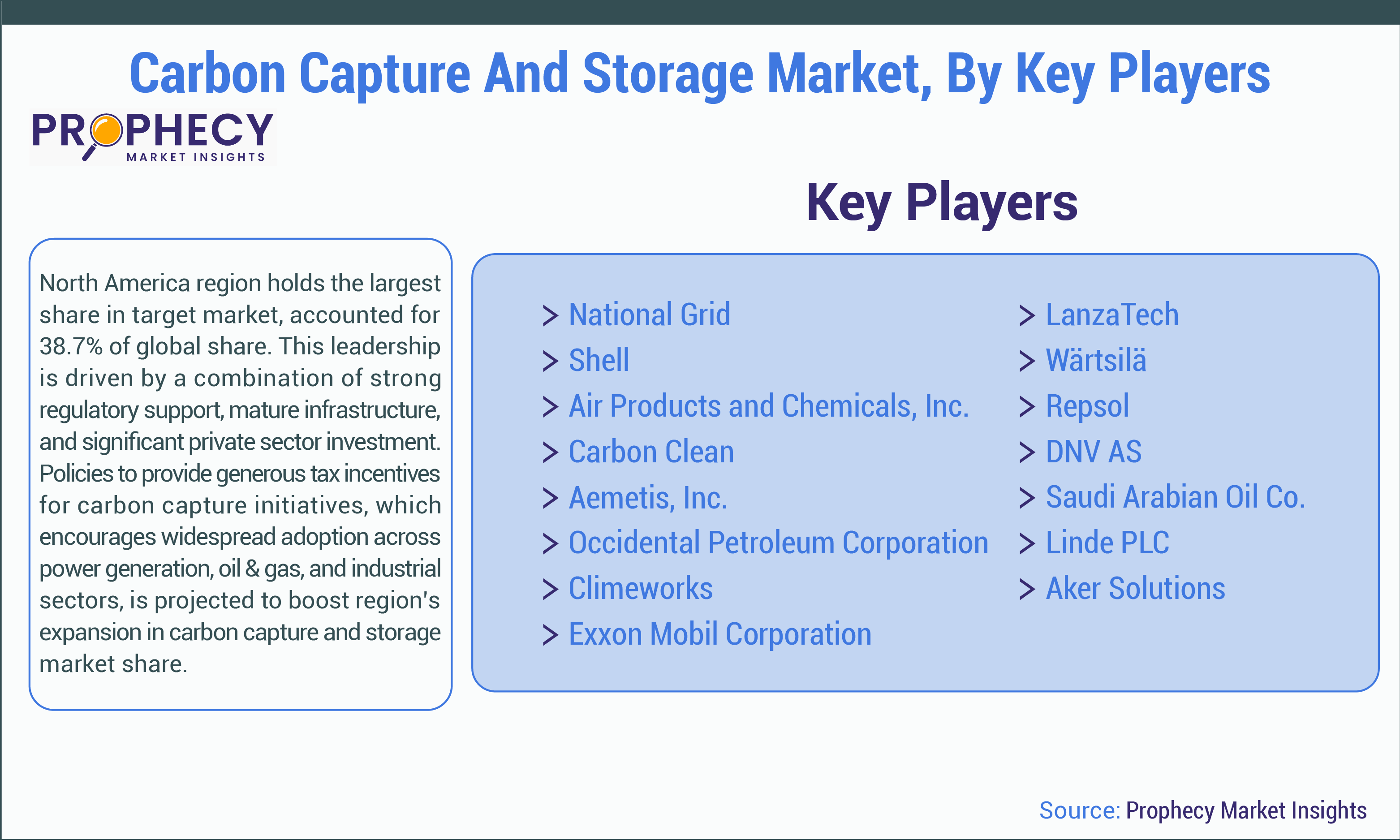
North America: This region holds the largest share in target market, accounted for 38.7% of global share. This leadership is driven by a combination of strong regulatory support, mature infrastructure, and significant private sector investment. Policies to provide generous tax incentives for carbon capture initiatives, which encourages widespread adoption across power generation, oil & gas, and industrial sectors, is projected to boost region’s expansion in carbon capture and storage market share.
- U.S. Carbon Capture and Storage Market Insights:
The U.S. is leading country in North America region for market. It hosts the majority of large-scale carbon capture and storage projects, supported by strong government incentives, with extensive CO? infrastructure, and active private sector involvement, is contributing to carbon capture and storage market growth.
Europe: This region is second leading region in this market. Europe’s position is fueled by its determined climate targets, with investing in large-scale carbon capture and storage hubs and industrial decarbonization projects. The strong government support and collaboration between public & private stakeholders, resulting to propel carbon capture and storage market size.
- Norway Carbon Capture and Storage Market Insights:
Norway stands out as the dominant country in Europe for carbon capture and storage. It has established several leading projects, leveraging its favorable geology and proactive climate policies. The growing emphasis on advanced manufacturing process, is expected to boost carbon capture and storage market size.
Asia Pacific: This region is emerging as a rapidly growing market for carbon capture and storage, driven by its fast-paced industrialization and increasing focus on reducing carbon emissions. Countries are investing heavily in carbon capture and storage technologies to address the environmental impact of their expanding energy and manufacturing sectors. With rising environmental awareness and strengthening regulations, is anticipated to drive region growth in carbon capture and storage market share.
- China Carbon Capture and Storage Market Insights:
China has leading country in Asia Pacific for the target market, due to its massive industrial capabilities and significant demand across multiple industries. China is heavily investing in carbon capture and storage to meet its climate goals and industrial decarbonization targets. Its scale of industrial activity and government backing position it as the regional leader in carbon capture and storage development, resulting to propel carbon capture and storage market share.

Carbon Capture and Storage Market Report Scope:
|
Attribute |
Details |
|
Market Size 2025 |
USD 8.2 Billion |
|
Projected Market Size 2035 |
USD 35.3 Billion |
|
CAGR Growth Rate |
17.4% (2025-2035) |
|
Base year for estimation |
2024 |
|
Forecast period |
2025 – 2035 |
|
Market representation |
Revenue in USD Billion & CAGR from 2025 to 2035 |
|
Regional scope |
North America - U.S. and Canada Europe – Germany, U.K., France, Russia, Italy, Spain, Netherlands, and Rest of Europe Asia Pacific – China, India, Japan, Australia, Indonesia, Malaysia, South Korea, and Rest of Asia-Pacific Latin America - Brazil, Mexico, Argentina, and Rest of Latin America Middle East & Africa – GCC, Israel, South Africa, and Rest of Middle East & Africa |
|
Report coverage |
Revenue forecast, company share, competitive landscape, growth factors, and trends |
Segmentation:
By Services:
- Capture
- Transportation
- Utilization
- Storage
By Technology:
- Post-combustion
- Pre-combustion
- Oxy-combustion
- Others
By End-User:
- Manufacturing
- Oil & Gas
- Iron & Steel
- Energy & Power
- Chemical & Petrochemical
- Cement
- Others
By Region:
- North America
- U.S.
- Canada
- Europe
- Germany
- U.K.
- France
- Russia
- Italy
- Spain
- Netherlands
- Rest of Europe
- Asia Pacific
- China
- India
- Japan
- Australia
- Indonesia
- Malaysia
- South Korea
- Rest of Asia Pacific
- Latin America
- Brazil
- Mexico
- Argentina
- Rest of Latin America
- Middle East & Africa
- GCC
- Israel
- South Africa
- Rest of Middle East & Africa
Global Carbon Capture And Storage Competitive Landscape & Key Players
The major companies are functioning in the carbon capture and storage market are, National Grid, Shell, Air Products and Chemicals, Inc., and others. This companies are constantly innovating and developing new services to meet consumer demand through their strategic partnership and collaboration. The key players are focusing on development of advancement technology using carbon capture and storage through acquisition, is anticipated to growth of carbon capture and storage market size.
Carbon Capture and Storage Market Companies:
- National Grid
- Shell
- Air Products and Chemicals, Inc.
- Carbon Clean
- Aemetis, Inc.
- Occidental Petroleum Corporation
- Climeworks
- Exxon Mobil Corporation
- LanzaTech
- Wärtsilä
- Repsol
- DNV AS
- Saudi Arabian Oil Co.
- Linde PLC
- Aker Solutions
View an Additional List of Companies in the Carbon Capture and Storage Market
Global Carbon Capture And Storage Recent News
- In May 2025, EU’s Industrial Carbon Management Strategy and the Clean Industrial Deal, the European Commission adopted a Delegated Regulation, which was required to provide new CO2 storage solutions by 2030. It was based on Delegated Regulation, in which 44 oil and gas companies were contributing to achieve EU target. These entities were aimed to provide operational CO2 injection, which permitted in accordance with Carbon Capture and Storage (CCS) Directive (2009/31/EC), for companies that capture CO2 to reduce their emissions.
- In May 2025, The Indonesia Carbon Capture and Storage Center (ICCSC) were established to propel the country’s agenda to become a regional hub for carbon capture storage (CCS) solution. Indonesia issued the MEMR 2/2023, the implementation of carbon capture and storage and carbon capture, utilization and storage (CCUS) schemes in exploration and production operations in country. This regulation aimed to help decarbonize the upstream industry and develop new approach for low-carbon businesses in the upcoming years.
- In May 2025, The TotaEnergies, Shell, and Equinor partnered to establish, Northern Lights, the first major carbon capture and storage project in Norway. This project aimed to allow global industrial companies to transport and sequester their CO2 emissions. TotalEnergies aimed to develop CO2 storage capacity more than 10 million tons by 2030.
- In May 2025, China’s first offshore carbon capture, utilization and storage project operated in the Pearl River Mouth Basin in south China. Located at the Enping 15-1 platform, the CCUS project aimed to capture CO2 produced during oil development, purifies and pressurizes it to a supercritical state, and injects it into underground oil reservoirs at an initial rate of 8 metric tons per hour. CCUS represented an emerging technological approach for low-carbon and efficient development of fossil energy.
- In April 2025, Mitsubishi Shipbuilding Co., Ltd., a part of Mitsubishi Heavy Industries (MHI) Group acquired Approval in Princile from Nippon Kaiji Kyokai (ClassNK) for its Onboard Carbon Capture and Storage system (OCCS) developed to capture and store CO2 emitted from ships. The OCCS aimed to AiP captures, liquifies, and stores CO2 after permanent exhaust gas emitted from ships. Mitsubishi Shipbuilding has developed the system by utilizing CO2 capture technologies of MHI, which aimed to promote decarbonization of ships.
Analyst View:
The carbon capture and storage market are witnessed as significant growth over forecast period. The market growth is driven by its strength environmental regulation, technological advancements, global shift towards net zero emissions. and increasing investments across various industries. The market is expected to witness strong growth over the next period, attributed by demand for decarbonization in key sectors such as, energy storage, chemical & petrochemical, and cement industries.
More Related Reports
Advanced Carbon Materials Market
Activated Carbon Market
Carbon Credits Market
Carbon Fiber Bike Market
Carbon Nanotubes Market
Global Carbon Capture And Storage Company Profile
|
Company Name |
Shell |
|
Headquarter |
London, England, U.K. |
|
CEO |
Wael Sawan |
|
Employee Count (2024) |
96,000 Employees |
Global Carbon Capture And Storage Highlights
FAQs
Carbon capture and storage market size was valued at USD 8.2 Billion in 2025 and is expected to reach USD 35.3 Billion by 2035 growing at a CAGR of 17.4%.
Services, technology, end-user, and region are the segmentation for the target market.
North America, Asia Pacific, Europe, Latin America, and the Middle East & Africa. North America is expected to dominate the market.
The key players operating in the carbon capture and storage market include National Grid, Shell, Air Products and Chemicals, Inc., Carbon Clean, Aemetis, Inc., Occidental Petroleum Corporation, Climeworks, Exxon Mobil Corporation, LanzaTech, Wärtsilä, Repsol, DNV AS, Saudi Arabian Oil Co., Linde PLC, and Aker Solutions.