Global Bioplastics & Biopolymers Market Overview
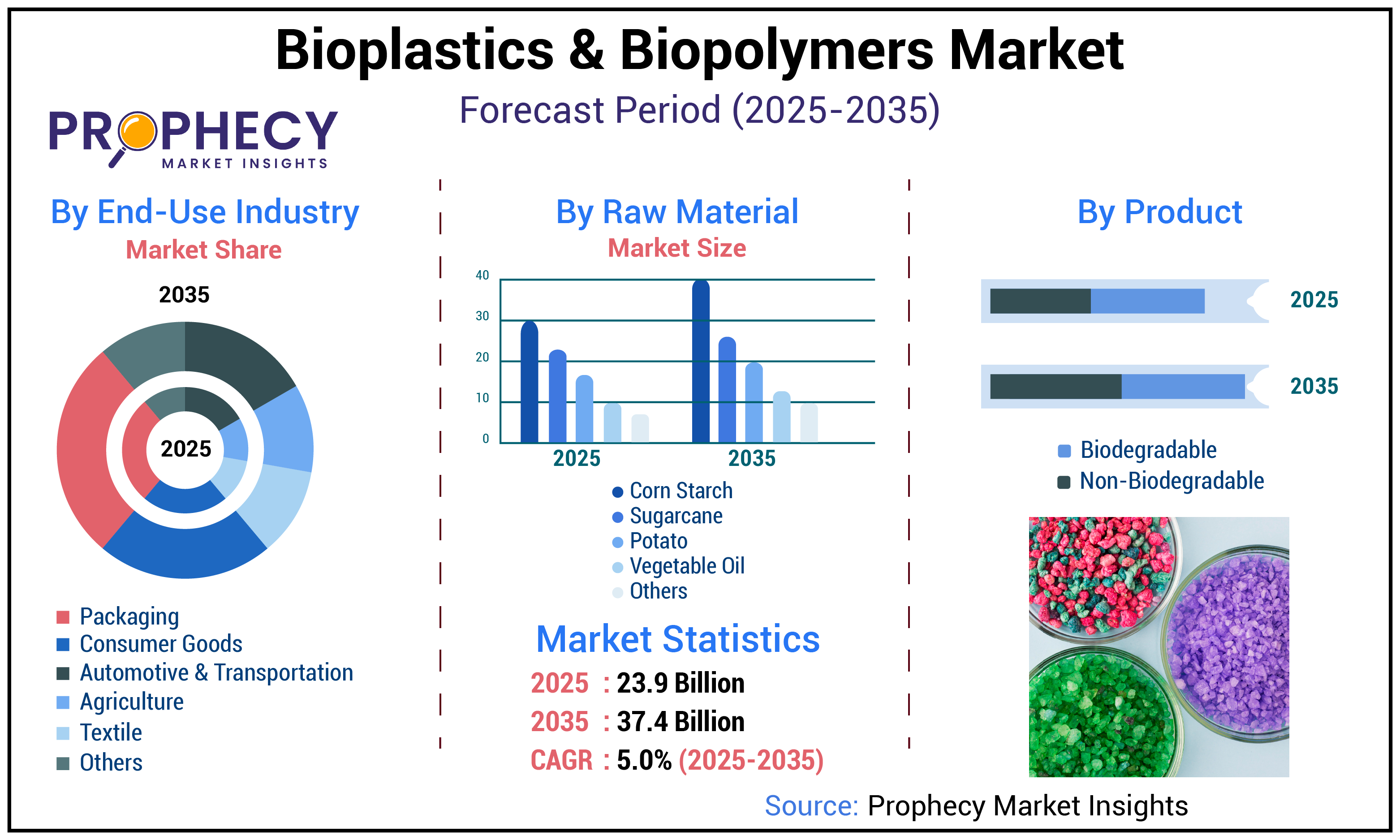
- Bioplastics & biopolymers market size is expected to expand at a rate of USD 37.4 Billion, by 2035.
- In 2024, the market valuation was USD 23.2 Billion.
- Bioplastics & biopolymers market is growing at a CAGR of 5.0%.
Bioplastics are plastics derived from renewable biological resources, and biopolymers are the natural polymers found in living organisms. Bioplastics are a subset of biopolymers, meaning all bioplastics are biopolymers, but not all biopolymers are bioplastics. Essentially, bioplastics are plastics made from things such as corn, potatoes, and sugarcane, while biopolymers are naturally occurring polymers such as cellulose and silk. These materials reduce reliance on fossil fuels, lower greenhouse gas emissions, and can be composted or recycled, mitigating plastic waste accumulation and its environmental impact.
The bioplastics and biopolymers market is experiencing growth due to several factors, primarily driven by increasing conscious of the environmental impact of conventional plastics, implementation of stricter regulations on plastic waste management, shift towards a circular economy, rising urbanization and industrialization, increasing demand from key industries, and supportive government policies.
The market’s diversification is also boosted by development of new and improved bioplastics with enhanced properties, such as biodegradability, durability, and barrier properties, technological advancements are leading to more efficient and cost-effective production of bioplastics, making it more competitive with conventional plastics, and increasing government funding for research and development.
Recession Risk and Tariff Analysis:
- Due to high manufacturing costs and competition from less expensive plastics derived from fossil fuels, the market for bioplastics and biopolymers is more vulnerable to recession, particularly during periods of low oil prices. Demand is further strained by economic downturns, and market volatility is increased by supply chain interruptions and regulatory obstacles. Support from policymakers and advances in technology are essential for sustained prosperity.
- Global trade flows are affected by the substantial regional variations in import tariffs, according to a tariff study of the market for bioplastics and biopolymers. While tariff reductions under trade agreements foster innovation and competition and encourage a broader use of sustainable alternatives to traditional plastics, high tariffs in some countries might make it difficult to enter new markets.
Impact of Generative AI on Bioplastics & Biopolymers Market:
- By speeding up material discovery, streamlining production procedures, and cutting R&D expenses, generative AI is revolutionizing the bioplastics & biopolymers market. It makes it possible to quickly simulate and forecast the characteristics of polymers, which results in the creation of high-performance, sustainable materials.
- Competitiveness is increased via AI-driven insights that increase market forecasts and supply chain efficiency. Additionally, generative models encourage the creation of eco-friendly products by supporting creative packaging uses and designs. The commercialization of next-generation bioplastic solutions is accelerated and innovation is stimulated by this technical integration.
Global Bioplastics & Biopolymers Market Drivers & Restraints
Key Drivers:
Rising Urbanization is Fostering the Market Expansion
Growing urbanization increases demand for sustainable packaging, consumer products, and infrastructure materials, which propels the market for bioplastics and biopolymers. Growing urban populations raise environmental concerns and trash production, which forces businesses and governments to switch to more environmentally friendly options.
Additionally, urban customers are increasingly conscious of the effects on the environment, which increases its choice for renewable and biodegradable items. This transition encourages investment and innovation in bioplastic solutions to fulfil the expanding demands of urban consumption while supporting regulatory reforms and corporate sustainability goals.
- For instance, according to the data published by World Bank Group, in order to fulfill the World Bank's purpose of eradicating poverty and promoting shared prosperity on a habitable world, more livable cities must be built. Currently, 4.4 billion people, or more than half of the world's population, reside in urban areas. This trend is predicted to continue, with nearly seven out of ten people living in cities by 2050, when the urban population is predicted to more than quadruple.
Restraints:
The limited Industrial Composting Infrastructure is Obstructing the Market Expansion
The lack of adequate industrial composting infrastructure is a major drawback of the bioplastics and biopolymers business. Many bioplastics don't break down in normal household or landfill settings as it needs certain conditions. As a result, recycling streams get contaminated and incorrect disposal occurs. Confusion among the public over disposal techniques exacerbates the problem and lessens the advantages of bioplastics for the environment. Inadequate collection methods and inconsistent labelling make it even more difficult to manage trash effectively and jeopardize the sustainability objectives of utilizing these materials.
- Counterbalance Statements: Governments and industry participants should make investments in growing industrial composting facilities and creating uniform bioplastic labelling in order to solve this. Proper end-of-life treatment may be ensured by public education campaigns on proper disposal techniques and enhanced bioplastic collecting systems, which will increase the market credibility and overall environmental advantages of bioplastics and biopolymers.
Opportunities & Trends:
Technological Advancements in Bioplastics & Biopolymers is Opening Up Growth Opportunities in the Future
Future market expansion is mostly driven by technological developments in bioplastics and biopolymers, which make it possible to create high-performance, biodegradable, and bio-based materials with improved strength, flexibility, and durability. More sustainable and effective production methods are made possible by advancements in genetic engineering, microbial fermentation, and polymer synthesis.
Applications in the packaging, automotive, agricultural, and medical industries are further expanded by advances in material science and nanotechnology. These developments enhance the environmental impact of products and lessen reliance on fossil fuels. Manufacturers, consumers, and regulatory agencies all find bioplastics and biopolymers more appealing as technology advances as it improves cost-effectiveness, scalability, and product customization.
Global Bioplastics & Biopolymers Market Segmentations & Regional Insights
The bioplastics & biopolymers market is segmented into product type, raw material, end-use industry, and region.
By Product Type:
Based on product type, the market is bifurcated into biodegradable and non-biodegradable. The biodegradable segment is expected to hold the superior position, in the bioplastics & biopolymers market share. This is due to the growing environmental concerns and increasing demand for sustainable alternatives in various industries including packaging, textiles, and agriculture.
The non-biodegradable segment is the second superior product type, in the bioplastics & biopolymers market. This is due to its versatility and durability, which makes it suitable for a wide range of applications where biodegradability is not a primary requirement.
By Raw Material:
Appertaining from raw material, the market is divided into sugarcane, corn starch, potato, vegetable oil, and others. The corn starch segment is dominating the bioplastics & biopolymers market. This is due to its abundance, cost-effectiveness, and the established infrastructure for its production. Corn starch is a key ingredient in producing polylactic acid (PLA), a widely used bioplastic.
The sugarcane segment is the second dominating raw material, in the bioplastics & biopolymers market. This is due to its abundance as a renewable feedstock, its suitability for producing various bioplastics, and the established infrastructure for processing it.
By End-Use Industry:
On the basis of end-use industry, the market is divided into packaging, consumer goods, automotive & transportation, agriculture, textile, and others. The packaging segment is attributed to dominate the bioplastics & biopolymers market. This is due to the widespread use of bioplastics in food and beverage packaging, household care items, and packaging for personal care goods. The packaging sector's large market share is further driven by the increasing demand for sustainable, recyclable, and compostable packaging across various industries.
The consumer segment is the second dominating end-use industry, in the bioplastics & biopolymers market. This is due to the growing demand for sustainable and biodegradable packaging and products within the consumer goods sector. Consumers are increasingly aware of the environmental impact of plastic waste and are actively seeking eco-friendly alternatives.
Regional Insights:
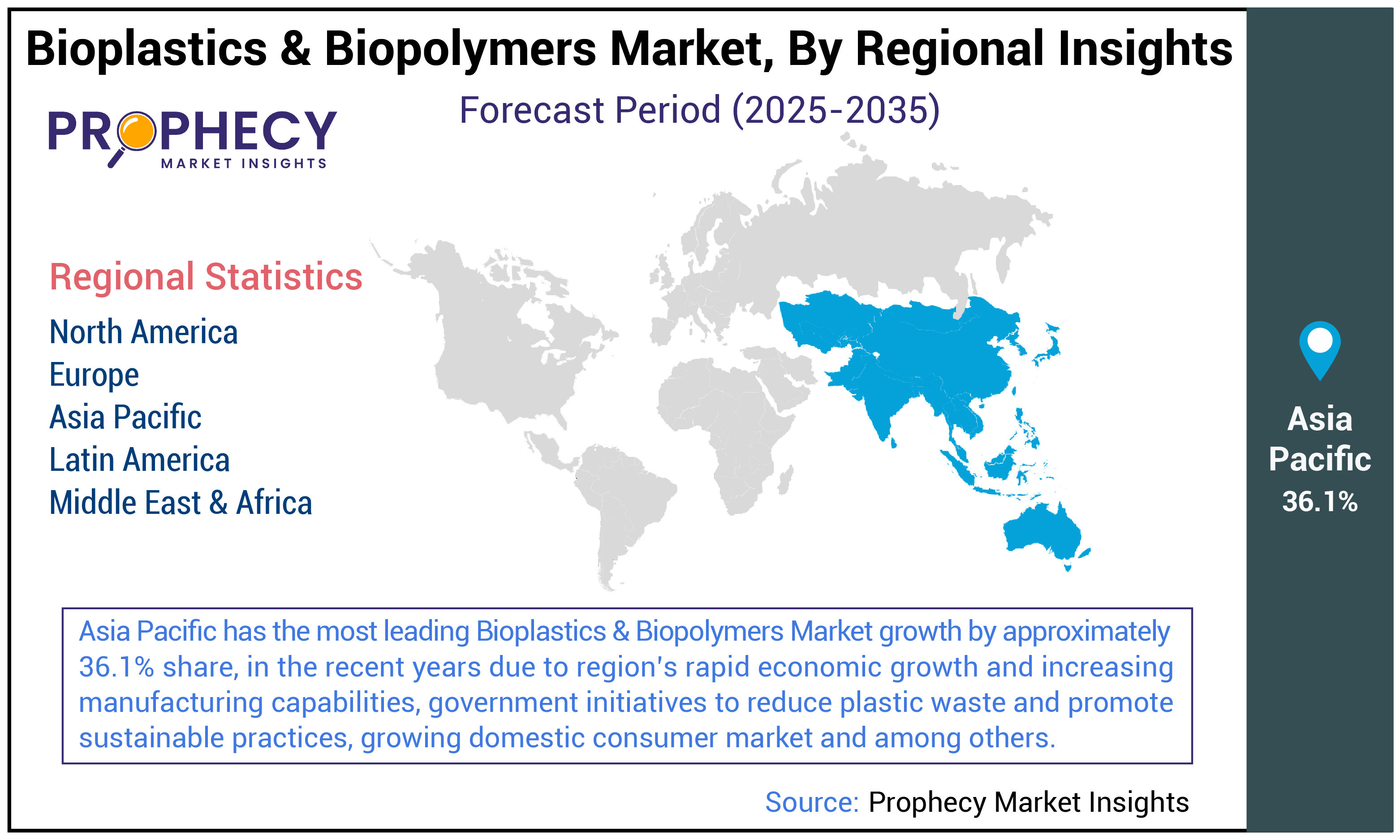
Geographically, the market is studied across North America, Europe, Asia Pacific, Latin America, and the Middle East & Africa.
Asia Pacific: This is the region which has the most leading bioplastics & biopolymers market share by approximately 36.1%, in the recent years. This is due to a combination of factors, such as, this region’s rapid economic growth and increasing manufacturing capabilities, government initiatives to reduce plastic waste and promote sustainable practices, increasing awareness about environmental issues and a preference for sustainable and eco-friendly products, lower cost of production, and a large and growing domestic consumer markets in the region, particularly for packaged food, healthcare, and consumer goods.
- China Bioplastics & Biopolymers Market Insights:
The bioplastics & biopolymers market in China is the most governing market, in the recent years. This is due to this country’s robust manufacturing capabilities, a growing awareness and demand for environmentally friendly alternatives to petroleum-based plastics, government support in several countries, vast consumer base and rapidly growing economies, coupled with increasing demand for sustainable packaging, and China’s ban on single-use plastics and India's plastic waste management rules are examples of legislative actions that are driving the adoption of bioplastics.
North America: This is the region which has the bioplastics & biopolymers market, growing with the fastest growth rate, during the forecast period, in the recent years. This is due to a confluence of factors, such as, this region’s growing demand for sustainable packaging solutions, increasing awareness of the environmental impact of plastic waste and are actively seeking eco-friendly alternatives, regulatory influences, boasts a strong technology and innovation base, the growth of food products manufacturing and other industries, and the increasing demand for products in the agriculture and horticulture sectors.
- U.S. Bioplastics & Biopolymers Market Insights:
The bioplastics & biopolymers market in the U.S., is growing with the highest CAGR, in the recent years, during the forecast period. This is due to this country’s strong manufacturing base, facilitating the production and use of bioplastics and biopolymers, government policies such as the USDA Bio Preferred Program incentivize the use of bio-based products and bio-energy, promoting sustainability, and growing awareness of environmental issues has led to increased consumer demand for biodegradable and compostable materials, particularly in packaging, food & beverage, and personal care.
Europe: The region which has the bioplastics & biopolymers market, growing significantly, in the recent years, is Europe. This is due to several number of factors, stringent regulations regarding plastic waste, growing public awareness of the environmental impact of plastic waste fuels demand for eco-friendly alternatives including bioplastics, European Union's Circular Economy Action Plan and other policies encourage the use of bioplastics and biopolymers, setting targets for replacing traditional plastics, and the adoption by industries.
- Germany Bioplastics & Biopolymers Market Insights:
The bioplastics & biopolymers market in Germany is experiencing considerate amount of growth, in the recent years. This is due to numerous factors, such as, this country’s major automotive and manufacturing hub, a well-established system for waste separation and composting, particularly in urban areas, the German government has implemented regulations and incentives to encourage the use of biodegradable plastics, increased research and development, and presence of key market players.
Bioplastics & Biopolymers Market Report Scope:
|
Attribute |
Details |
|
Market Size 2025 |
USD 23.9 Billion |
|
Projected Market Size 2035 |
USD 37.4 Billion |
|
CAGR Growth Rate |
5.0% (2025-2035) |
|
Base year for estimation |
2024 |
|
Forecast period |
2025 – 2035 |
|
Market representation |
Revenue in USD Billion & CAGR from 2025 to 2035 |
|
Regional scope |
North America - U.S. and Canada Europe – Germany, U.K., France, Russia, Italy, Spain, Netherlands, and Rest of Europe Asia Pacific – China, India, Japan, Australia, Indonesia, Malaysia, South Korea, and Rest of Asia-Pacific Latin America - Brazil, Mexico, Argentina, and Rest of Latin America Middle East & Africa – GCC, Israel, South Africa, and Rest of Middle East & Africa |
|
Report coverage |
|
Segmentation:
By Product Type:
- Biodegradable
- PLA
- PHA
- Starch Blends
- Biodegradable Polyester
- Others
- Non-Biodegradable
- Bio-PET
- Bio-PE
- Others
By Raw Material:
- Sugarcane
- Corn Starch
- Potato
- Vegetable Oil
- Others
By End-Use Industry:
- Packaging
- Consumer Goods
- Automotive & Transportation
- Agriculture
- Textile
- Others
By Region:
- North America
- U.S.
- Canada
- Europe
- Germany
- U.K.
- France
- Russia
- Italy
- Spain
- Netherlands
- Rest of Europe
- Asia Pacific
- China
- India
- Japan
- Australia
- Indonesia
- Malaysia
- South Korea
- Rest of Asia Pacific
- Latin America
- Brazil
- Mexico
- Argentina
- Rest of Latin America
- Middle East & Africa
- GCC
- Israel
- South Africa
- Rest of Middle East & Africa
Global Bioplastics & Biopolymers Market Competitive Landscape & Key Players
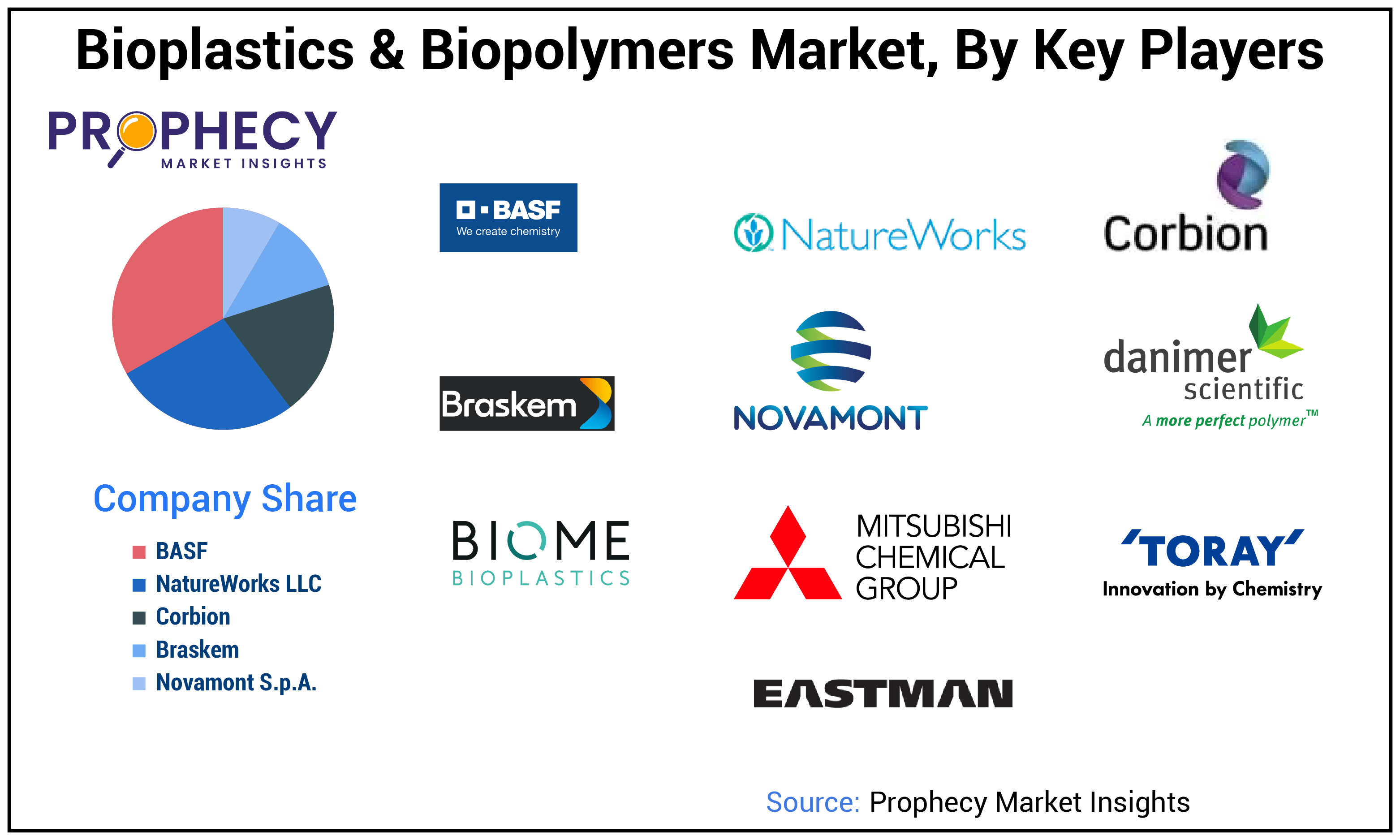
The key players operating in the market include, BASF, NatureWorks LLC, Corbion, and others. These key players are utilizing several key strategies, including capacity expansion, partnerships, collaborations, and new product development, to maintain market leadership and foster growth. These companies also focus on sustainable practices, reducing carbon footprints, and developing bio-based alternatives to traditional plastics, for driving bioplastics & biopolymers market growth.
Bioplastics & Biopolymers Market Companies:
- BASF
- NatureWorks LLC
- Corbion
- Braskem
- Novamont S.p.A.
- Danimer Scientific
- Biome Bioplastics
- Mitsubishi Chemical Group Corporation
- FKuR
- TORAY INDUSTRIES, INC.
- Eastman Chemical Company
- Mediapilote Normandie
- Plantic
- Cardia Bioplastics
- Green Dot Bioplastics Inc
View an Additional List of Companies in the Bioplastics & Biopolymers Market
Global Bioplastics & Biopolymers Market Recent News
- In February 2025, BASF had created a certified industrial compostable biopolymer that could be used to make black and white plant clips for the sustainable production of greenhouse fruits and vegetables. Commercial greenhouses can simply bind annual creepers such as tomatoes, cucumbers, and peppers using clips manufactured of ecovio 60 IA 1552. The clips are certified industrial biodegradable by EN 13432 and benefit from the biopolymer's balanced high performance of strength and flexibility.
- In November 2024, a French start-up called Lactips has secured USD 16 million in additional funding. The company has created a bio-sourced, biodegradable, and water-soluble substitute for several industrial plastics. The Blue Ocean Fund spearheaded the capital round, with participation from Impact Ocean Capital Fund, SPI Fund, and BNP Paribas Development, all of whom have previously made investments in the business. A 100% natural polymer derived from caseins, which are naturally occurring proteins frequently present in mammalian milk, was created, produced, and commercialized by Lactips.
- In September 2024, Home compostable extrusion coating biopolymers made with Danimer's signature polyhydroxyalkanoate (PHA), Nodax, have been commercially launched by Ningbo Homelink Eco-iTech Co. Ltd., a leading manufacturer of disposable tableware, and Danimer Scientific, Inc., a leading next-generation biotechnology company focused on the production of biodegradable materials. With its coating of Nodax PHA-based biopolymer, Homelink's cups would provide its clients with a completely recyclable and biodegradable substitute for conventional paper cups in both the home and the workplace. The PHA biopolymer grade is intended to be utilised as a liquid barrier covering for paper cups, taking the role of polyethylene.
- In September 2024, The Bioplastics Innovation Hub, a USD 8 million partnership between Murdoch University and Australia's national research agency CSIRO, will collaborate with business partners to create a new generation of 100% biodegradable plastic. By creating biologically produced plastic that decomposes in compost, soil, or water, the Bioplastics Innovation Hub seeks to transform plastic packaging.
- In April 2023, With the launch of Ingeo 6500D for nonwovens, leading biopolymer and polylactic acid (PLA) producer NatureWorks significantly enhanced the performance features offered by Ingeo biopolymer in hygiene applications. When paired with the best hydrophilic surface finish technology, the new Ingeo solution provided enhanced softness, strength, and fluid management. As a low-carbon, biobased, and certified renewable resource, Ingeo 6500D also satisfies the increasing demand from customers and companies for goods manufactured with more environmentally friendly materials.
Analyst View:
Growing awareness of the negative environmental effects of conventional plastics, the introduction of more stringent laws governing the management of plastic waste, the transition to a circular economy, the increase in urbanization and industrialization, the growing demand from important industries, and supportive government policies are the main drivers of the market expansion for bioplastics and biopolymers. Other factors contributing to the market's diversification include the creation of new and improved bioplastics with improved qualities such as durability, biodegradability, and barrier qualities; technological developments that make bioplastic production more economical and efficient, increasing its competitiveness with traditional plastics; and rising government investment in R&D.
More Related Reports
Returnable Packaging Market
Biopolymers Market
Biodegradable Plastic Market
Biodegradable Films Market
Sustainable Plastic Packaging Market
Global Bioplastics & Biopolymers Market Company Profile
|
Company Name |
BASF |
|
Headquarter |
Ludwigshafen, Germany |
|
CEO |
Dr. Markus Kamieth |
|
Employee Count (2024) |
112,000 Employees |
Global Bioplastics & Biopolymers Market Highlights
FAQs
Bioplastics & biopolymers market size was valued at USD 23.9 Billion in 2025 and is expected to reach USD 37.4 Billion by 2035 growing at a CAGR of 5.0%.
Product type, raw material, end-use industry, and region are the segmentation for the bioplastics & biopolymers market.
North America, Asia Pacific, Europe, Latin America, and the Middle East & Africa. Asia Pacific is expected to dominate the market.
The key players operating in the bioplastics & biopolymers market include BASF, NatureWorks LLC, Corbion, FKuR, Braskem, Novamont S.p.A., Danimer Scientific, Biome Bioplastics, Mitsubishi Chemical Group Corporation, TORAY INDUSTRIES, INC., Eastman Chemical Company, Mediapilote Normandie, Plantic, Cardia Bioplastics, and Green Dot Bioplastics Inc