Global Airport Passenger Screening Systems Overview
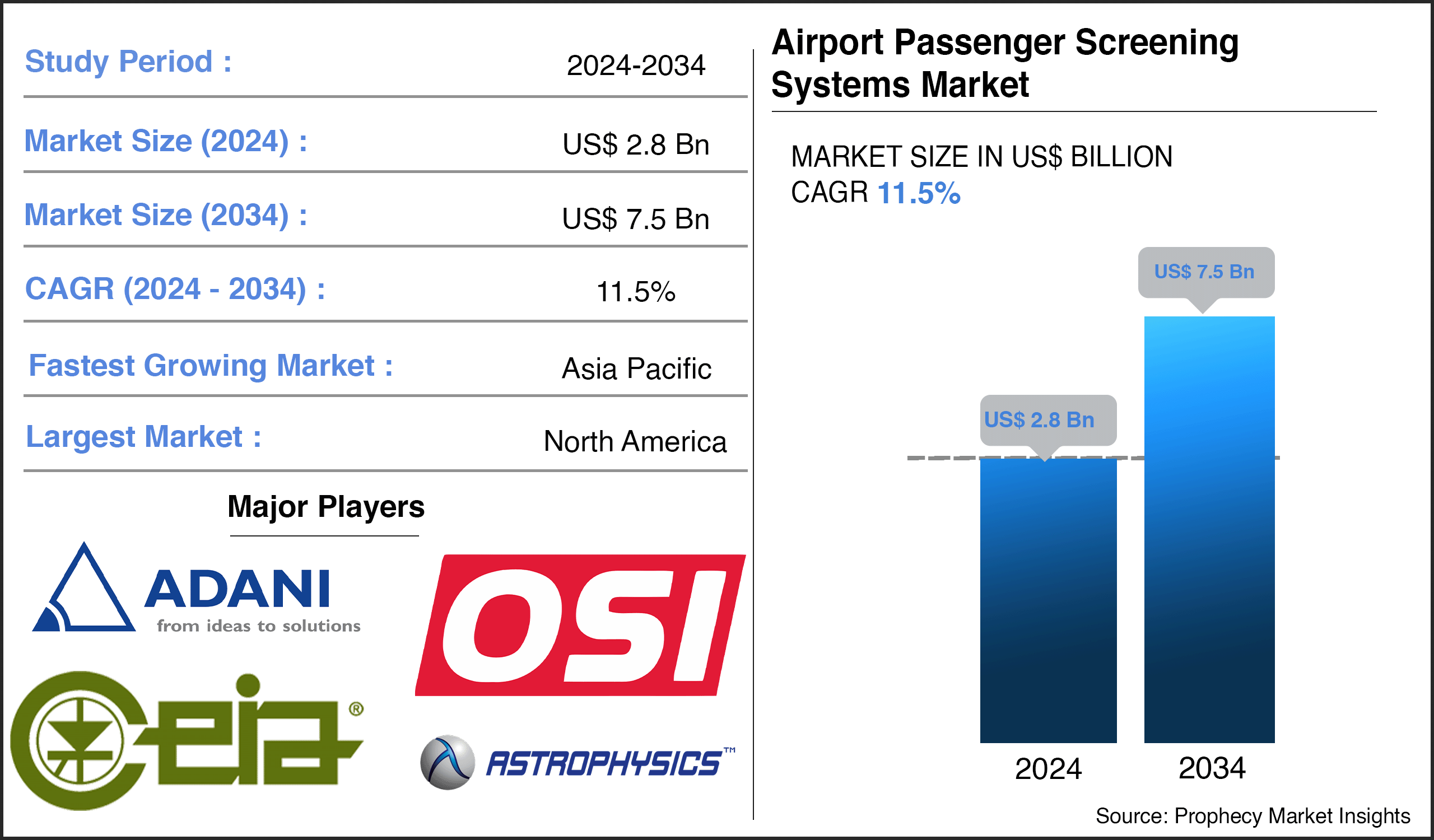
Airport Passenger Screening Systems Market Size was valued at US$ 2.8 billion in 2024 and is projected to grow at a CAGR of 11.5%to reach US$ 7.5 billion by 2034.
Airport passenger security screening, in which travellers are screened by metal detectors and/or millimetre wave scanners. X-ray machines and explosives trace-detection portal machines (sometimes known as "puffer machines") are two types of explosive detection equipment that are employed. It stops items and supplies from being brought into airplanes that might be used to carry out illegal interference. The walk-through metal detectors, x-ray screening equipment, and specialized software make up the security screening system. CT scanners provide airport security personnel with the ability to examine luggage from all sides. Operators are aided in making prompt and precise judgments by automated explosives detection algorithms and automated object identification software, which can identify forbidden objects like guns.
Airport passenger screening systems are an essential part of aviation security, designed to detect prohibited items and potential threats while facilitating the smooth flow of passengers through airports. These systems typically involve a combination of various technologies and procedures.
Explosive Trace Detection (ETD) equipment is used to swab and analyse surfaces for traces of explosive materials. These devices can detect even minute amounts of explosives, providing an additional layer of security. Specially trained officers observe passengers' behaviour and body language for any indicators of potential risk or suspicious activities.
Global Airport Passenger Screening Systems Drivers & Restraints
Airport Passenger Screening Systems Market Drivers:
Rising Investment in Advanced Technologies for a Smoother Journey
- Airports are increasingly investing in sophisticated screening systems like millimetre wave scanners and AI-powered threat detection software. This intends to streamline the procedure, cut down on passenger wait times, and improve the overall travel experience in addition to enhancing security.
Terrorism and Illegal Immigration Drive Security Upgrades
- Governments and airport authorities are forced to prioritize security due to the constant threat of illegal immigration and terrorism. Increased funding for sophisticated screening systems that can successfully identify a broader spectrum of dangers will result from this.
Restrains in the Airport Passenger Screening Systems Market:
Health and Privacy Concerns with High-Frequency Scanners
- Certain screening technologies create health concerns because they may expose users to low levels of radiation, such as full-body scanners that use millimetre waves or X-rays. Passengers may be concerned about their privacy because these scanners may also provide detailed body photos.
Key Opportunities in Airport Passenger Screening Systems Market:
Non-intrusive and privacy-focused technologies:
- There is an increasing need for efficient screening methods that don't jeopardize the safety or privacy of passengers. This creates opportunities for technologies such as low-power advanced millimetre wave scanners and body scanners that use alternative technologies like millimetre wave imaging that doesn't provide detailed body outlines or backscatter X-rays, which release less radiation.
Integration of Artificial Intelligence (AI):
- AI can transform passenger screening by more effectively identifying possible threats by analysing data from multiple sources (cameras, sensors, and passenger information). In order to free up security staff time to concentrate on high-risk passengers and accelerate screening for low-risk tourists, AI-powered systems have the ability to identify suspicious behaviour or anomalies.
Biometric Identification Systems:
- By streamlining passenger identification and enhancing security, biometric technology such as facial recognition and iris scanners can be used. These tools assist in identifying people on watchlists and can swiftly confirm the identification of a passenger.
Enhanced Threat Detection for changing risks
- Screening systems must be able to identify a greater variety of forbidden objects as security risks grow more complex. This includes developments in radiological detection systems that can identify a wider range of radioactive materials and explosive trace detection for new types of explosives and contraband.
Global Airport Passenger Screening Systems Segmentations & Regional Insights
Airport Passenger Screening Systems Market is segmented based on based on by Technology, Application, Application, Product and Region.
Technology Insight
- Metal Detectors - Metal detectors use magnetic fields to help identify metal objects. Magnetic fields are produced by the flow of current through wires or electrical devices. Metal detectors create a magnetic field by using a brief pulse of electrical current. The magnetic field will be reflected back to the machine if there are any metal objects present, such as a watch or a belt buckle.
- Full Body Scanners – A full-body scanner is an apparatus that, without the need for clothing removal or physical touch, identifies things on or inside a person's body for security screening reasons. Full-body scanners, in contrast to metal detectors, are able to identify non-metal things, which is a growing worry in the wake of multiple airliner bombing attempts in the 2000s. A person's bodily cavities may contain objects that some scanners are able to find if they have been ingested.
- Millimetre wave machines - A millimetre wave scanner is a whole-body imaging device used for detecting objects concealed underneath a person’s clothing using a form of electromagnetic radiation. Typical uses for this technology include detection of items for commercial loss prevention, smuggling, and screening for weapons at government buildings and airport security checkpoints.
- Cabinet X-ray systems– Cabinet x-ray systems are common at security sites worldwide, from critical infrastructure sites like government buildings and courthouses to airports and aviation sites, as well as ports and border crossings. These systems can be deployed for screening baggage, air cargo, vehicles and much more. Cabinet x-ray systems make it possible to inspect items quickly without damaging the contents inside.
- Advanced Imaging Technology - Advanced imaging technology safely screens passengers without physical contact for both metallic and non-metallic threats, including weapons and explosives, which may be concealed under a passenger’s clothing.
Application Insights
- Civil - Civil airport passenger screening programs are an essential component of contemporary aviation security. These devices are used to check luggage and passengers for contraband such as explosives and weapons.
- Military - Military passenger screening is stricter than civilian, with a focus on a wider range of threats and advanced technologies. It often incorporates intelligence and canine screening and exists within a multi-layered security environment. Military airports also screen cargo and handle unique considerations for military personnel and deployments.
Product Insights
- Passenger Screening– Uses metal detectors to detect metal on a person's body and body scanners: which use X-rays or millimetre waves to see through clothing.
- Carry-on Baggage Screening- Using X-rays to create an image of the bag's contents, allowing security personnel to identify prohibited items.
Airport Passenger Screening Systems Market Regional Insights:
On region the Airport Passenger Screening Systems Market is segmented into North America, Europe, Asia Pacific, Latin America, and Middle East & Africa.
- North America: This region currently dominates the market due to stringent security regulations and high investments in advanced screening technologies by the US and Canada.
- Asia Pacific: This region is experiencing the fastest growth due to a booming aviation industry and increasing passenger traffic in China, India, and other developing economies. Government investments in airport infrastructure also contribute to market growth.
- Europe: Stringent regulations and a focus on technological advancements make Europe a significant market. However, privacy concerns can sometimes hinder the adoption of certain screening technologies.
- Latin America: This region has a growing market driven by increased air travel and investments in airport security. However, political instability and limited budgets in some African countries can pose challenges.
- Middle East & Africa: This region is a growing interest from both regional and international investors in ESG factors, driving companies to adopt ESG reporting tools to enhance transparency and attract investment.
Airport Passenger Screening Systems Market Report Scope:
|
Attribute |
Details |
|
Market Size 2024 |
US$ 2.8 Billion |
|
Projected Market Size 2034 |
US$ 7.5 Billion |
|
CAGR Growth Rate |
11.5% |
|
Base year for estimation |
2023 |
|
Forecast period |
2024-2034 |
|
Market representation |
Revenue in USD Billion & CAGR from 2024 to 2034 |
|
Market Segmentation |
By Technology - Metal Detectors, Full Body Scanners, Millimetre wave machines, Cabinet X-ray systems, and Advanced Imaging Technology By Application - Civil, and Military By Product- Passenger Screening and Carry-On Baggage Screening |
|
Regional scope |
North America - U.S., Canada Europe - UK, Germany, Spain, France, Italy, Russia, Rest of Europe Asia Pacific - Japan, India, China, South Korea, Australia, Rest of Asia-Pacific Latin America - Brazil, Mexico, Argentina, Rest of Latin America Middle East & Africa - South Africa, Saudi Arabia, UAE, Rest of Middle East & Africa |
|
Report coverage |
Revenue forecast, company share, competitive landscape, growth factors, and trends |
Segments Covered in the Report:
This report forecasts revenue growth at global, regional, and country levels and provides an analysis of the latest industry trends and opportunities in each of the sub-segments from 2024 to 2034. For the purpose of this study, has segmented the Airport Passenger Screening Systems Market report based on By Technology, By Application, By Product and Region:
Airport Passenger Screening Systems Market, By Technology:
- Metal Detectors
- Full Body Scanners
- Millimetre wave machines
- Cabinet X-ray systems
- Advanced Imaging Technology
Airport Passenger Screening Systems Market, By Application:
- Civil
- Military
Airport Passenger Screening Systems Market, By Product:
- Passenger Screening
- Carry-On Baggage Screening
Airport Passenger Screening Systems Market, By Region:
Global Airport Passenger Screening Systems Competitive Landscape & Key Players
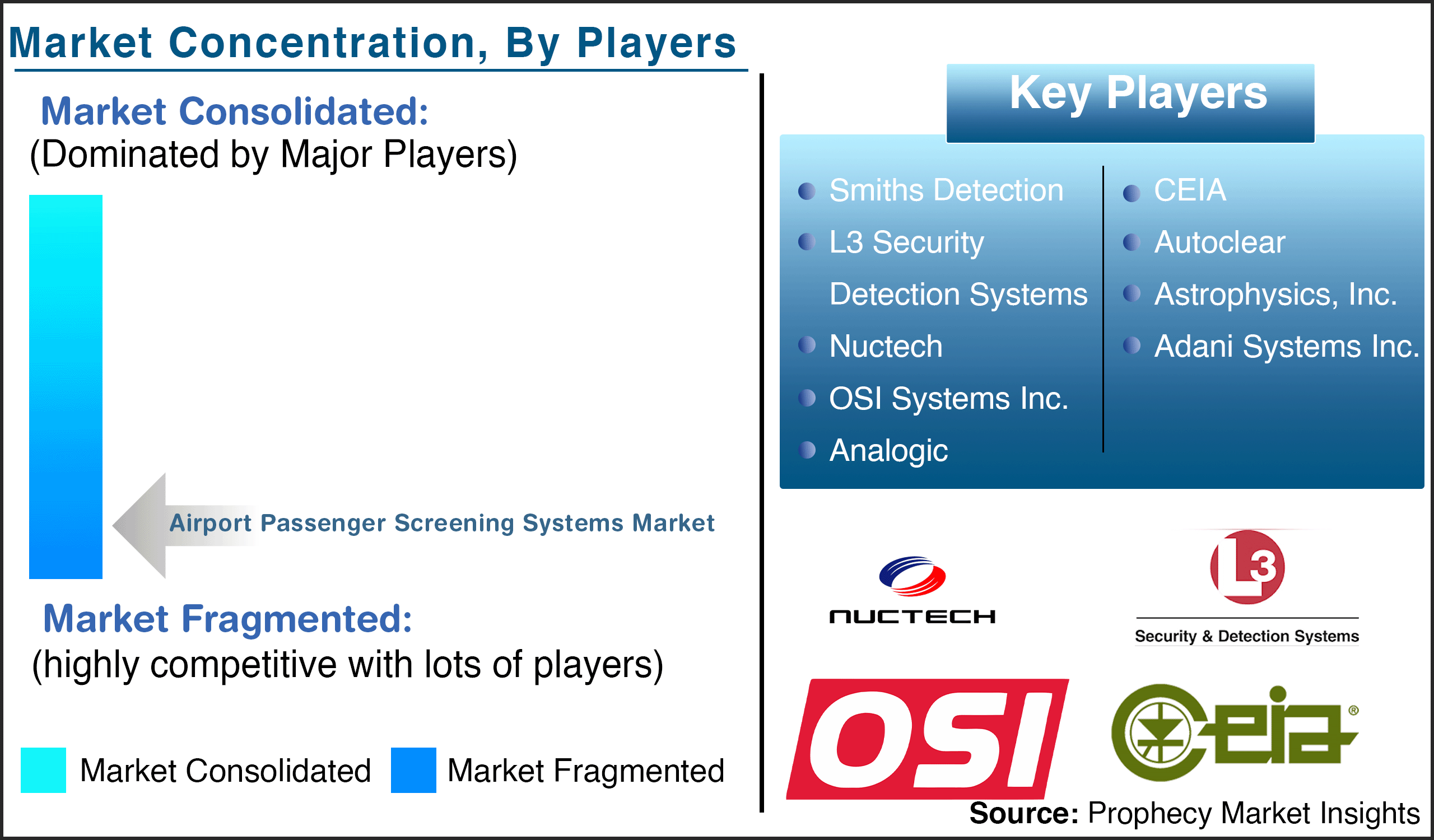
The key players operating the Airport Passenger Screening Systems Market include Smiths Detection, L3 Security Detection Systems, Nuctech, OSI Systems, Inc., Analogic, CEIA, Autoclear, Astrophysics, Inc., and Adani Systems Inc.
Global Airport Passenger Screening Systems Recent News
- In September 2023, Smiths Detection launched advanced scan machines in India after BCAS mandate, with this passengers will no longer have to place electronic devices, chargers and liquids among other items, into separate trays outside of their carry-on baggage, something that has to be done with the currently deployed 2-D X-ray scanning system at airports in India leading to wild scramble for trays.
- In October 2023, Leidos launched software platform to centralize airport security systems. ProSight’s open-architecture software is designed for improved performance, maintainability and scalability, as well as reduced development time and cost. The software’s OpenAPI supports additional system connectivity to multiple device types and data sources.
Global Airport Passenger Screening Systems Company Profile
- Smiths Detection
- Company Overview
- Product Portfolio
- Key Highlights
- Financial Overview
- Business Strategy Overview
- L3 Security Detection Systems
- Nuctech, OSI Systems, Inc.
- Analogic
- CEIA
- Autoclear
- Astrophysics, Inc.
- Adani Systems Inc.
Global Airport Passenger Screening Systems Highlights
FAQs
Airport Passenger Screening Systems Market report segments the market basis on type and region.
Because of the advancement of computer screening in airports, the market for airport passenger screening systems is expected to have a strong foothold in its expansion.
Asia Pacific is fastest growth due to a booming aviation industry.
The leading players operating in the Airport Passenger Screening Systems Market includes OSI Systems Inc., OSI Systems Inc., Analogic Corporation, C.E.I.A. SpA, Agilent Technologies, Garrett Electronics Inc., Nuctech Systems Ltd, Kromek, Technologies Inc., Vanderlande Industries BV, and Leidos.