Global Aircraft Leasing Market Overview
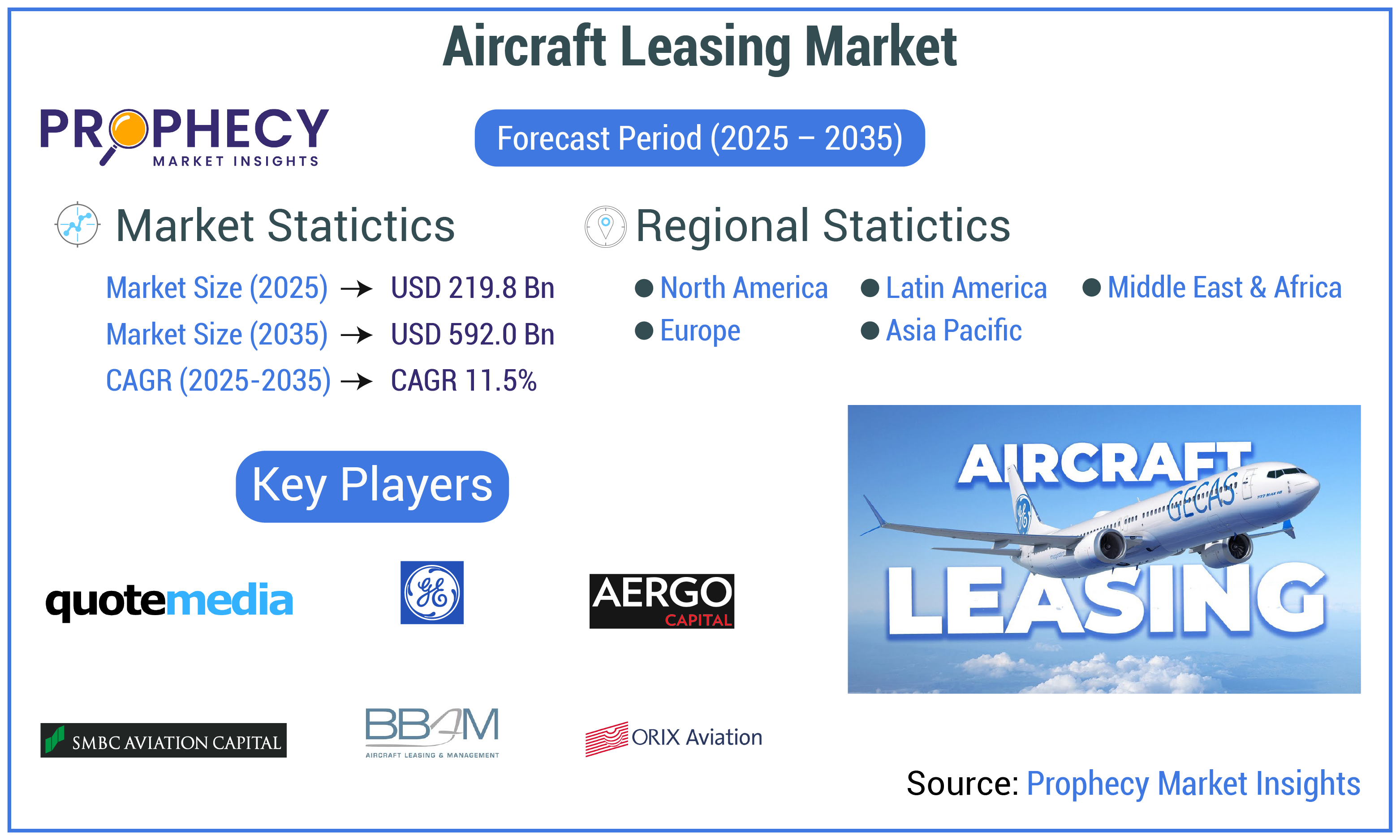
- Aircraft leasing market size is expected to expand at a rate of USD 592.0 Billion, by 2035.
- In 2024, the market valuation was USD 200.7 Billion.
- Aircraft leasing market is growing at a CAGR 11.5%.
Aircraft leasing is a business arrangement in which airlines or operators rent aircraft from leasing companies instead of purchasing them outright. Leasing allows airlines to maintain fleet flexibility, manage cash flow efficiently, and respond to changing market demands without committing to the full investment of ownership. There are two main types of aircraft leasing, wet lease and dry lease. In wet lease, the lessor providers the aircraft with crew, maintenance, and insurance, while in dry lease, aircraft is only provided by the lessor.
Rising global air travel passenger, high cost of aircraft ownership, and fleet modernization, to meet fuel efficiency goals, is anticipated to drive aircraft leasing market growth. Leasing reduces debt on airlines’ balance sheets and provides more flexibility during economic downturns, growing low-cost carriers, and globalization of leasing companies, is expected to pitch aircraft leasing market growth.
Expansion in emerging markets, e-commerce growth, and global logistics increases need for air cargo capacity, can significantly create opportunities for aircraft leasing market growth. Growing demand for eco-friendly aircraft, technology integration for better manage fleets, optimize maintenance, and growing interest from investors, is estimated to propel aircraft leasing market growth.
Recession Risk & Triff Analysis for the Aircraft Leasing Market:
- A global or regional recession poses significant risks to the aircraft leasing market. During economic downturns, air travel demand declines as consumers and businesses reduce spending on travel expenses. This can lead reduce airline capacity, defer fleet expansion, or return leased aircraft early.
- The market is expected to grow steadily, driven by fleet modernization, low-cost carriers, and increasing passenger demand, especially in Asia-Pacific and Africa. Leasing offers stable returns, risks like rising interest rates and recession impact profitability.
Impact of Generative AI on Aircraft Leasing Market:
- Leasing companies can use AI models to simulate aircraft performance based on usage history, environment, and maintenance logs. This helps in proactively scheduling maintenance, extending asset life, and reducing downtime, leading to better aircraft availability and higher lease income.
- AI-generated simulations can also support residual value forecasting, which helps lessors to make smart investment decision by predicating aircraft’s value in market trends and operational data. AI algorithms help to process large volumes of data, generate insights, and support predictive analysis, which is crucial in a capital-intensive and risk-sensitive aircraft leasing market.
Global Aircraft Leasing Market Drivers & Restraints
Key Drivers:
Rising Global Air Passenger Traffic is Donating to Market Amplification
The expansion of middle-class populations in emerging economies, particularly in Asia-Pacific, the Middle East, and Africa, the demand for air travel rises. Airlines have pressure to rapidly scale up their fleets to meet this increasing demand, but buying aircraft requires massive capital, which many airlines cannot afford or prefer to avoid buying up. To address this, airlines are turning to aircraft leasing as a cost-effective and flexible solution to expand their fleets quickly. Leasing allows airlines to operate new, fuel-efficient aircraft without the burden of long-term ownership costs or debt. This is especially critical for low-cost carriers (LCCs) and new airline. Airlines can lease aircraft short-term during peak seasons and return them when demand drops. This flexibility is crucial for optimizing fleet size and maintaining profitability in a dynamic air travel environment. Thus, as the global air passenger traffic increases, is anticipated to drive the aircraft leasing market growth.
- For instance, according to data published in June 2024, the Asia Pacific total passenger number is anticipated to increase 10.4% in 2024. Over the next 20 years, passengers’ number is expected to increase by 3.8% per year on average, resulting in over 4 billion additional passenger journeys in 2043 compared to 2023. European and North American markets will see a rise in demand, 2.3% and 2.7% per year respectively. Asia Pacific is anticipated to record the fastest rise in passenger numbers and to contribute to more than half of the net increase in global passenger numbers by 2043.
Restraints:
Market Growth Delayed by High Capital Requirements for Lessors
Leasing companies must invest heavily upfront to purchase extremely expensive aircraft before generating revenue through lease agreements. This creates a high barrier to entry and limits market participation to well-capitalized firms, and also increases the financial risk during periods of market downturn or airline defaults.
- Counterbalance Statements: Leasing companies often access institutional funding through bonds, asset-backed securities (ABS), private equity, and bank loans, which reduces risk and individual financial exposure. The long-term nature of leasing contracts also provides revenue stability, making it attractive for investors seeking reliable returns in a capital-intensive industry.
Opportunities & Trends:
Low-Cost Carrier (LCC) Expansion in Emerging Market Fuels Market Expansion
The rapid expansion of low-cost carriers (LCCs), especially in emerging markets such as Southeast Asia, Latin America, and Africa, presents a significant opportunity for the aircraft leasing market. As disposable incomes rise and middle-class populations grow in these regions, the demand for affordable air travel is surging. LCCs are capitalizing on this trend by launching new routes, increasing flight frequencies, and entering previously underserved markets.
Aircraft leasing offers them fleet flexibility, the ability to access modern, fuel-efficient aircraft, and reduced upfront costs, making it the preferred option for LCCs for rapid market penetration. As LCCs continue to expand in developing regions, leasing companies have a huge opportunity to grow their portfolios and tap into high-growth markets with strong future demand. Thus, as the low-cost carrier boost in emerging economics, it creates new opportunities through long term partnerships, and deeper market penetration resulting to fuels aircraft leasing market growth.
- For instance, according to article published by Skift, in January 2025, this article states that, low-cost carrier (LCC) model is creating new travel market, by venturing into long-haul flights and expanding their fleets to include wide-body aircraft. LCC have strong presence in Europe and Asia, by holding second-largest aviation market share up to 42% in Europe. Latin America holds 39%, Southwest Pacific holds 37%, Asia and North America holds 31% of global market share. In Asia, LCCs had nearly 10% of year-on-year capacity growth, while in Europe it had 9% of growth. In Africa, their capacity increased by nearly 27% in 2024 compared to 2023.
Global Aircraft Leasing Market Segmentations & Regional Insights
The aircraft leasing market is categorized into, aircraft type, lease type, security type, and region.
By Aircraft Type:
By aircraft type, target market is divided into narrow-body, wide-body, regional jet, and others. Narrow-body hold the significant aircraft leasing market share. Their high utilization rates and shorter turnaround times require frequent maintenance, driving substantial demand for MRO services, expansion of narrow-body fleets, especially in emerging markets, is predicated to drive segment’s growth in aircraft leasing market.
Wide-body aircraft represent the second-largest segment in the market. These twin-aisle aircraft are used for long-haul international routes, which are leased by full-service and flag carriers. This are more expensive to lease and operate, wide-bodies are essential for high-capacity, long-range travel, contribution to segment’s growth in aircraft leasing market size.
By Lease Type:
On the basis of lease type, the market is segmented into wet lease, dry lease, and damp lease. The dry lease is the most widely used lease type in the market. Dry leases are long-term and are most popular in established airlines with their own infrastructure. Their widespread use for fleet expansion, modernization, and cost-effective operations, is propelling growth of segment in aircraft leasing market share.
Wet lease is second dominating segment in the market. It is commonly used for seasonal demand spikes, route testing, operational emergencies, or when an airline lacks the regulatory approval to operate in certain regions. Wet leases are crucial for quick capacity deployment and are popular in charter operators and start-up airlines, resulting to boost segment’s development in aircraft leasing market size.
By Security Type:
asset-backed security (ABS), non- asset-backed security (non- ABS), are divided by end-user in the market. The market is dominated by, non-ABS segment. It is more flexible, faster to execute, and not bound by the structuring complexity of securitized products. Most large and established lessors prefer this model due to greater control and scalability, and it allows more straightforward aircraft remarketing or repositioning during lease transitions or defaults, is anticipated to drive segment growth in aircraft leasing market share.
The ABS segment is growing and represents the second-largest aircraft leasing market share. In this model, aircraft leases are rushed into a portfolio and sold as securities to investors. ABS provides lessors and investors with liquidity and risk diversification, and it's particularly attractive for smaller lessors or investment funds looking for predictable cash flows, is projected to impel segment’s extension in aircraft leasing market size.
Regional Insights:
Geographically, the market is studied across North America, Europe, Asia Pacific, Latin America, and the Middle East & Africa.
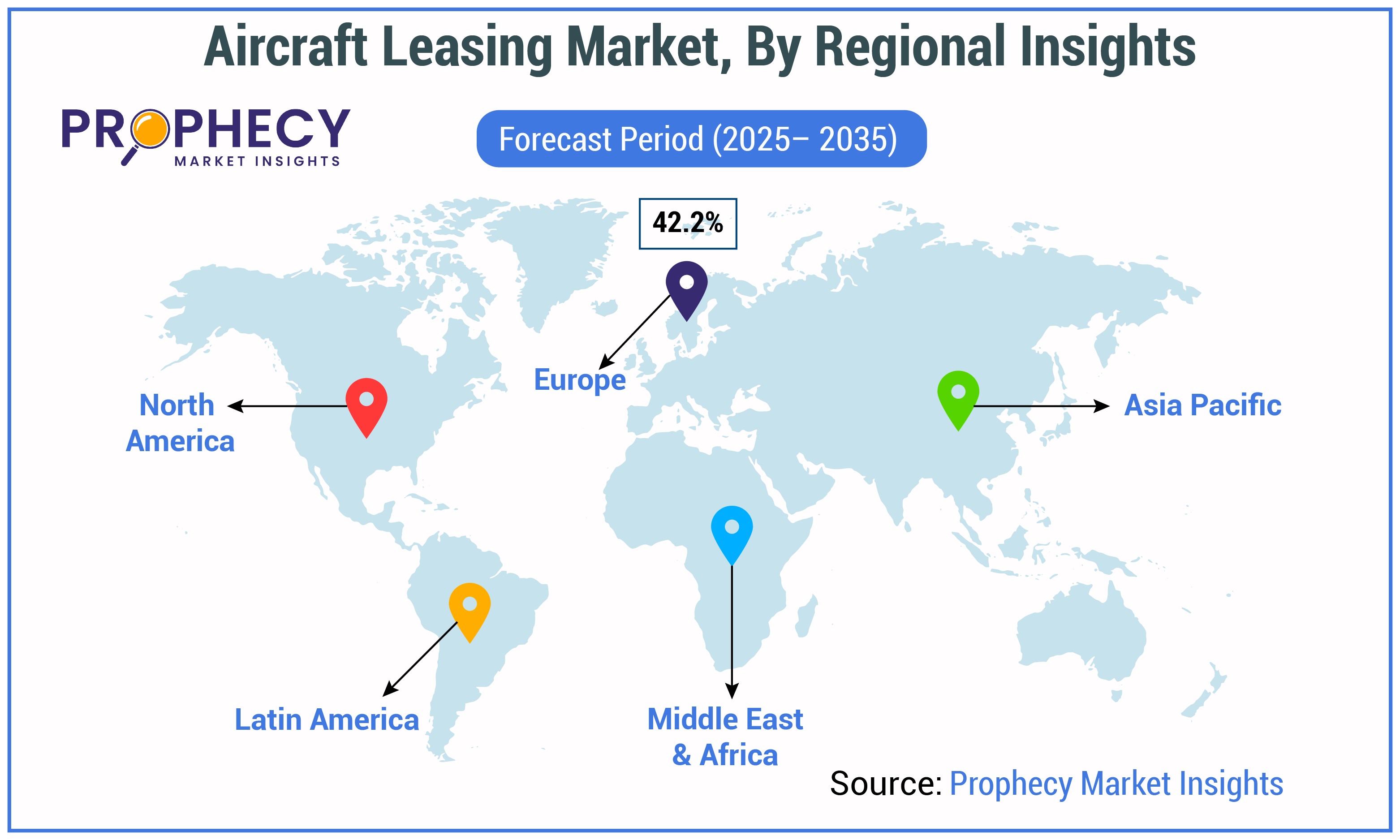
Europe: This region holds the largest aircraft leasing market share with 42.2% share. This region contains low corporate tax rate and favorable tax treaties with countries worldwide, making it a prime location for aircraft leasing companies. It has highly developed legal framework for aviation, presence of leading aircraft leasing companies, and contains developed deep pool of expertise, is expected to fuel region growth in aircraft leasing market size.
- Ireland Aircraft Leasing Market Insights:
Ireland is the leader in the global aircraft leasing market, due to large scale of leased aircraft and the concentration of lessors based. The half of global leased aircraft are managed by companies headquartered in Ireland. The country’s dominance is driven by its favorable tax policies, robust legal framework, and highly skilled aviation finance professionals.
Asia Pacific: This region is the second-largest and fastest-growing market for aircraft leasing. The rapid growth of air travel, expanding middle class, and the rise of low-cost carriers in countries, which rises demand for leased aircraft. Airlines in this region prefer leasing to support fast fleet expansion without large upfront investments is estimated to propel aircraft leasing market growth.
- China Aircraft Leasing Market Insights:
China is the dominant country in Asia for aircraft leasing, driven by the rapid expansion of its aviation market and the increasing demand for leased aircraft. The government has heavily invested in infrastructure and airlines, making largest air travel market in the global by. The country’s growing middle class and the increasing popularity of air travel have resulted in a massive demand for aircraft, is projected to drive aircraft leasing market growth.
North America: This region holds a significant position in the global market. North America contains strong airline presence, it lays a major role in aircraft-backed securitization (ABS) deals, these airlines focusing on long-term leases and sale-and-leaseback transactions to maintain financial flexibility without taking on heavy responsibility, is assessed to boost region growth in target market.
- U.S. Aircraft Leasing Market Insights:
U.S. is dominant country in North America region for market. Aircraft leasing market in the U.S. is driven by cost optimization strategies, fleet flexibility, and financial structuring that provides airlines with a steady cash flow without the need for heavy upfront capital expenditures.
Aircraft Leasing Market Report Scope:
|
Attribute |
Details |
|
Market Size 2025 |
USD 219.8 Billion |
|
Projected Market Size 2035 |
USD 592.0 Billion |
|
CAGR Growth Rate |
11.5% (2025-2035) |
|
Base year for estimation |
2024 |
|
Forecast period |
2025 – 2035 |
|
Market representation |
Revenue in USD Billion & CAGR from 2025 to 2035 |
|
Regional scope |
North America - U.S. and Canada Europe – Germany, U.K., France, Russia, Italy, Spain, Netherlands, and Rest of Europe Asia Pacific – China, India, Japan, Australia, Indonesia, Malaysia, South Korea, and Rest of Asia-Pacific Latin America - Brazil, Mexico, Argentina, and Rest of Latin America Middle East & Africa – GCC, Israel, South Africa, and Rest of Middle East & Africa |
|
Report coverage |
Revenue forecast, company share, competitive landscape, growth factors, and trends |
Segmentation:
By Aircraft Type:
- Narrow-body
- Wide-body
- Regional Jet
By Lease Type:
- Wet Lease
- Dry Lease
- Damp Lease
By Security Type:
- Asset-Backed Security (ABS)
- Non- Asset-Backed Security (Non- ABS)
By Region:
- North America
- U.S.
- Canada
- Europe
- Germany
- U.K.
- France
- Russia
- Italy
- Spain
- Netherlands
- Rest of Europe
- Asia Pacific
- China
- India
- Japan
- Australia
- Indonesia
- Malaysia
- South Korea
- Rest of Asia Pacific
- Latin America
- Brazil
- Mexico
- Argentina
- Rest of Latin America
- Middle East & Africa
- GCC
- Israel
- South Africa
- Rest of Middle East & Africa
Global Aircraft Leasing Market Competitive Landscape & Key Players
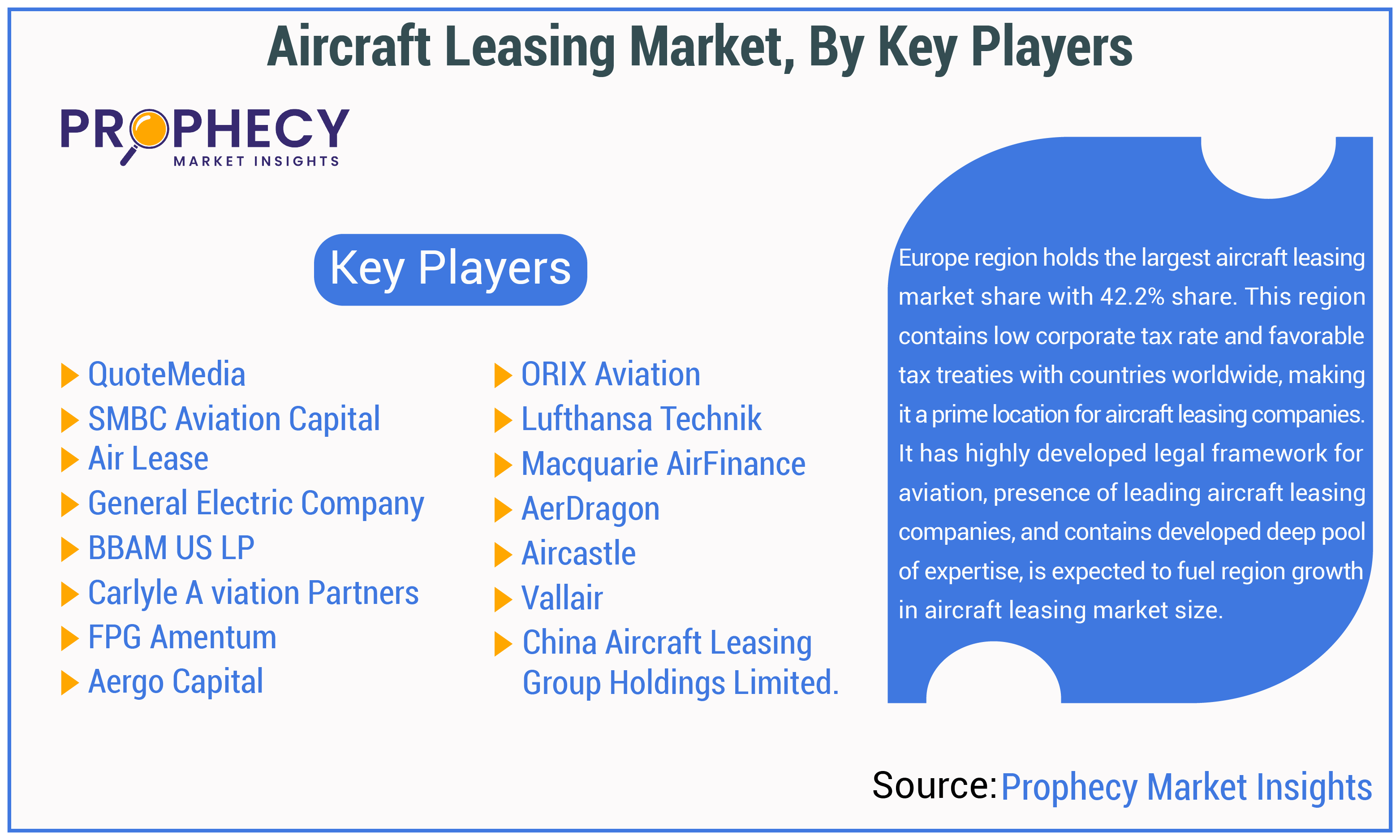
QuoteMedia, SMBC Aviation Capital, Air Lease, and others are the significant players functioning in the aircraft leasing market. This companies are constantly innovating and developing new services to enhance efficiency and effectiveness of maintenance operations through their strategic partnership and collaboration. The key players are focusing secured new aircraft orders, through their acquisition, is awaited to growth of aircraft leasing market size.
Aircraft Leasing Market Companies:
- QuoteMedia
- SMBC Aviation Capital
- Air Lease
- General Electric Company
- BBAM US LP
- Carlyle A viation Partners
- FPG Amentum
- Aergo Capital
- ORIX Aviation
- Lufthansa Technik
- China Aircraft Leasing Group Holdings Limited.
- Macquarie AirFinance
- AerDragon
- Aircastle
- Vallair
View an Additional List of Companies in the Aircraft Leasing Market
Global Aircraft Leasing Market Recent News
- In April 2025, Saudi Public Investment Fund Unit Aircraft Leasing Company (AviLease) had confirmed a USD 1.5 billion credit facility to fund aircraft purchases and business expansion. The company completed the acquisition of Standard Chartered’s aircraft leasing business for USD 3.6 billion, adding 167 fuel-efficient aircraft leased to 46 airlines globally.
- In December 2022, SMBC Aviation Captital, global leading aircraft leasing companies announced completion of acquisition of Goshawk Management Ltd and associated corporate assets, the Dublin-based global aircraft lessor. This acquisition created global second largest player in aircraft and the largest Japanese-owned aircraft lessor. This acquisition was focused on new technology narrowbody aircraft and an industry leading funding advantage to capitalize opportunities in leasing sector.
- In April 2022, Boeing and Air Lease Corp., announced partnership to aircraft lessor expand its airplane portfolio with order for 32 additional 737-8 and 737-9 jets. Aircraft Lease Corp, was aimed to increase its 737 MAX family to meet airline demand for modern, fuel-efficient and sustainable operations. This family aimed enable airlines to optimize their fleets across a broad range of missions by reducing fuel use and carbon emissions by at least 20% compared to the airplanes was replaced.
Analyst View:
The Aircraft Leasing market is experiencing strong growth and is expected to continue evolving, as growth in aviation sector fuels the demand for aircraft leasing services. Advancement in services, development of high-performance predicative maintenance with enhanced properties, and technological advancement in additive manufacturing, is anticipated to drive market growth. The growing military & space exploration, and aging global fleet to enhance product quality, is expected to boost aircraft leasing market share.
More Related Reports
Aircraft Engines Market
Commercial Aircraft Video Surveillance Systems Market
Ultralight Aircraft Market
Aircraft Fairings Market
Hydrogen Aircraft Market
Global Aircraft Leasing Market Company Profile
|
Company Name |
Vallair |
|
Headquarter |
Mauguio, France |
|
CEO |
Grégoire Lebigot |
|
Employee Count |
201 and 500 employees |
Global Aircraft Leasing Market Highlights
FAQs
Aircraft leasing market size was valued at USD 219.8 Billion in 2025 and is expected to reach USD 592.0 Billion by 2035 growing at a CAGR of 11.5%.
Aircraft type, lease type, security type, and region are the segmentation for the target market.
North America, Asia Pacific, Europe, Latin America, and the Middle East & Africa. Europe is expected to dominate the market.
The key players operating in the aircraft leasing market include QuoteMedia, SMBC Aviation Capital, Air Lease, General Electric Company, BBAM US LP, Carlyle A viation Partners, FPG Amentum, Aergo Capital, ORIX Aviation, Lufthansa Technik, China Aircraft Leasing Group Holdings Limited, Macquarie AirFinance, AerDragon, Aircastle, and Vallair.