Global Aircraft Actuator Market By Overview
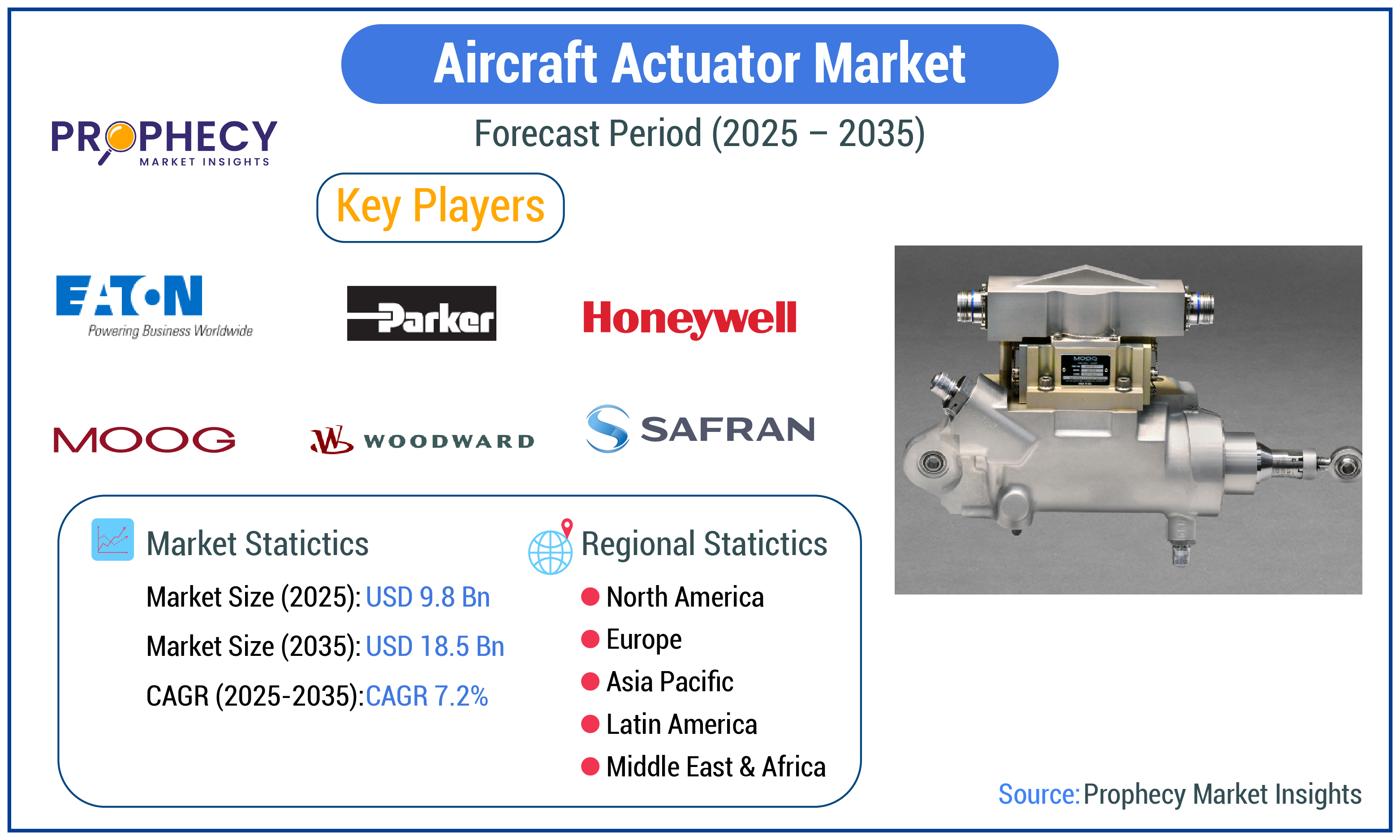
- Aircraft actuator market size is expected to expand at a rate of USD 18.5 Billion, by 2035.
- In 2024, the market valuation was USD 9.3 Billion.
- Aircraft actuator market is growing at a CAGR 7.2%.
In the context of aircraft, an actuator is a device that converts energy (such as electricity, hydraulic pressure, or pneumatic pressure) into mechanical movement, allowing for precise control of flight surfaces and other critical systems. These are essential for moving parts such as ailerons, elevators, rudders, flaps, slats, spoilers, landing gear, and thrust reversers. These systems offer advantages, such as, high precision, reliability, and adaptability. It enables functions such as flight control surface adjustment, landing gear deployment, and engine control, contributing to safe and efficient flight.
The aircraft actuator market is experiencing growth due to several key factors, such as the increasing global demand for air travel, particularly in emerging economies, is fueling the need for larger and more efficient aircraft fleets, rapidly rising urbanization, demand for comfortable and efficient passenger experiences is driving the adoption of advanced seating solutions with actuators for recline, leg rest adjustment, and other features, and rising air passenger traffic.
The market’s expansion is also stimulated by the shift towards electric aircraft (MEA) concepts, fly-by-wire technology, and autonomous systems requires sophisticated actuation systems. These advancements are pushing the demand for high-performance, lightweight, and reliable actuators. Moreover, aircraft manufacturers are increasingly focused on creating high-performance aircraft with lower weight profiles, which influences the design and selection of actuators.
Recession Risk and Tariff Analysis:
- Geopolitical tensions, supply chain interruptions, and possible declines in commercial aviation provide a moderate recession risk to the aircraft actuator market. Nonetheless, fleet modernization, electrification trends, and expansion in emerging countries such as China and India continue to fuel significant long-term demand. Resilience is further enhanced by defense spending and aftermarket services.
- The influence of import taxes and trade laws on component costs and supply chains is examined using tariff analysis on the aircraft actuator market. Higher tariffs can increase production expenses and limit global market access, while lower tariffs encourage competition and innovation, ultimately influencing pricing strategies, market growth, and international trade dynamics.
Impact of Generative AI on Aircraft Actuator Market:
- By streamlining design procedures, improving predictive maintenance, and spurring innovation, generative AI is revolutionizing the market for aviation actuators. AI-powered simulations save down on development time and expenses by producing actuators that are more robust, lightweight, and efficient. AI-powered predictive analytics increases dependability by foreseeing issues before it happens.
- AI also facilitates quick prototyping and customization, which helps producers satisfy changing consumer needs. All things considered, generative AI is increasing competitiveness, product quality, and operational efficiency in the quickly developing aircraft industry.
Global Aircraft Actuator Market By Drivers & Restraints
Key Drivers:
Rising Urbanization is Stimulating the Market Augmentation
Growing urbanization increases demand for air travel, especially in emerging nations, which propels the expansion of the aircraft actuator market. Greater expenditures in commercial aviation and cutting-edge aircraft technology result from the need for improved transportation networks in growing cities. High-performance actuators are becoming more and more necessary as airlines look for more dependable and efficient aircraft to handle increasing passenger numbers. The necessity for creative actuator systems suited to urban transportation requirements is also being increased by the emergence of urban air mobility alternatives such as drones and air taxis.
- For instance, according to the data published by World Bank Group, in order to fulfill the World Bank's purpose of eradicating poverty and promoting shared prosperity on a habitable world, more livable cities must be built. Currently, 4.4 billion people, or more than half of the world's population, reside in urban areas. This trend is predicted to continue, with nearly seven out of ten people living in cities by 2050, when the urban population is predicted to more than quadruple.
Restraints:
The Complexity of Integration of Aircraft Actuators is Limiting the Market Expansion
The difficulty of integrating with sophisticated aviation systems is a significant drawback of the airplane actuator business. Actuators are necessary for modern aircraft to communicate with ever-more-advanced flight control, avionics, and monitoring systems. Failure to integrate can result in certification issues, manufacturing delays, and safety compromises. Furthermore, strict testing and validation are necessary to meet the high accuracy and reliability requirements, which might impede innovation cycles and reduce the flexibility required to swiftly adjust to changing technical standards and needs.
- Counterbalance Statements: Manufacturers should use modular actuator designs and established communication protocols to handle integration complexity. Purchasing collaborative engineering platforms can improve system interoperability. By ensuring easier integration, quicker validation procedures, and enhanced safety, early engagement of actuator specialists during aircraft design phases supports more flexible development and certification schedules.
Opportunities & Trends:
Introduction of Electric Aviation is Opening Up Growth Opportunities for the Future Generations
The aircraft actuator market is expected to develop as a result of the advent of electric aviation, which will raise demand for actuators that are lightweight, energy-efficient, and extremely dependable. For electric aircraft to reduce weight and increase overall efficiency, sophisticated electromechanical actuators must be used in place of conventional hydraulic systems. The requirement for actuators that work with electric propulsion systems is growing as the aviation sector transitions to greener technology. The development of more intelligent, integrated actuator solutions that improve performance, safety, and sustainability in next-generation electric aircraft is facilitated by this trend, which stimulates innovation.
- For instance, according to the review article published by Elsevier, With the aviation industry's explosive growth and the correspondingly large increase in aviation-related emissions, electric aviation has emerged as a key study topic. The implementation of this new sustainable air transportation regime is hampered by a number of technological and regulatory issues, despite the electric aircraft's encouraging ability to reduce emissions. Commercial air transport cannot be made profitable without significant improvements in enabling technology, new certification requirements, and infrastructure development. Thus, with the help of electric aviation the aircraft actuator market also experiences significant growth.
Global Aircraft Actuator Market By Segmentations & Regional Insights
The aircraft actuator market is segmented into type, installation, platform, actuation function, application, distribution channel, and region.
By Type:
Dependent upon type, the market is divided into mechanical actuators, pneumatic actuators, hydraulic actuators, and electric actuators. The hydraulic actuators segment is expected to lead the aircraft actuator market share. This is due its well-established technology in aircraft, particularly for applications requiring high force and power, such as landing gear and flight control systems.
The electric actuators is the second leading type in the target market. This is due to the increasing adoption of electric actuators in various applications, including those previously dominated by hydraulics and pneumatics.
By Installation:
Based on installation the market is catalogued into power generation & distribution system, flight control system, fuel management system, landing gear & braking system, passenger comfort, and others. The flight control system segment is governing the aircraft actuator market growth. This is due to the critical role of actuators in controlling the aircraft's movement and stability, with flight controls being a primary function. The increasing adoption of fly-by-wire systems, which rely heavily on actuators, further solidifies this segment's dominance.
The power generation & distribution system has the fastest growing segment, in the target market. This is due to the increasing demand for more electric aircraft (MEA).
By Platform:
Stemming from platform, the market is bifurcated into fixed-wing, and rotary-wing. The fixed-wing segment is holding the upper hand in the aircraft actuator market share. This is due to the larger number and wider range of fixed-wing aircraft in operation compared to rotary-wing aircraft. Fixed-wing aircraft, including commercial airliners, business jets, and military transport aircraft, constitute a larger portion of the global aircraft fleet and thus drive greater demand for actuators.
The rotary wing segment is the second dominating platform, in the target market. This is due to its unique capabilities and increasing demand in both military and commercial sectors. Its ability to perform vertical takeoff and landing (VTOL), hover, and operate in confined spaces makes them essential for various missions, driving the need for specialized actuators.
By Actuation Function:
According to actuation function, the market is categorized into linear actuators, rotary actuators, servo actuators, and control valves. The linear actuators segment is the dominating actuation function in the aircraft actuator market size. This is due to its superior precision and controllability compared to rotary actuators, making it ideal for critical flight control and landing gear systems. The increasing adoption of electric linear actuators, offering enhanced reliability and efficiency, further strengthens its market position.
The rotary actuators segment is holding the second dominating actuation function, in the target market. This is due to its efficiency in applications such as gates and valves, and its compatibility with automated control systems.
By Application:
Appertaining from application, the market is divided into flight control, landing gear, primary and secondary flight control, auxiliary power unit, utility systems, and others. The flight control segment is the leading application, in the aircraft actuator market share. This is due to the critical role actuators play in controlling the aircraft's movement, including primary flight controls such as ailerons, elevators, and rudder, and secondary controls such as flaps and slats. The reliability and precision of these actuators directly impact flight performance and safety, making it essential for all types of aircraft.
The landing gear segment is the second leading application, in the target market. This is due to its critical role in ensuring safe takeoff, landing, and taxiing operations, and its complex design and the need for high reliability.
By Distribution Channel:
On the foundation of distribution channel, the market is classified into OEM, aftermarket, and others. The original equipment manufacturer (OEM) segment is the ruling distribution channel in the aircraft actuator market share. This is due to the continuous demand for new aircraft, especially in developing economies such as China and India, which are expanding its aviation industries. This surge in aircraft deliveries directly translates to a high demand for actuators, which are essential components for various aircraft systems.
The aftermarket distribution channel is experiencing steady growth, in the target market. This is due to a few key factors, including the need for spare parts for routine maintenance and repair, and upgrades and modifications to existing aircraft.
Regional Insights:
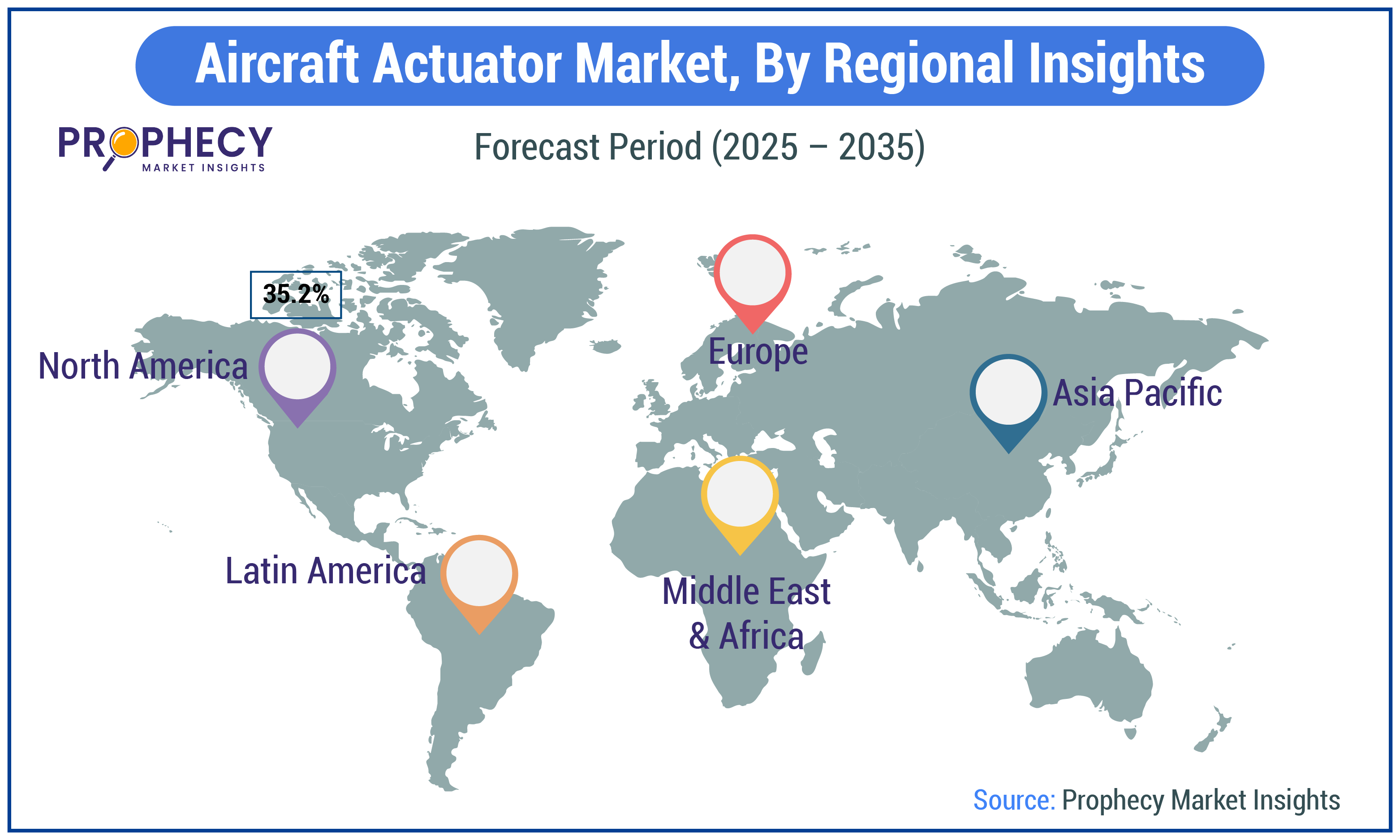
Geographically, the market is studied across North America, Europe, Asia Pacific, Latin America, and the Middle East & Africa.
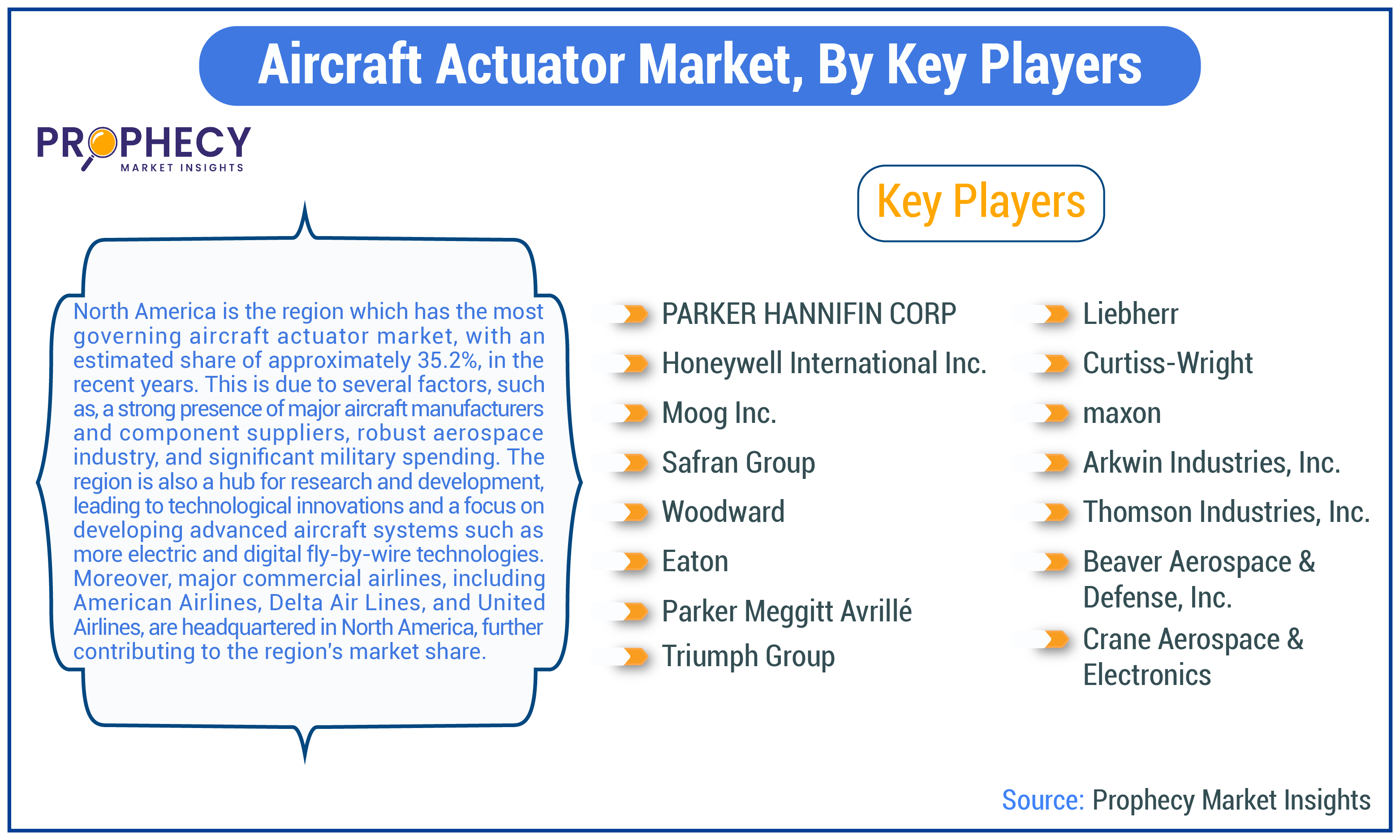
North America: This is the region which has the most governing aircraft actuator market, with an estimated share of approximately 35.2%, in the recent years. This is due to several factors, such as, a strong presence of major aircraft manufacturers and component suppliers, robust aerospace industry, and significant military spending. The region is also a hub for research and development, leading to technological innovations and a focus on developing advanced aircraft systems such as more electric and digital fly-by-wire technologies. Moreover, major commercial airlines, including American Airlines, Delta Air Lines, and United Airlines, are headquartered in North America, further contributing to the region's market share.
- U.S. Aircraft Actuator Market Insights:
The aircraft actuator market in the U.S. has the largest market, in the recent years. This is due to numerous factors, such as, this country’s vast and active commercial aviation industry, with numerous airlines operating a large number of flights daily, a large and technologically advanced aircraft fleet, requiring a wide range of actuators for flight control, propulsion, and other operational systems, presence of major aerospace manufacturers, including Honeywell, Collins Aerospace, and Moog, heavy investment by the U.S. government, advanced manufacturing capabilities, and ongoing fleet modernization.
Europe: This is the region which has the aircraft actuator market, growing with the fastest growth rate, during the forecast period, in the recent years. This is due to a combination of factors, including a well-established aviation industry, increasing demand for upgrades and modernization of actuator technologies for improved reliability and efficiency, and a significant number of Tier 1 and Tier 2 players in the region. Moreover, Europe is home to several major aircraft actuator manufacturers, and the development of more electric aircraft in Europe is also driving the demand for lighter and more efficient actuator systems.
- Germany Aircraft Actuator Market Insights:
The aircraft actuator market in Germany is growing with the highest CAGR, during the forecast period, in the recent years. This is due to Germany's strong aerospace manufacturing base, advanced technological capabilities, and the presence of major aircraft component manufacturers. The country's focus on developing innovative actuator solutions and strong support for aerospace industry development also contribute to its market dominance.
Asia Pacific: The region which is experiencing considerate amount of growth, in the recent years, is Asia Pacific. This is due to a combination of factors including rapidly increasing air travel, growing aircraft deliveries in emerging economies, and the presence of major aviation industry players and government initiatives. These factors are driving demand for both commercial and Rotary-Wing, which in turn increases the need for actuators. Moreover, increased military spending and modernization efforts in some countries in the Asia-Pacific region are also driving demand for actuators in Rotary-Wing and defense-related applications.
- China Aircraft Actuator Market Insights:
The aircraft actuator market in China is experiencing significant amount of growth, in the recent years. This is due to China’s aviation market is experiencing substantial growth, leading to increased demand for aircraft actuators, the rising number of aircraft deliveries, the development of the aviation industry actively promoted by the Chinese government, and China is prioritizing automation and digitalization in various sectors, including aviation, which is creating demand for advanced actuator systems.
Aircraft Actuator Market Report Scope:
|
Attribute |
Details |
|
Market Size 2025 |
USD 9.8 Billion |
|
Projected Market Size 2035 |
USD 18.5 Billion |
|
CAGR Growth Rate |
7.2% (2025-2035) |
|
Base year for estimation |
2024 |
|
Forecast period |
2025 – 2035 |
|
Market representation |
Revenue in USD Billion & CAGR from 2025 to 2035 |
|
Regional scope |
North America - U.S. and Canada Europe – Germany, U.K., France, Russia, Italy, Spain, Netherlands, and Rest of Europe Asia Pacific – China, India, Japan, Australia, Indonesia, Malaysia, South Korea, and Rest of Asia-Pacific Latin America - Brazil, Mexico, Argentina, and Rest of Latin America Middle East & Africa – GCC, Israel, South Africa, and Rest of Middle East & Africa |
|
Report coverage |
Revenue forecast, company share, competitive landscape, growth factors, and trends |
Segmentation:
By Type:
- Mechanical Actuators
- Pneumatic Actuators
- Hydraulic Actuators
- Electric Actuators
By Installation:
- Power Generation & Distribution System
- Flight Control System
- Fuel Management System
- Landing Gear & Braking System
- Passenger Comfort
- Others
By Platform:
- Fixed-Wing
- Commercial Aircraft
- Business Aircraft
- Military Aircraft
- General Aviation Aircraft
- Rotary-Wing
- Military Helicopter
- Commercial Helicopter
By Actuator Function:
- Linear Actuators
- Rotary Actuators
- Servo Actuators
- Control Valves
By Application:
- Flight Control
- Landing Gear
- Primary and Secondary Flight Control
- Auxiliary Power Unit
- Utility Systems
- Others
By Distribution Channel:
- OEM
- Aftermarket
- Others
By Region:
- North America
- U.S.
- Canada
- Europe
- Germany
- U.K.
- France
- Russia
- Italy
- Spain
- Netherlands
- Rest of Europe
- Asia Pacific
- China
- India
- Japan
- Australia
- Indonesia
- Malaysia
- South Korea
- Rest of Asia Pacific
- Latin America
- Brazil
- Mexico
- Argentina
- Rest of Latin America
- Middle East & Africa
- GCC
- Israel
- South Africa
- Rest of Middle East & Africa
Global Aircraft Actuator Market By Competitive Landscape & Key Players
The key players operating in the market include, PARKER HANNIFIN CORP, Honeywell International Inc., Moog Inc., and others. These key players are leveraging strategies such as product innovation, strategic partnerships, and expansion into emerging markets to drive growth. Specifically, these companies are focused on developing more electric aircraft (MEA) solutions, expanding its global presence, and adopting digital technologies such as IoT to enhance its products and services, for driving aircraft actuator market growth.
Aircraft Actuator Market Companies:
- PARKER HANNIFIN CORP
- Honeywell International Inc.
- Moog Inc.
- Safran Group
- Woodward
- Eaton
- Parker Meggitt Avrillé
- Triumph Group
- Liebherr
- Curtiss-Wright
- maxon
- Crane Aerospace & Electronics
- Beaver Aerospace & Defense, Inc.
- Arkwin Industries, Inc.
- Thomson Industries, Inc.
View an Additional List of Companies in the Aircraft Actuator Market
Global Aircraft Actuator Market By Recent News
- In January 2025, a USD 5.9 million contract for flight control assemblies or actuators for the US Air Force F-5/T-38 aircraft was awarded to Air Industries Group, a top producer of precision parts and assemblies for major aerospace and defense prime contractors. An established Air Force aircraft platform is the F-5/T-38. It has been a long time since Air Industries produced anything for this aircraft.
- In December 2024, Woodward, a world leader in industrial and aerospace energy control systems, declared that it has finalized a deal to buy the US, Canadian, and Mexican electromechanical actuation company Safran Electronics & Defense. Intellectual property, operating assets, personnel, and long-term customer agreements for Horizontal Stabilizer Trim Actuation (HSTA) systems—which are primarily utilized for the Airbus A350—were acquired. These systems stabilize aircraft to promote safe and effective flying.
- In December 2024, Actuator control units (ACUs) for JetZero's next-generation blended wing body aircraft demonstration, which was intended to provide increased energy efficiency and lower emissions, will be supplied and integrated by BAE Systems. ACUs from BAE Systems, which the firm will also supply for the demonstration, interpret flight control signals as part of the flight control system, including pilot directions from active control sticks. Within a dispersed flight control system, the sophisticated ACUs operate as remote actuators. With dependable, accurate coordination and reactivity, the units' localized flight surface management capabilities improve flight control.
- In July 2023, For JetZero's next-generation blended wing body aircraft demonstration, which was intended to provide increased energy efficiency and lower emissions, BAE Systems would provide and integrate actuator control units (ACUs). BAE Systems will also supply the demonstration with its ACUs, which are used as part of the flight control system to analyze flight control inputs, including pilot orders from active control sticks. The sophisticated ACUs operate as distant actuators in a system of distributed flight control. The localized flight surface management capabilities of the units provide rapid, accurate, and dependable flight control.
- In January 2020, In order to provide agility and safety to a new generation of urban air vehicles that can take off and land vertically, Honeywell created a range of lighter, electromechanical flight controls. These actuators, which were specifically made to endure the vibrations and power demands of urban air mobility vehicles—many of which would require several propellers or fans to stay in the air—used tiny amounts of electricity to move control surfaces on the aircraft.
Analyst View:
The aircraft actuator market is expanding as a result of a number of important factors, including the growing demand for air travel worldwide, especially in emerging economies, which is driving the need for larger and more effective aircraft fleets; the fast acceleration of urbanization; the need for efficient and comfortable passenger experiences; and the increase in air passenger traffic.
The move to electric aircraft (MEA) ideas, fly-by-wire technologies, and autonomous systems that need complex actuation systems are also driving market growth. The need for actuators that are dependable, lightweight, and high-performing is being driven by these developments.Actuator design and selection are also influenced by manufacturers' growing emphasis on producing high-performance aircraft with reduced weight profiles.
More Related Reports
Commercial Aircraft Avionics Market
Commercial Aircraft Video Surveillance Systems Market
Ultralight Aircraft Market
Aircraft Fairings Market
Hydrogen Aircraft Market
Global Aircraft Actuator Market By Company Profile
|
Company Name |
PARKER HANNIFIN CORP |
|
Headquarter |
Cleveland, Ohio, United States |
|
CEO |
Mrs. Jennifer A. Parmentier |
|
Employee Count (2024) |
61,000 Employees |
Global Aircraft Actuator Market By Highlights
FAQs
Aircraft actuator market size was valued at USD 9.8 Billion in 2025 and is expected to reach USD 18.5 Billion by 2035 growing at a CAGR of 7.2%.
Type, installation, platform, actuator function, application, distribution channel, and region are the segmentation for the aircraft actuator market .
North America, Asia Pacific, Europe, Latin America, and the Middle East & Africa. North America is expected to dominate the aircraft actuator market .
The key players operating in the aircraft actuator market include PARKER HANNIFIN CORP, Honeywell International Inc., Moog Inc., Liebherr, Safran Group, Woodward, Eaton, Parker Meggitt Avrillé, Triumph Group, Curtiss-Wright, maxon, Crane Aerospace & Electronics, Beaver Aerospace & Defense, Inc., Arkwin Industries, Inc., and Thomson Industries, Inc.