Global 4D Printing In Healthcare Market Overview
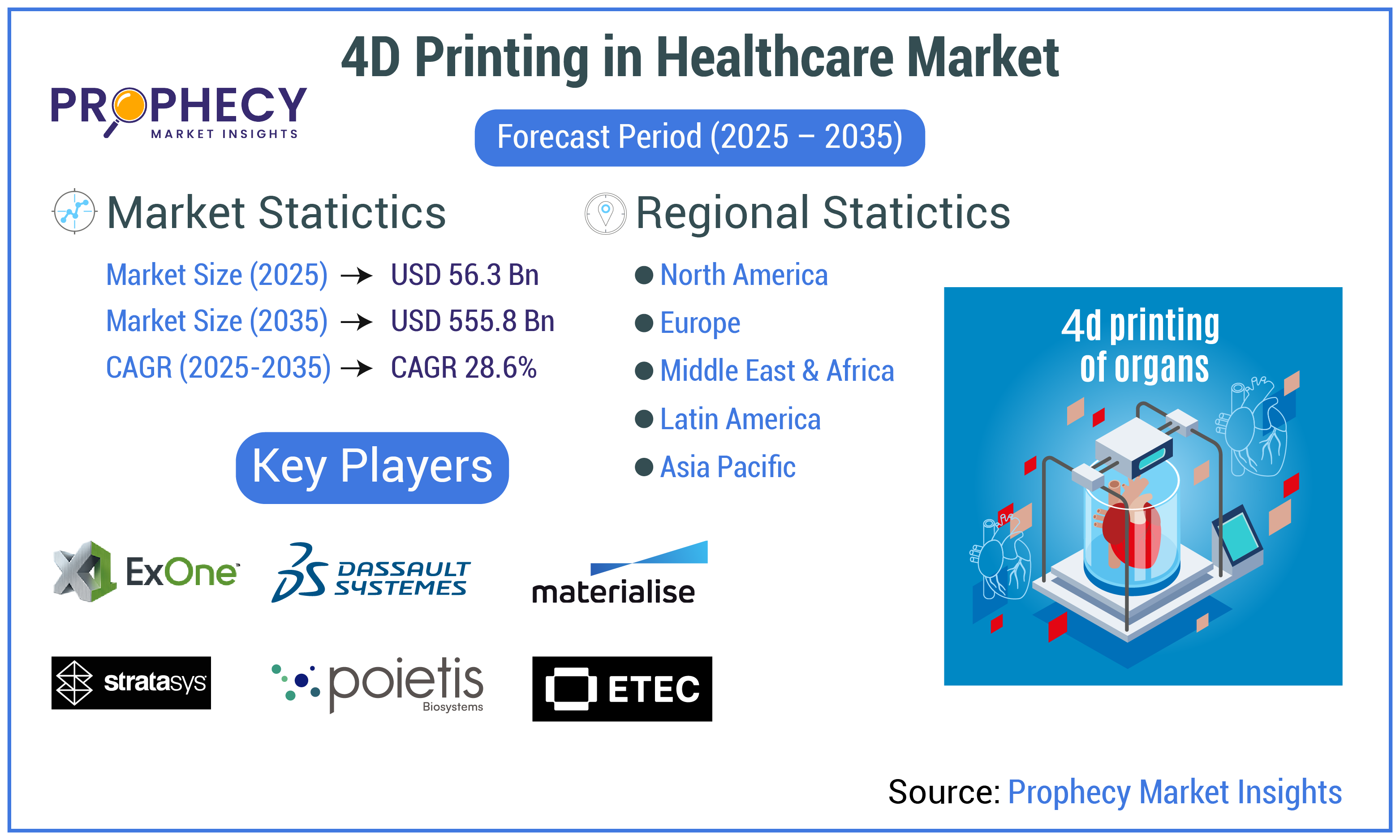
- By 2035, the target market is expected to increase at a rate of USD 555.8 Billion.
- In 2024, 4D printing in healthcare market size accounted for USD 45.6 Billion.
- The market is expanding at a CAGR of 28.6%.
4D printing in healthcare is a technology that uses 3D printers to create objects that can change shape and function over time. This technology is used to create patient-specific medical implants, tools, and devices. 4D printing uses smart materials to change external stimuli, such as temperature, light, and pressure. 4D printing helps to reduce challenges related with 3D printing in regenerative medicine and improve therapeutic outcomes and patient-specific treatment. The growing demand for smart and adaptive materials is expanding 4D printing market by industrial and healthcare applications. The technology used in medical devices, creation of smart implants, and improves=d patient outcomes further boosts the 4D printing in healthcare market growth.
Impact of AI in 4D Printing in Healthcare Market:
Artificial intelligence (AI) has the potential of design and creation of highly personalized, dynamic devices, and implants to adapt changing conditions in the body and give effective treatments. AI algorithms can analyze patient’s data to design customized 4D printed implants and devices according to individual anatomy, which help to minimizing surgery and improves patient’s fitness.
Global 4D Printing In Healthcare Market Drivers & Restraints
Key Drivers of Target Market:
Customized and Personalized Medical Devices is Projected to Drive the Market Growth
4D printing allows to create highly customized and personalized medical devices, implants, and drug delivery systems as per individual patient needs. These 4D printed-implants give unique anatomical structures of each patient, by ensuring an exact fit and reduces risk of complications. The use of materials and adaptive designs allows the implants to adjust according to patient’s body pH and temperature parameters.
- For instance, the article published in Frontiers Media S.A. in September 2023, highlights that 4D printing manufacturing uses a digital model to generate 4D solid product. The usage of biomaterials with 4D printers in the pharma and healthcare industries is increasing. The printed structure alter over time under numerous stimuli and smart polymeric materials are frequently working in tissue engineering applications of 4D printing.
Increasing Usage of 4D Bioprinting in Tissues and Organs Propels Market Expansion
4D bioprinting allows personalized and adaptable organ and tissue construction to match individual’s patient anatomical and physiological needs. 4D printing contains smart materials known as bio-inks, these bio-inks are the biocompatible materials that contain living cells allowing researcher to construct multi-layered structures of human tissues. 4D printing has the unique application in medical field to achieve desired functionalities and performance, resulting to drive target market growth.
- For instance, the article published by Elsevier B.V. in August 2021, highlights that, the progress of additive manufacturing technology in medical science research. The 4D bioprinting technique proceeds after 3D bioprinting for tissue remodeling. The aim of 4D bioprinting to construct fabricate complex products having the ability to transform their properties against response of internal or external stimuli to repair, regrow, and replace diseases and damaged cells, tissue and organs.
Restraints:
Lack of Skilled Professionals and High Cost Development Distract the Target Market Growth
Lack of professionals with specialized knowledge and experience in advanced technologies may restrict the growth of target market. The initial costs for developing 4D printing technologies is high as compared to another 3D printing technologies, and this financial requirement limit the expansion of technologies in the 4D printing market.
- Counterbalance Statements: Increase education and training programs to focus on 4D printing in the medical field. Collaborate research initiatives between universities and healthcare companies to develop new affordable and accessible 4D printing technologies.
Opportunities & Market Trends:
Usage of 4D Printing in Drug Delivery System to Create Significant Market Opportunity
Drug delivery is a growing application of 4D printing in the pharmaceutical industry. The rising research opportunities in 4D printing focused on developing novel materials for drug delivery systems. The implantation of 4D printing in drug delivery allow to develop less invasive and different ways to manage medication and achieve therapeutic objectives.
Global 4D Printing In Healthcare Market Segmentations & Regional Insights
The 4D printing in healthcare market is segmented into product, technology, application, end-user, and region.
Product:
By component, the 4D printing in healthcare is segmented into equipment (3d bio printers and 3d printers), programmable materials (nanomaterials and hydrogels), and software & services. The software & services segment play a dominating role as these machines require updated software and various services for the manufacturing of 4D products. Software & services help to create objects that change shape according to time and are used in many industries to reduce energy consumption and self-healing components.
- For instance, in May 2022, Materialise Company introduced CO-AM, an open software platform to manage the additive manufacturing or 4D printing production process more efficiently. CO-AM gives manufacture cloud-based access to a full range of software tools that allow to plan, manage and optimize every stage of 4D printing or additive manufacturing operations.
Technology:
Fusion deposition modelling (FDM), poly jet, stereo lithography and selective laser sintering (SLS), and others are technologies used in the target market. The fusion deposition modeling (FDM) dominate 4D printing in healthcare market share due to its ability to create objects made from shape-memory polymers (SMPs), which can change shape based on external stimuli, such as heat. FDM used to create soft robotics, medical devices, and wearable electronics drive market growth in upcoming years.
Application:
Based on application, the 4D printing in healthcare market is divided into medical devices, bone grafts, tissue engineering, and patient-specific implants. The patient-specific implants segment holds the largest 4D printing in healthcare market as these implants have the ability of customized design production. Medical implants manufactured from 3D printing technology, specially designed for unique anatomy of individual patient. Implants have property to change shape on the response of external stimuli driving the market expansion in the medical field.
- For instance, in July 2023, Queen’s researchers created new 4D printed implants for efficient breast cancer management. The aim of these new smart implants is to change size according to personalized and individual’s body fit within the breast cavity. Implants have the ability to release chemotherapy drugs to protect patients from the cancer cells in the breast area.
End-User:
By end-user, the target market is divided into hospitals, research institutes, dental laboratories, and others. The dental laboratories dominate 4D printing in healthcare market share. The 4D printed dental implants have unique characteristics to create customized dental implants, aligners, and dentures. Smart implants enhance the function of wires, which could help move the teeth in the desired direction.
Region:
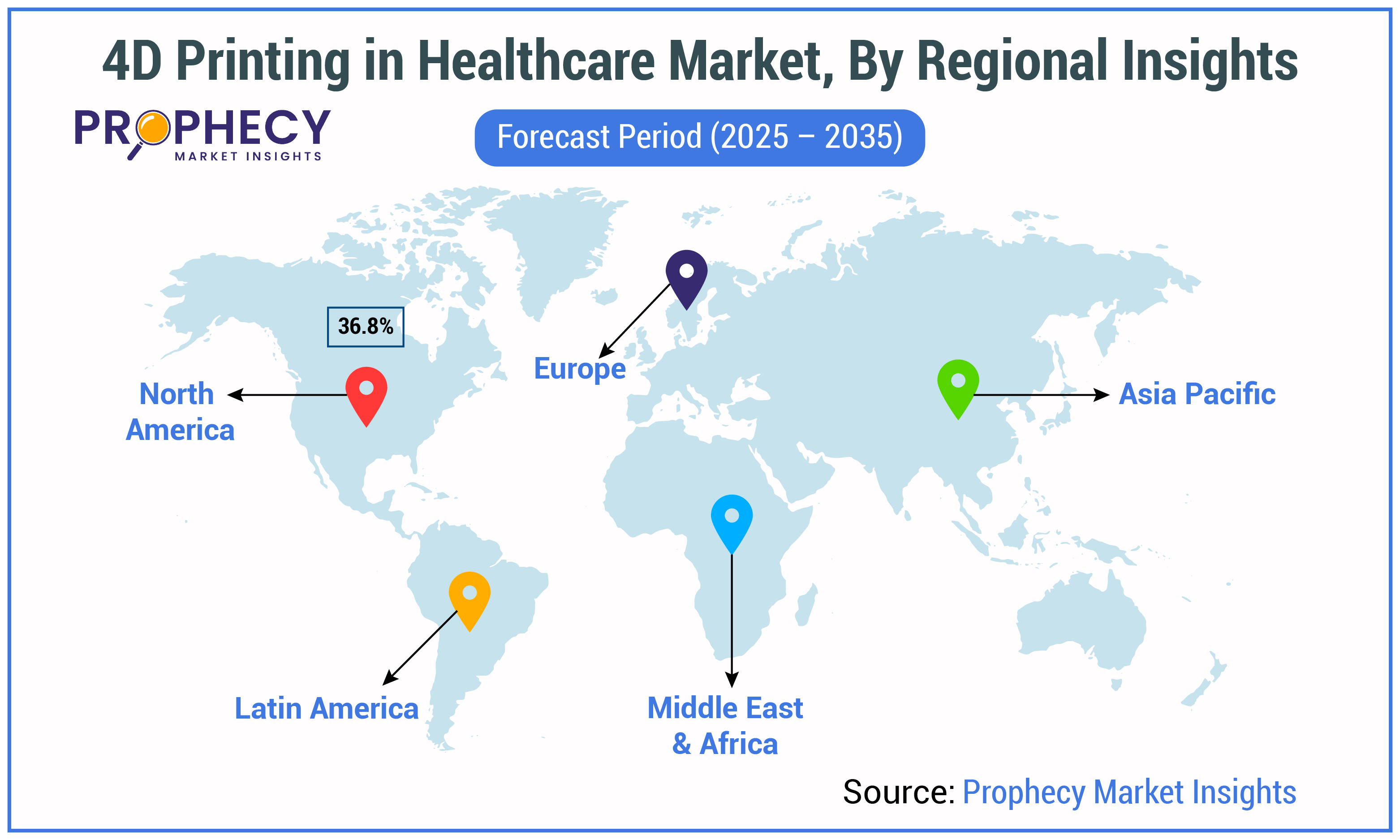
Geographically, the market is studied across North America, Europe, Asia Pacific, Latin America, and the Middle East & Africa.
North America: This is the dominating region for 4D printing in healthcare market. The region’s growth is attributed to the increased research and development into healthcare technology, and increasing investments of companies in healthcare technology. Countries, such as the U.S. and Canada introducing 4D printing technologies for the customized medical application in patient-specific implants.
- For instance, in April 2024, K Line Europe launched ClearX aligners, a 4D-printing technology at AAO Annual Session in New Orleans. This innovation was aimed to the orthodontic space with the help of ClearX aligners and 4D printing technology. This 4D printing offer new technology, with more precision, flexibility, and potentially shorter treatment time as compared to 3D-printing technology.
Asia Pacific: Asia Pacific is expected as the second most dominating region in the target market owing to the rising investments by government and privet companies for the 4D printing technological advancements. The growing biotechnology industry, advancement in healthcare technology and medical devices, helps to drive target market in upcoming years.
4D Printing in Healthcare Market Report Scope:
|
Attribute |
Details |
|
Market Size 2025 |
USD 56.3 Billion |
|
Projected Market Size 2035 |
USD 555.8 Billion |
|
CAGR Growth Rate |
28.6% (2025-2035) |
|
Base year for estimation |
2024 |
|
Forecast period |
2025 – 2035 |
|
Market representation |
Revenue in USD Billion & CAGR from 2025 to 2035 |
|
Regional scope |
North America - U.S. and Canada Europe – Germany, U.K., France, Russia, Italy, Spain, Netherlands, and Rest of Europe Asia Pacific – China, India Japan, Australia Indonesia Malaysia, South Korea, and Rest of Asia-Pacific Latin America - Brazil, Mexico, Argentina, and Rest of Latin America Middle East & Africa – GCC, Israel, South Africa, and Rest of Middle East & Africa |
|
Report coverage |
Revenue forecast, company share, competitive landscape, growth factors, and trends |
Segmentation:
By Component:
- Equipment
- 3D Bio printers
- 3D Printers
- Programmable Materials
- Nanomaterials
- Hydrogels
- Software and Services
By Technology:
- Fusion Deposition Modelling (FDM)
- Poly Jet
- Stereo lithography
- Selective Laser Sintering (SLS)
- Others
By Application:
- Medical Devices
- Bone Grafts
- Tissue Engineering
- Patient-specific implants
By End-User:
- Hospitals
- Research Institutes
- Dental Laboratories
- Others
By Region:
- North America
- U.S.
- Canada
- Europe
- Germany
- U.K.
- France
- Russia
- Italy
- Spain
- Netherlands
- Rest of Europe
- Asia Pacific
- China
- India
- Japan
- Australia
- Indonesia
- Malaysia
- South Korea
- Rest of Asia Pacific
- Latin America
- Brazil
- Mexico
- Argentina
- Rest of Latin America
- Middle East & Africa
- GCC
- Israel
- South Africa
- Rest of Middle East & Africa
Global 4D Printing In Healthcare Market Competitive Landscape & Key Players
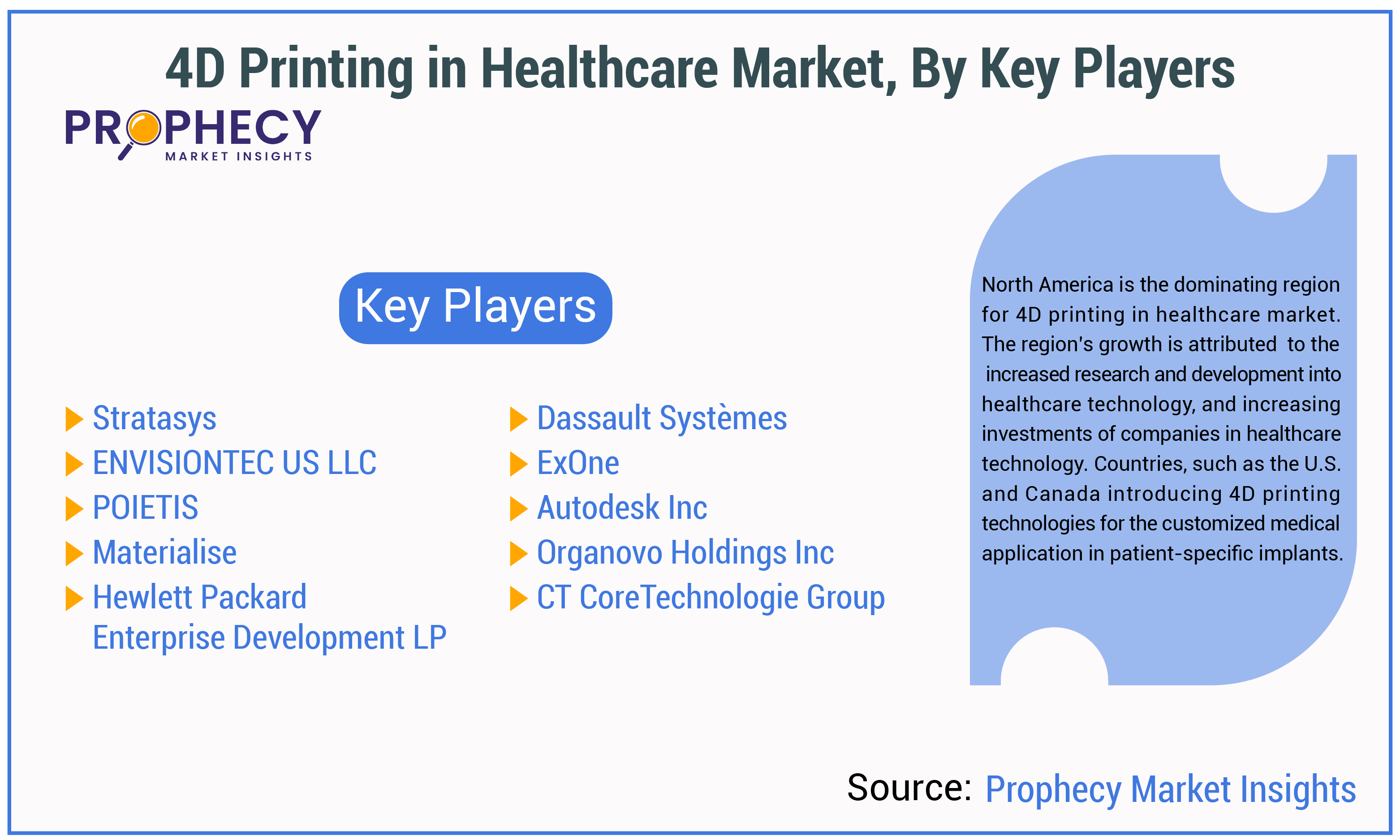
The key players operating in the 4D Printing in Healthcare market include Stratasys, ENVISIONTEC US LLC, POIETIS, and others. Major companies are developing strategies, making collaboration and partnerships with other companies to develop advanced techniques, and introducing more effective 4D printing in healthcare to maintain competitive edge in the market.
List of Key Players in the Market:
- Stratasys
- ENVISIONTEC US LLC
- POIETIS
- Materialise
- Dassault Systèmes
- ExOne
- Hewlett Packard Enterprise Development LP
- Autodesk Inc
- CT CoreTechnologie Group
- Organovo Holdings Inc
Global 4D Printing In Healthcare Market Recent News
- In November 2022, 4D Biomaterials Company launched 4D Design medical device. 4D Design aims to support medical devices’ developers to deliver improved biodegradable medical products using 4D Biomaterials. The 4Degra photo curable polycarbonate urethane polymer material is used, which is an innovative device designed for efficient and effective applications. This device offer product requirements development, design optimization with degradation modeling, prototype performance testing, and manufacturing process.
- According to article published by Technology Networks, in December 2024, the traditional tissue engineering materials adapt to the constantly changing needs of the living body. These shape-shifting materials that became transformative technology in the biomedical field, offers potential to create smart biomaterials that change shape in response to physiological stimuli. These 4D materials are dynamic and can adapt changing need of the living body.
Analyst View:
4D printing in healthcare market is significantly developing new technologies, it contains biomaterials that use to change shape and properties over time in response to external and internal stimuli, such as temperature, pH, and light. 4D printing is used in healthcare field, such as, drug delivery, surgical tools & devices, tissue engineering, and personalized implants driving the market expansion.
More Related Reports
Advanced (3d/4d) Visualization Systems Market
Flexographic Printing Machine Market
3D Printing Market
3D Printing Medical Devices Market
Printing Toners Market
Global 4D Printing In Healthcare Market Company Profile
|
Company Name |
Stratasys |
|
Headquarter |
Eden Prairie, Minnesota, U.S. |
|
CEO |
Yoav Zeif |
|
Employee Count (2024) |
1,981 Employees |
Global 4D Printing In Healthcare Market Highlights
FAQs
4D printing in healthcare market size was valued at USD 56.3 Billion in 2025 and is expected to reach USD 555.8 Billion by 2035 growing at a CAGR of 28.6%.
Component, technology, application, end-user and region are the segmentation for the target market.
North America, Asia Pacific, Europe, Latin America, and the Middle East & Africa. North America is expected to dominate the market.
The key players operating the 4D printing in healthcare market include Stratasys, ENVISIONTEC US LLC, POIETIS, Materialise, Dassault Systèmes, ExOne, Hewlett Packard Enterprise Development LP, Autodesk Inc, CT CoreTechnologie Group, and Organovo Holdings Inc.