Genomics In Cancer Care Market Overview
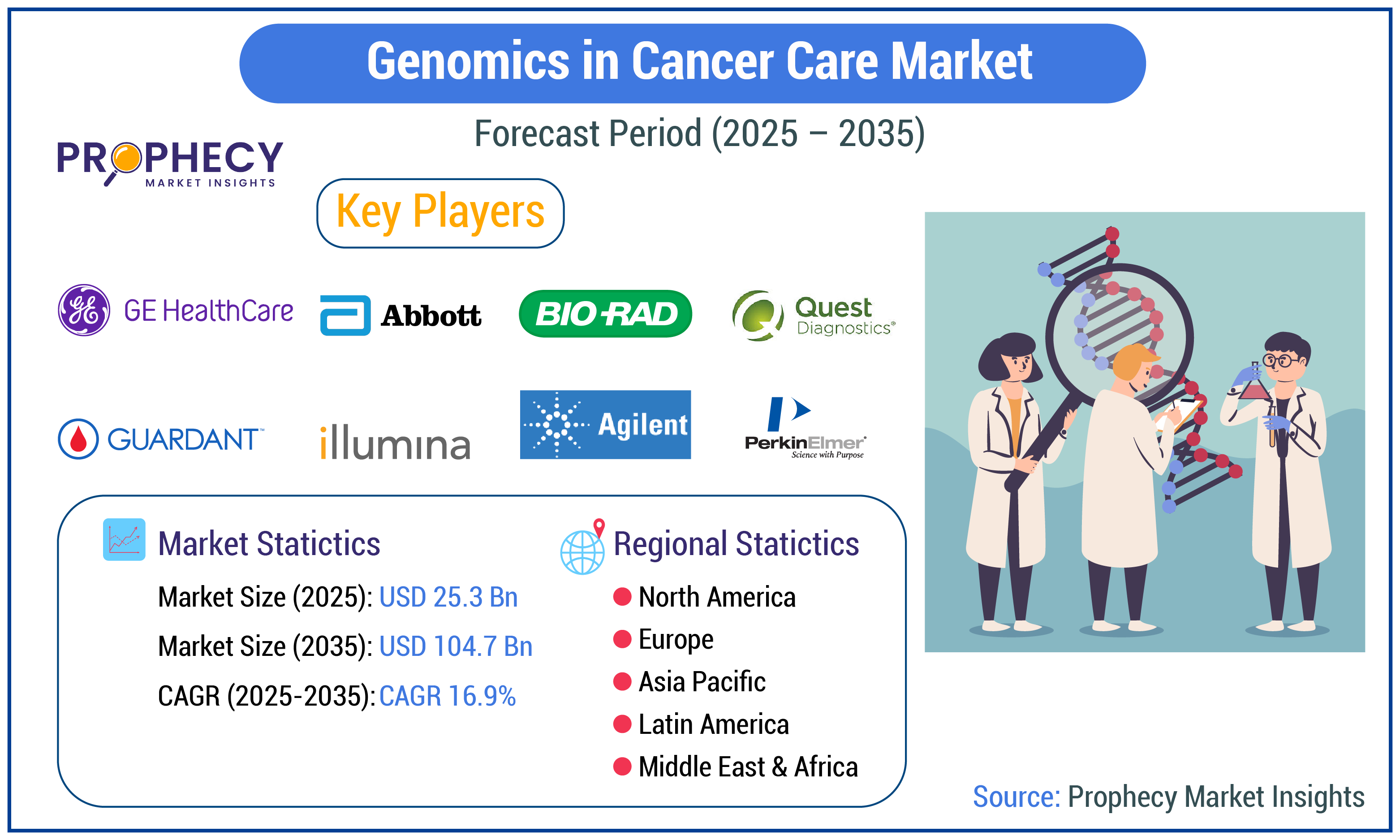
- The genomics in cancer market size is expected to grow at a valuation of USD 104.7 Billion by 2035.
- In 2024, genomics in cancer care market size was worth USD 22.2 Billion.
- The market is growing at a CAGR of 16.9%.
Genomics in cancer care is the study of a cancer patient’s entire genome that is, DNA sequence to identify alteration within their tumor cells. By analyzing a patient’s tumor DNA, researchers can identify specific genetic mutations. Genetic mutation can be analyzed by diagnosis, prognosis, and treatment selection, allowing for more precise and personalized medicine for cancer care. The increasing number of cancer patient and technological advancements in genome sequencing for effective, and targeted treatment, resulting to drive genomics in cancer care market growth.
Impact of AI on Genomics in Cancer Care Market:
Artificial Intelligence (AI) significantly impacting genomics in cancer care market by enabling more accurate personalized diagnoses, and predicting treatment outcomes with greater precision. AI algorithms can analyze large volume of genomic data to identify specific genetic mutation within a patient’s tumor. AI models help to predict cancer recurrence or progression based on a patient’s genetic profile, which can be used by healthcare professionals to make informed treatment decisions.
Genomics In Cancer Care Market Drivers & Restraints
Key Drivers of Target Market:
Rising Incidence of Cancer is Expected to Pitch the Market Growth
Rising prevalence of breast cancer, lung cancer, and other type of cancer lead to technological advancement in genomic testing with advanced diagnostic, treatment, and personalized care solutions. The aging population, changing lifestyle and environmental factors are responsible for the increasing burden of cancer patient. The increasing demand for early detection, more accurate diagnosis and personalized treatment plan, resulting to drive genomics in cancer care market growth.
- For instance, according to data published by World Health Organization (WHO), in 2022, there were an estimated 20 million new cancer cases and 9.7 million deaths. Lung cancer was the most commonly occurring cancer globally with 2.5 million new cases accounting for 12.4% of the total new cases. Female breast cancer ranked second with 2.3 million cases accounting for 11.6% of the total new cases.
Restraints:
High Treatment Costs Distract Target Market Growth
The high cost of advanced genomics in cancer care treatment and therapies lead to major financial burden on both patient and healthcare systems. The increasing incidence of cancer lead to need for advanced technology and sequencing methods, which are expensive for both patients and healthcare systems, resulting to disrupt the genomics in cancer care market growth.
- Counterbalance Statements: Government health programs and private health insurance companies are increasingly covering the high costs of advanced therapies and developing more cost-effective and efficient therapies for genomics in cancer care treatment. As technology advances and sequencing methods become more efficient, the cost of genomic testing continues to decrease.
Opportunities & Market Trends:
Rising Demand for Personalized Medicine Fuels the Market Expansion
Genomic testing allows healthcare providers for personalized treatments based on the genetic profile of the tumor. Genetic testing allows for identifying mutations, and alteration in the DNA. By analyzing a patient’s genetic makeup and the genetics of patient tumor, healthcare specialist predicts individual treatment plan and improve patient outcome.
Technological Advancement and Integration of AI is Expected to Drive Market Growth
Technological advancement and integration of artificial intelligence (AI) have significantly improved detection, diagnosis, and treatment by improving patients’ outcomes. The increasing prevalence of cancer and rising demand for advanced technologies such as next-generation sequencing, help to reduce cost and improve the accuracy of genome analysis. AI algorithms can process and analyze large amounts of genomic data from NGS for identifying mutations, gene expression, and epigenetic changes related to cancer development and progression.
- For instance, in December 2024, Strand partnered with Palisade Bio and other life sciences company applied machine learning algorithms to public datasets by identifying novel biomarkers for ulcerative colitis. After integration of AI in life sciences, AI improves early melanoma detection by distinguishing benign from malignant skin lesions. AI is widely used to reduce the cost and timelines in drug discovery and treatment planning by evaluating therapeutic effects and enabling data-driven precision oncology.
Genomics In Cancer Care Market Segmentations & Regional Insights
The genomics in cancer care market is segmented into product, type, technology, cancer type, sample type, application, end-user, and region.
Product:
By product, the target market is divided into instruments, consumables, and services are divided. The consumables holds the largest genomics in cancer care market share as consumables are the materials used in genomic testing, sequencing, and analysis, such as reagents, kits and test panels. These products are essential for conducting genomic test and used in diagnosis, treatment monitoring and personalized medicine, is anticipated to growth of target market.
Type:
Structural genomics, and functional genomics are the type in which focused market is categorized. Functional genomics dominate in the target market due to its direct impact on diagnosis, treatment planning and development of personalized therapies. Functional genomics offer immediate and accurate genetic information by identifying mutation related to cancer, resulting to drive genomics in cancer care market growth.
Technology:
By technology, the focused market is divided into next-generation sequencing [NGS], comparative genomic hybridization (CGH), fluorescence in situ hybridization, exome sequencing, whole genome sequencing, and others. The next-generation sequencing [NGS] holds the biggest genomics in cancer care market share due to it allows healthcare providers for the sequencing of large scale of genomes, and exomes at faster and cost-effective rate than traditional sequencing technologies. It allows for the detection of rare genetic variation and genetic mutation & alteration, helping to personalize treatments, resulting to drive genomics in cancer care market growth.
- For instance, in July 2024, Thermo Fisher Scientific Inc. partnered with the National Cancer Institute for the myeloMATCH, a clinical trial (Molecular Analysis for Therapy Choice) to accelerate research into new treatments for Acute Myeloid Leukemia and Myelodysplastic Syndrome (MDS). By testing patients’ bone marrow and blood for certain genetic biomarkers using Thermo Fisher’s next-generation sequencing (NGS) technology, clinical sites can more quickly match patients with an appropriate clinical trial that tests a treatment designed to target specific mutations present in the samples.
Cancer Type:
By cancer type, the target market is segmented into, breast cancer, lung cancer, melanoma, others. The lung cancer segment leads the genomics in cancer care market due to increasing prevalence of lung cancer, growing need for non-invasive methods of monitoring tumor progression, treatment response and early detection of lung cancer, resulting to genomics in cancer care market growth.
Sample Type:
Blood, tissue, urine, and saliva is the sample type divided for genomics in cancer care market. Blood segment to grow with the highest CAGR in the target market as it is the primary sample used to detect genetic mutation in cancer cells. Blood testing allows real-time monitoring of cancer progression, treatment response and minimal residual disease for genetic testing, anticipated to growth of focused market.
Application:
By application the target market is divided into diagnosis, drug discovery & development, personalized medicine, prognostic evaluation, research, and others. Diagnosis segment play a dominant role in the target market as it is widely applied in early detection and screening of cancer cells. Genetic diagnosis improves patient outcomes with advanced techniques, such as liquid biopsy, genomic profiling and multi-cancer detection. The ability to identify mutations, biomarkers and other molecular alteration is expected to drive genomics in cancer care market growth.
- For instance, in April 2023, Quest Diagnostics acquired Haystack Oncology, to focus on minimal residual diseases (MRD) testing. MRD testing is a category of liquid biopsy test that identify circulating tumor DNA (ctDNA) in the bloodstream of patients for surgery and treatment of cancer. This acquisition leveraged Quest’s expertise and scale in oncology, genomic and pathology by providing approximately 7,000 patient access points in the U.S. for blood and other specimen collection.
End-User:
By end-user genomics in cancer care market is segmented into, hospitals, diagnostic research institutes, and others. The hospitals segment to witness high growth as it is considered as primary source for cancer diagnosis and treatment. Hospitals are equipped with necessary infrastructure, trained medical professionals and technologies to handle advanced treatments and manage associated therapies of particular diseases, resulting to drive genomics in cancer care market growth.
Region:
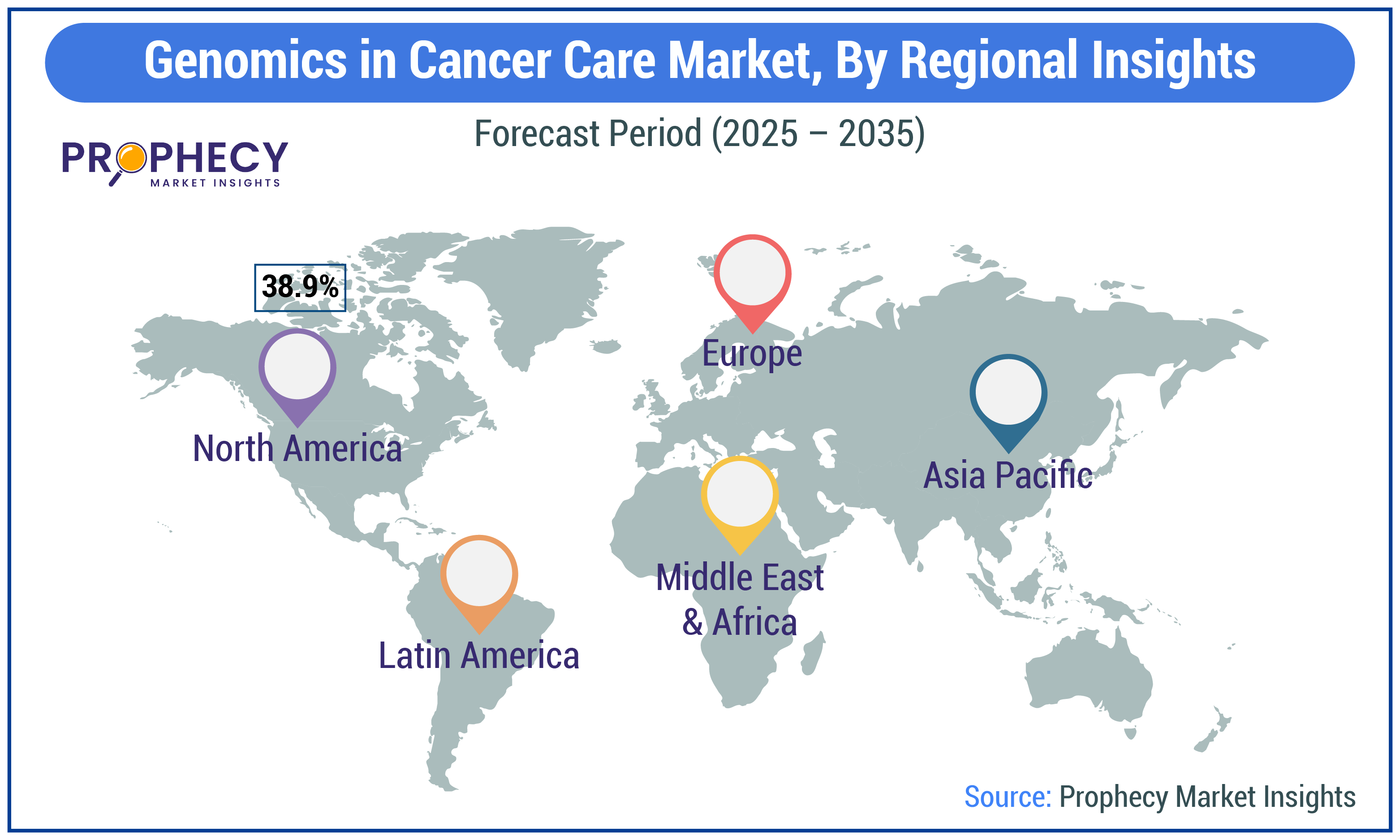
Geographically, the market is studied across North America, Europe, Asia Pacific, Latin America, and the Middle East & Africa.
North America: This is the dominating region for the genomics in cancer care market due to increasing prevalence of cancer and government initiatives are supporting to the adoption of genome science across nation. The presence of major market players, high healthcare expenditure and advanced healthcare infrastructure, resulting to growth of North America Region.
- For instance, in August 2024, International medical imaging IT and cyber security company Sectra collaborated with the University of Pennsylvania Health System to launch a new diagnostics IT module for genomics with molecular pathology in the U.S. The IT solution allows healthcare providers to handle genomic sequencing and predict individual cancer patient respond to different treatment based on genomic information.
Asia Pacific: Asia Pacific is expected to be the fastest-growing region in the target market due to rapid healthcare improvements, and increasing cancer awareness in countries, such as China, Japan, and India, which are creating unique opportunities for treatment development. Government are focusing on improving healthcare infrastructure and rising investment in cancer care, resulting to drive genomics in cancer care market in upcoming years.
- For instance, in September 2023, Agilent announced partnership with National Cancer Center Singapore for genomic research. Agilent’s fully-automated NGS library preparation platform, was installed at Singapore’s Cancer Discovery Hub (CDH), aimed to deliver reproducible results by simplifying an assay of multiple genes and complex genetic aberrations from genomic DNA.
Genomics in Cancer Care Market Report Scope:
|
Attribute |
Details |
|
Market Size 2025 |
USD 25.3 Billion |
|
Projected Market Size 2035 |
USD 104.7 Billion |
|
CAGR Growth Rate |
16.9% (2025-2035) |
|
Base year for estimation |
2024 |
|
Forecast period |
2025 – 2035 |
|
Market representation |
Revenue in USD Billion & CAGR from 2025 to 2035 |
|
Regional scope |
North America - U.S. and Canada Europe – Germany, U.K., France, Russia, Italy, Spain, Netherlands, and Rest of Europe Asia Pacific – China, India, Japan, Australia Indonesia Malaysia, South Korea, and Rest of Asia-Pacific Latin America - Brazil, Mexico, Argentina, and Rest of Latin America Middle East & Africa – GCC, Israel, South Africa, and Rest of Middle East & Africa |
|
Report coverage |
Revenue forecast, company share, competitive landscape, growth factors, and trends |
Segmentation:
By Product:
- Instruments
- Consumables
- Services
By Type:
- Structural Genomics
- Functional Genomics
By Technology:
- Next-Generation Sequencing [NGS]
- Comparative Genomic Hybridization (CGH)
- Fluorescence In Situ Hybridization
- Exome Sequencing
- Whole Genome Sequencing
- Others
By Cancer Type:
- Breast Cancer
- Lung Cancer
- Melanoma
- Others
By Sample Type:
- Blood
- Tissue
- Urine
- Saliva
By Application:
- Diagnosis
- Drug Discovery & Development
- Personalized Medicine
- Prognostic Evaluation
- Research
- Others
By End-User:
- Hospitals
- Diagnostic Research Institutes
- Others
By Region:
- North America
- U.S.
- Canada
- Europe
- Germany
- U.K.
- France
- Russia
- Italy
- Spain
- Netherlands
- Rest of Europe
- Asia Pacific
- China
- India
- Japan
- Australia
- Indonesia
- Malaysia
- South Korea
- Rest of Asia Pacific
- Latin America
- Brazil
- Mexico
- Argentina
- Rest of Latin America
- Middle East & Africa
- GCC
- Israel
- South Africa
- Rest of Middle East & Africa
Genomics In Cancer Care Market Competitive Landscape & Key Players
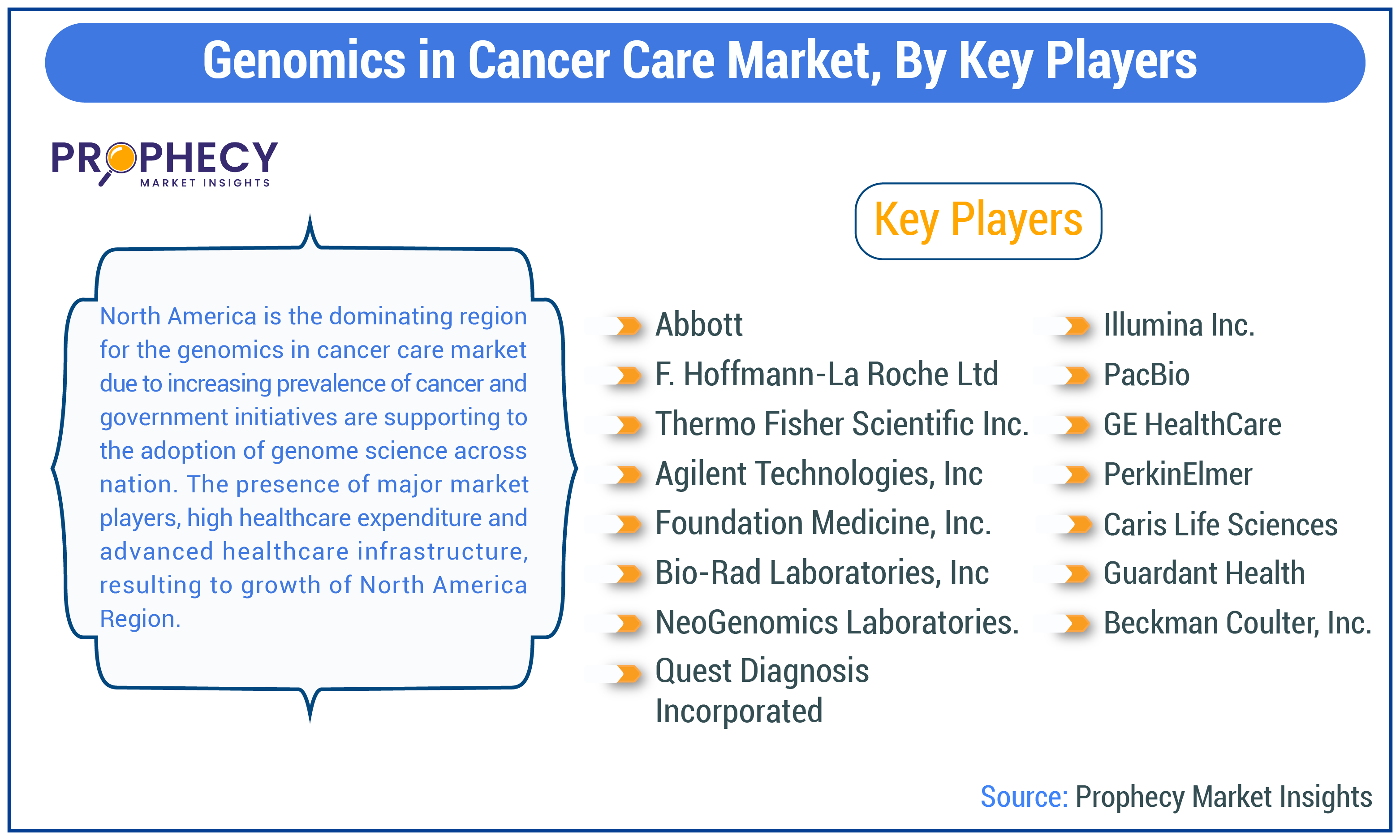
The key players operating in target market include Abbott, F. Hoffmann-La Roche Ltd, Thermo Fisher Scientific Inc. and others. These key players are focusing on improving on research and development, innovative strategies, new product launches, strategic partnerships and acquisitions to enhance their product offerings globally.
List of Key Players in the Market:
- Abbott
- F. Hoffmann-La Roche Ltd
- Thermo Fisher Scientific Inc.
- Agilent Technologies, Inc
- Illumina Inc.
- PacBio
- Bio-Rad Laboratories, Inc
- Beckman Coulter, Inc.
- GE HealthCare
- Quest Diagnosis Incorporated
- PerkinElmer
- Caris Life Sciences
- Foundation Medicine, Inc.
- Guardant Health
- NeoGenomics Laboratories
Genomics In Cancer Care Market Recent News
- In September 2024, Indian Cancer Genome Atlas (ICGA) launched India’s first comprehensive cancer multi-omics data portal. This platform aimed to transforming cancer research and treatment for Indian population. The ICGA cancer multi-omics portal was the first in India to offer data that includes DNA, RNA, and protein profiles of breast cancer patients, integrated with clinical outcomes. The datasets help researchers and clinicians to develop personalized treatment protocols.
- In January 2024, SOPHiA GENETICS and Karkinos Healthcare Forge announced partnership to adopt the SOPHiA DDM Platform to advance cancer testing and research for blood cancers and solid tumors in low and middle-income countries. Through strategic partnership, Karkinos Healthcare aimed to address the comprehensive genomic landscape identification for Indian population, with a focus on precision medicine.
Analyst View:
The increasing incidence of breast cancer & lung cancer and proliferation of sequencing techniques, including next-generation sequencing, liquid biopsy, aimed to enhance the accuracy and accessibility of molecular diagnosis for genomic cancer. The increasing demand for personalized & precision medicine, and rising investment of key players for innovation in technologies, leading to growth of target market in coming years.
More Related Reports
Next-generation Products in Tobacco Market
Cancer Diagnostics Market
Cancer Therapy Market
Genomics Market
Blockchain in Genomics Market
Genomics In Cancer Care Market Company Profile
|
Company Name |
Thermo Fisher Scientific Inc |
|
Headquarter |
Waltham, Massachusetts, U.S. |
|
CEO |
Mr. Marc N. Casper |
|
Employee Count (2024) |
100,000 Employees |
Genomics In Cancer Care Market Highlights
FAQs
Genomics in cancer care market size was valued at USD 25.3 Billion in 2025 and is expected to reach USD 104.7 Billion by 2035 growing at a CAGR of 16.9%.
Product, type, technology, cancer type, sample type, application, end-user, and region are the segmentation for the target market.
North America, Asia Pacific, Europe, Latin America, and the Middle East & Africa. North America is expected to dominate the market.
The key players operating in the genomics in cancer care market include Abbott, F. Hoffmann-La Roche Ltd, Thermo Fisher Scientific Inc., Agilent Technologies, Inc, Illumina Inc., PacBio, Bio-Rad Laboratories, Inc, Beckman Coulter, Inc., GE HealthCare, Quest Diagnosis Incorporated, PerkinElmer, Caris Life Sciences, Foundation Medicine, Inc., Guardant Health, NeoGenomics Laboratories.