Digestive Health Product Market Overview
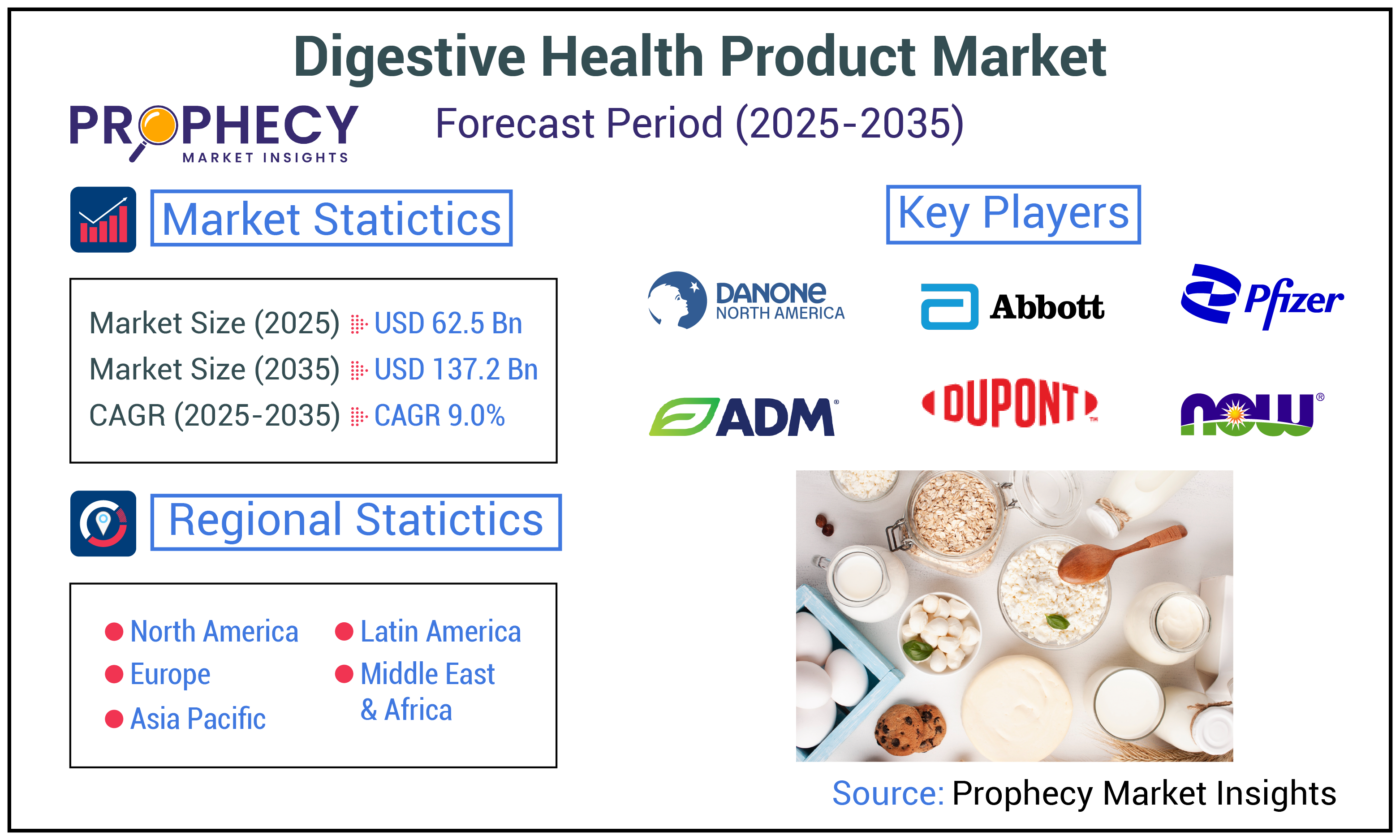
- By 2035, digestive health product market size is contemplated to enlarge at a valuation of USD 137.2 Billion.
- In 2024, the digestive health product market valuation was USD 58.2 Billion.
- Digestive health product market is developing at a CAGR of 9.0%.
Digestive health products include supplements, probiotics, prebiotics and functional foods that are meant to enhance gut health and improve digestion. These products may improve nutrient absorption, support regular bowel movements and promote a balanced micro biome. The increased awareness of overall wellness, including gut health and the gut-brain connection, has increased the consumer appetite for digestive health products.
The market for digestive health products is expanding due to the growing prevalence of lifestyle-related digestive problems that are driving awareness on gut health and the popularity of functional foods. The increasing demand for preventative health solutions that are natural and recent innovations regarding prebiotics and enzyme-based products are increasing the growth of the market. The increase in aging populations and interest in food and nutrition has also contributed to the growth of digestive health products in a variety of populations.
Over the next few years, the market will experience further growth due to advancements in microbiomes, personalized nutrition approaches, and clean-label products. Additional growth will be augmented through further expansion in developing economies as well as focusing on preventative healthcare, increased use of digital and artificial intelligence in gut health monitoring could also significantly change and enhance the experience for the consumer.
Recession Risk & Tariff Analysis:
- When the economy slows, consumers rationally reduce discretionary spending, including premium health supplements and functional foods, which puts downward pressure on demand for digestive health products. Also, suppliers may raise prices or offer fewer products due to supply chain disruptions, which impacts product availability and market stability.
- Tariffs on imported raw materials for digestive health products (e.g. probiotics, enzymes, and herbal extracts) raise the cost of production. Countries that engage in cross-border trade to procure raw materials face significant price volatility on commodities. Protectionist policies can lead to trade disputes that can inhibit the functioning of global supply chains, thus restricting products available for sale and overall market competition.
Impact of Generative AI on Digestive Health Product Market:
- It is possible to develop personalized digestive health products utilizing generative AI consumer health insight dietary patterns, and microbiome profiles. This enables customized supplements or functional foods that will be more personal and successful, creating higher levels of customer satisfaction and coming to a point of synergy in a crowded environment.
- Generative AI is another tool to create custom targeted marketing strategies, educational materials, and chat-based health advisor tools to support consumer understanding about products and the digestive health benefits of using them. Personalization allows for brands to create and maintain customer loyalty, brand trust, and levels of conversion in the digestive health product space.
Digestive Health Product Market Drivers & Restraints
Key Drivers:
Rising Awareness of Gut Health and Preventive Wellness is changing the dynamics of the market
One of the most significant factors driving the market for digestive health products is the awareness of consumers now about how important gut health is for overall health and well-being. Increasing amounts of research linking gut microbiota to immunity and mental health and chronic disease prevention has contributed to this perhaps more than any other contributing factor. The increase in awareness of gut health by consumers has helped to increase the overall demand for probiotics, prebiotics, and digestive enzyme-based products/foods that promote digestive balance and has helped to establish them as a regular part of a consumer's daily health and wellbeing routine.
- For instance, according to World Health Organization (WHO), achieving a total daily fiber intake level of at least 25-30 grams per day to aid in the maintenance of digestive health and to prevent non-communicable diseases. WHO also promotes fermented foods that are rich in probiotics to support gut microbiota balance. This heightened interest in preventive care reflects a growing global shift toward preventive care and supports the increased demand for digestive health products, most notably, fiber and probiotics.
Restraints:
High Cost and Limited Accessibility of Advanced Products to repel market growth:
A specific limitation in the digestive health product market is the cost of advanced supplements and probiotics and functional foods. This is compounded by the ineffectiveness of distribution channels, and a lack of awareness preventing any penetration of the market in low- and middle-income areas. At the same time, these gross disparities in consumption are a major hurdle in the way of a diverse consumer base for digestive health products as evolving trends for global health and wellness represent an acceptance and a demand for solutions for digestive wellness.
- Counterbalance Statements: Nonetheless, the growth of e-commerce (within and outside of the pandemic context), increasing regional manufacturing, and private label products are making the product more affordable and accessible. Awareness through education, and marketing campaigns are benefitting from a regional approach or being closer to consumers and getting a representation in the market to address the awareness gaps and move products into greater areas and get to the underserved market.
Opportunities & Trends:
Integration of AI and Remote Coaching in Sports Training Platforms is a growing opportunity
A significant opportunity in the market for digestive health products is the creation of personalized nutrition options derived from the analysis of the individual's gut microbiome. Personalization is a trend that is developing rapidly in precision health, and consumers increasingly want personalized supplements and functional foods that support their unique digestive health needs. Currently, we are seeing enhancements in microbiome analysis and AI-informed formulations that will support brands providing even more targeted products. This has both market potential for consumer trust and effective health outcomes as well as emerging segments of digestive wellness benefits across industries.
Digestive Health Product Market Segmentations & Regional Insights
Product, form, ingredient type, distribution channel and region are the divisions of the digestive health product market.
By Product:
Based on Product, the market is divided into probiotics, prebiotics, digestive enzymes, laxatives, and others. Probiotics lead the digestive health product market share due to their established efficacy in enhancing gut microbiota, immunity, and relieving digestive ailments. Their increasing incorporation into dietary supplements and functional foods denotes a trend in consumer acceptance based on growing knowledge of gut health awareness and increased research on the efficacy of probiotics overall.
Prebiotics are positioned at second, as they provide the substrate for the culturing of beneficial gut bacteria and help increase overall digestive function. The fact that prebiotics are included in fiber foods and other supplements allows for a natural and preventive use that fits with the growing demand for natural solutions. Relatedly, growth in the market is also driven by product innovations in symbiotic formulations and clean-label, plant-based dietary fiber sources.
By Form:
Based on the form, the digestive health product market is divided into capsules, powders, liquids, and gummies. Capsules are the largest segment of the digestive health product market size. Capsules can also provide accurate and convenient dosing and protect sensitive ingredients (e.g., probiotics) from potential degradation. Safety and efficacy are often the major considerations taken into account by consumers with shelf life also usually a consideration.
Powders are the second largest segment of the digestive health product market growth. Powders also provide flexibility of dosing, convenience, solubility, and ease of consumption. They also offer greater stability profiles for certain ingredients. Powders are particularly relevant for fiber supplements and enzyme blends intended for consumers who want bespoke options to support composing their unique digestive health products. Advances in flavoring agents and solubility will enhance their usage and appeal near term.
By Ingredient Type:
Based on the ingredient type, the digestive health product market is divided into microorganisms-based, plant-based, and animal-based. Microorganism-derived ingredients, represented mainly by probiotics such as Lactobacillus and Bifidobacterium, account for the majority of the market share due to the evidence linked to their ability to support and improve gut microbiota and digestive health. Clinical validation for these ingredients is abundant, as they are found in supplements and functional foods, and as consumer awareness continues to grow around gut microbiome wellness, so does the popularity and consumer trust in probiotics.
The second ranking goes to plant-based products as there is more demand for natural substances that are vegan-friendly. Examples of such plant-based prebiotic ingredients and fiber supplements include inulin, psyllium husk, and chicory root. They are organic in nature targeting a majority of consumers. They are in the spotlight due to their clean-label image, such health benefits digestive functions, and versatility against varied dietary requirements with respect to the global prebiotic market.
By Distribution Channel:
Supermarkets & hypermarkets, pharmacies & drug stores, online retail, health & wellness stores are distribution channel of the digestive health product market. Supermarkets and hypermarkets dominate the distribution channel, owing to their reach and credibility and variety of products. They also provide access to branded and private label digestive health products and a context for impulse purchases and bulk purchases, especially in urban areas with high-foot traffic with health-conscious shoppers.
Pharmacies and drug stores come in second, they are preferred for their credibility and access to medically endorsed digestive health products. They can be trusted easily as they have the government license to sell the products. Consumers looking for clinically validated products or with particular digestive concerns prefer this distribution channel also due to pharmacist suggestions and the limited assortment of supplements.
Regional Insights:
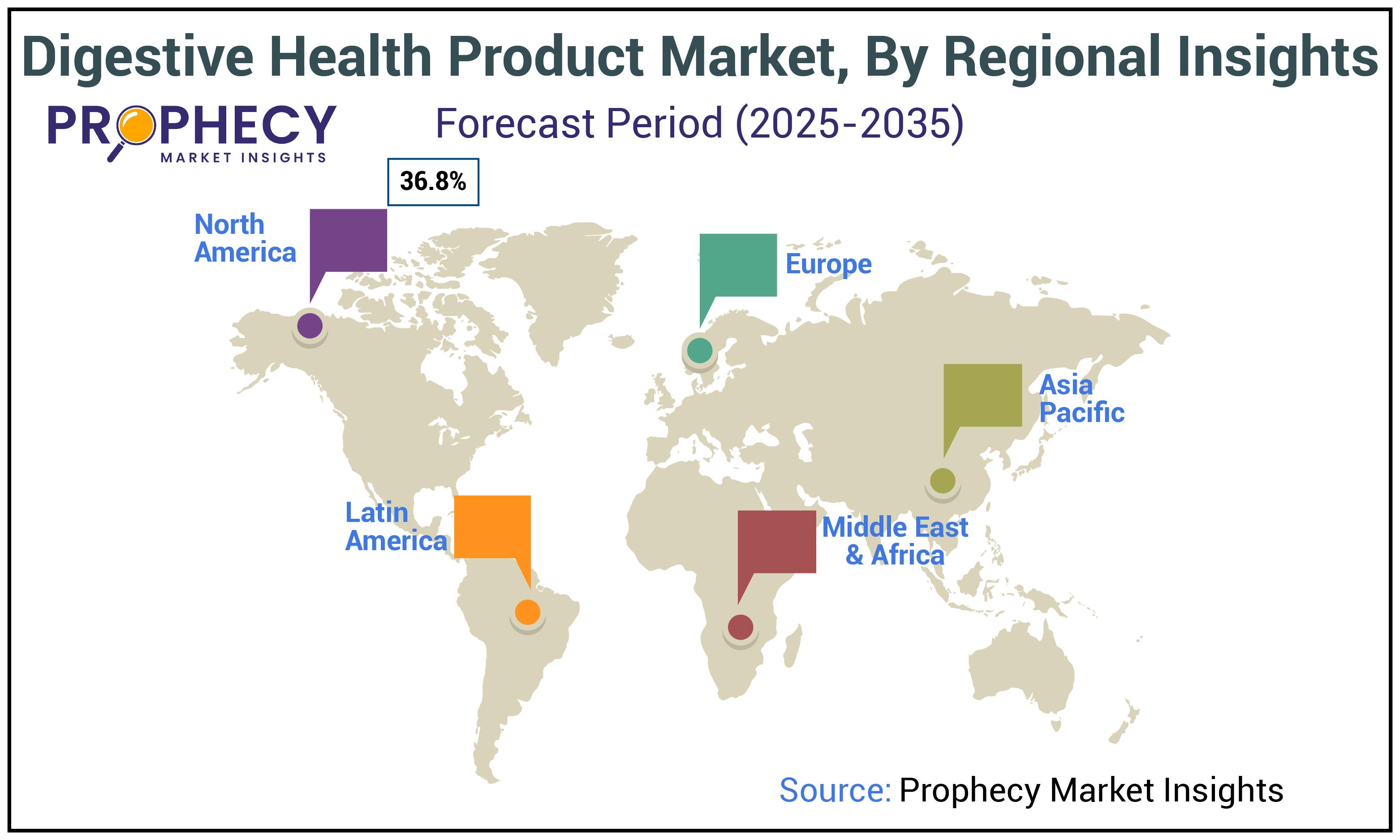
Geographically, the digestive health product market is studied across North America, Europe, Asia Pacific, Latin America, and the Middle East & Africa.
North America: This region digestive health product sales generate the highest revenue share of the global market due to high consumer awareness, established health care systems, high penetration of probiotics and dietary supplements. The presence of end-market players, supportive health perceptions and regulations, and increasing demand for preventive health products all enhance North America's market leadership position.
- U.S. Digestive Health Product Market Insights:
The U.S. is the leader in the North American digestive health product market due to favorable levels of awareness around gut health, a populace that showcases strong consumption of supplements, and significant representation from key players. Other factors such as established research infrastructure, natural remedy-seeking consumers solid distribution systems also help bolster the United States market share.
Europe: This is the second largest region by market share based on demands for functional foods, clean-label products, and a growing awareness of digestive wellness. Some of the highest per-capita consumers of probiotic branded products are in Germany, the UK, and France. Demand for plant-based ingredients and the high regulatory hurdles attached to European markets are also driving the overall digestive health market in Europe.
- Germany Digestive Health Product Market Insights:
Germany leads the European digestive health product market due to consumer value on preventative health mind set, preference for high quality functional foods or supplements. Germany's high, and highly regulated standards and health conscious consumer base foster innovation, and provides predictable demand for digestive wellness solutions.
Asia Pacific: This is the third-dominating region of the digestive health products market, now growing rapidly due to more disposable income, a growing base of health-conscious consumers, and expanding urban populations. In addition, large markets such as China, Japan, and India are rapidly adopting digestive health products since established tradition-based uses, the expansion of the e-commerce ecosystem, and advances in local manufacturing.
- China Digestive Health Product Market Insights:
China has the largest share of the Asia Pacific market, regarding increased disposable income, decreased interest in digestive health thinking. Ongoing urbanization in the region creates opportunities to reach the millennial generation, and the ease of e-commerce and logistics related to government support focuses further interest in health-related focused products into a growing influence in digestive health-related products.
Digestive Health Product Market Report Scope:
|
Attribute |
Details |
|
Market Size 2025 |
USD 62.5 Billion |
|
Projected Market Size 2035 |
USD 137.2 Billion |
|
CAGR Growth Rate |
9.0% (2025-2035) |
|
Base year for estimation |
2024 |
|
Forecast period |
2025 – 2035 |
|
Market representation |
Revenue in USD Billion & CAGR from 2025 to 2035 |
|
Regional scope |
North America - U.S. and Canada Europe – Germany, U.K., France, Russia, Italy, Spain, Netherlands, and Rest of Europe Asia Pacific – China, India, Japan, Australia, Indonesia, Malaysia, South Korea, and Rest of Asia-Pacific Latin America - Brazil, Mexico, Argentina, and Rest of Latin America Middle East & Africa – GCC, Israel, South Africa, and Rest of Middle East & Africa |
|
Report coverage |
Revenue forecast, company share, competitive landscape, growth factors, and trends |
Segmentation:
By Product:
- Probiotics
- Prebiotics
- Digestive Enzymes
- Laxatives
- Others
By Form:
- Capsules
- Powders
- Liquids
- Gummies
By Ingredient Type:
- Microorganisms-based
- Plant-based
- Animal-based
By Distribution Channel:
- Supermarket & Hypermarket
- Pharmacies & Drug Stores
- Online Retail
- Health & Wellness Stores
By Region:
- North America
- U.S.
- Canada
- Europe
- Germany
- U.K.
- France
- Russia
- Italy
- Spain
- Netherlands
- Rest of Europe
- Asia Pacific
- China
- India
- Japan
- Australia
- Indonesia
- Malaysia
- South Korea
- Rest of Asia Pacific
- Latin America
- Brazil
- Mexico
- Argentina
- Rest of Latin America
- Middle East & Africa
- GCC
- Israel
- South Africa
- Rest of Middle East & Africa
Digestive Health Product Market Competitive Landscape & Key Players
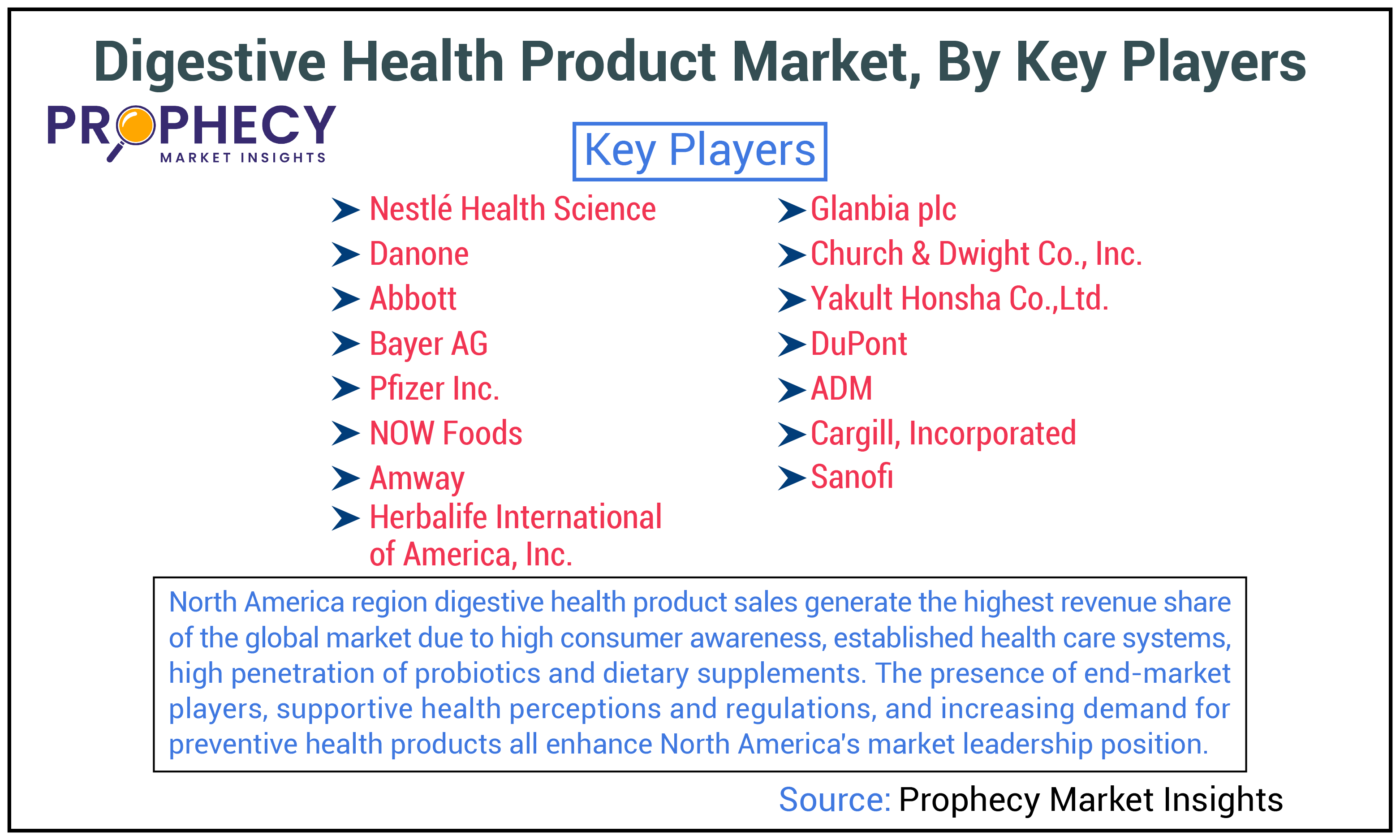
Leading companies in the digestive health product market include, Nestlé Health Science, Danone, Abbott, Bayer AG, Pfizer Inc., NOW Foods, Amway, Herbalife International of America, Inc., Glanbia plc, and among others. Market for digestive health products is competitive, dynamic, and strongly influenced by innovation in product type and methods of delivery. Companies compete on clinical validation, clean labels, and personalized solutions. Establishing strong global distribution networks, investing in microbiome research, and expanding e-commerce capabilities are critical strategies for helping firms grow market share and meet emerging consumer health needs.
Digestive Health Product Market Companies:
- Nestlé Health Science
- Danone
- Abbott
- Bayer AG
- Pfizer Inc.
- NOW Foods
- Amway
- Herbalife International of America, Inc.
- Glanbia plc
- Church & Dwight Co., Inc.
- Yakult Honsha Co.,Ltd.
- DuPont
- ADM
- Cargill, Incorporated
- Sanofi
View an Additional List of Companies in the Digestive Health Product Market
Digestive Health Product Market Recent News
- In July 2025, The Confederation of African Football (CAF) and Danone, a major company in nutrition in Africa, have entered into a joint agreement that will see Danone become an Official Partner of the TotalEnergies CAF Africa Cup of Nations (AFCON), Morocco 2025 and the TotalEnergies CAF Women’s Africa Cup of Nations (WAFCON), Morocco 2024. This partnership supports Danone's commitment to building health through food throughout the African continent, where nutrition and sports contribute to health throughout life.
- In May 2025, Yakult Honsha Co., Ltd. has announced that its overseas subsidiary PT Yakult Indonesia Persada will begin selling Yakult Mango Flavor products beginning June 2025. Yakult Indonesia seeks to capture the interest of as many customers as possible by launching the famous mango flavor in the Yakult brand and thereby create more opportunities for customers to consume Lactobacillus casei strain Shirota, the unique and proprietary bacterium in Yakult products.
Analyst View:
The market for digestive health products is expanding rapidly, as a result of an increase in awareness of gut health, increasing trends toward preventive healthcare, and increasing demand for probiotics, prebiotics and enzyme supplements. Product innovations are being influenced by trends in personalized nutrition and microbiome science. More broadly there also seem to be opportunities to link digital health innovations with product lines, and some markets in emerging economies, that could be further explored. The challenges in growth in the sector include, increasing cost impedances to product development, limited availability, particularly in rural markets, and regulation. Continued research and development, growth in e-commerce, and increasing consumer preference for natural solutions for their health and wellbeing, should allow for ongoing growth in the market and competitive advantage for product innovation in future years.
More Related Reports
Gut & Digestive Health Market
Healthcare Biometric Market
Digital Health Market
Healthcare Finance Solutions Market
Smart Healthcare Products Market
Digestive Health Product Market Company Profile
|
Company Name |
ADM |
|
Headquarter |
Illinois, U.S. |
|
CEO |
Juan Luciano |
|
Employee Count |
44,043 Employees |
Digestive Health Product Market Highlights
FAQs
Digestive health product market size was valued at USD 62.5 Billion in 2025 and is expected to reach USD 137.2 Billion by 2035 growing at a CAGR of 9.0%.
Product, form, distribution channel, and region are the segmentation for the target market.
North America, Asia Pacific, Europe, Latin America, and the Middle East & Africa. North America is expected to dominate the market.
The prominent players operating in the market include, Nestlé Health Science, Danone, Abbott, Bayer AG, Pfizer Inc., NOW Foods, Amway, Herbalife International of America, Inc., Glanbia plc, Church & Dwight Co., Inc., Yakult Honsha Co.,Ltd., DuPont, ADM, Cargill, Incorporated, and Sanofi