Biodegradable Packaging Market Overview
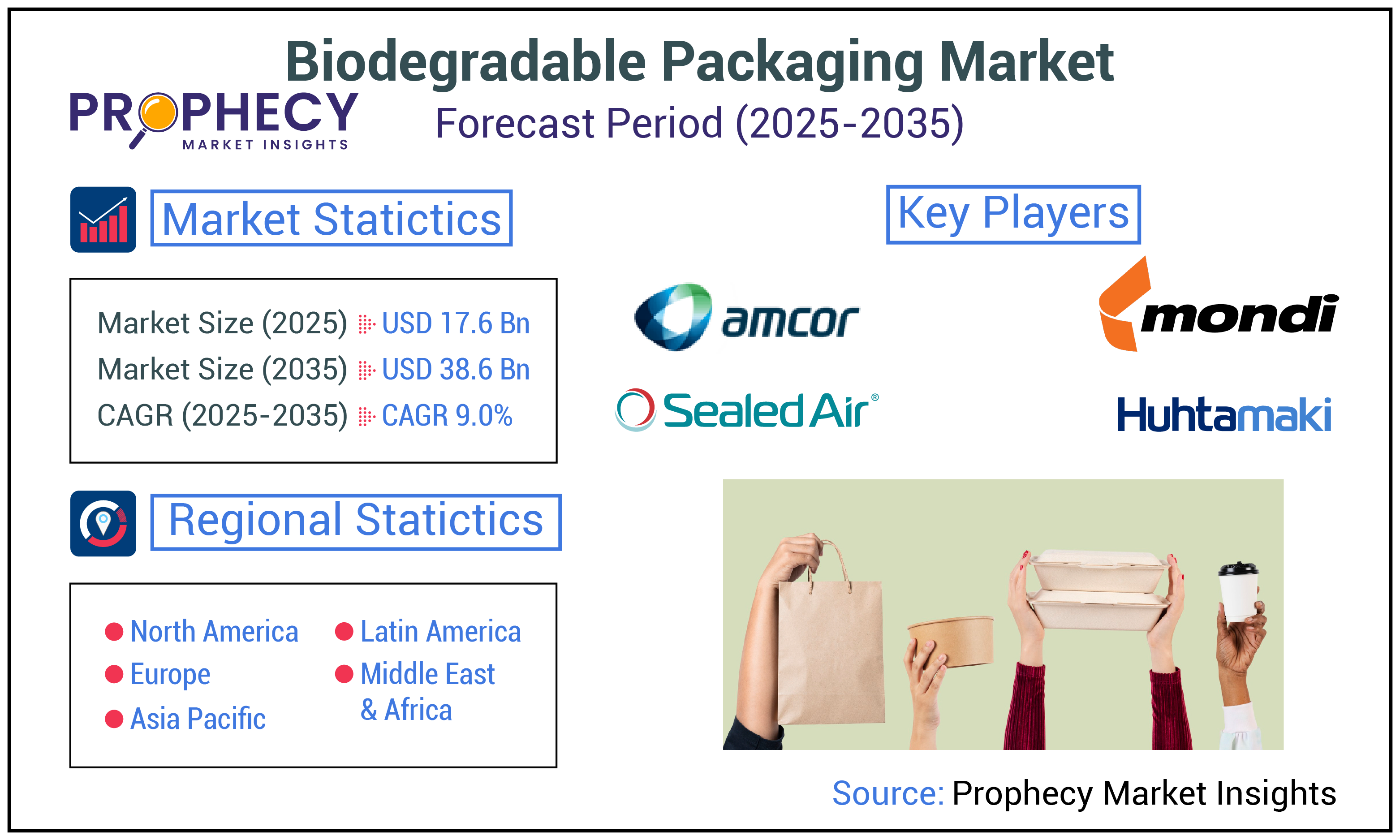
- By 2035, biodegradable packaging market size is contemplated to enlarge at a valuation of USD 38.6 Billion.
- In 2024, the biodegradable packaging market valuation was USD 16.4 Billion.
- Biodegradable packaging market is developing at a CAGR of 9.0%.
Biodegradable packaging is packaging that decomposes, thanks to natural microorganisms, and is lessening our footprint on the planet. Biodegradable packaging can use renewable resources such as cornstarch, paper, and cellulose, making it a more sustainable choice compared to traditional, plastic packaging. Biodegradable packaging is referred to as environmentally preferable packaging, contributing to waste reduction, and is helping to promote sustainability and environmental protection on a global level.
As more and more consumers and businesses are concerned about the environment, it is not just environmental factors driving the demand for biodegradable packaging; regulations around plastic use, along with consumer spending are helping in growing demand for sustainable packaging options. There are other drivers as well, companies/industries may use alternative packaging products to build on positive brand, and promoting corporate social responsibility. Also, there are new biodegradable product alternatives, innovations in biodegradable packaging, and better performance characteristics for biodegradable packaging; providing even more applications for biodegradable packaging to be used, in food service, health care or retail, in order to drive the market for biodegradable packaging.
At this time, the outlook for biodegradable packaging looks good. More attention is being given to sustainable materials, material science, and more investment is going towards sustainable materials and technologies. In addition, in light of tightening global environmental regulations and continued consumer awareness, we expect growth to continue in the future.
Recession Risk & Tariff Analysis:
- The biodegradable packaging market is also challenged by economic downturns, which limit consumer spending and cause companies looking to cut costs to focus on the cheapest options (often conventional plastics). High production costs, alongside the limited options of raw materials which can face supply constraints and limits supply chains, can also limit adoption. On moving toward sustainable packaging options can be difficult for small and medium enterprises, limiting the market as a whole.
- On the greater scale, tariffs related to newly imported raw materials (from changing policies regarding banned substances or preferred substances) for biodegradable packaging or changes in features on biodegradable products, increase the costs of production but cut the flexibility for global trade. And for allow manufacturers continue with pricing pressures on products that source all foreign inputs, they must seek region-based product and supply change management systems and consumer-driven eco-marketing methods.
Impact of Generative AI on Biodegradable Packaging Market:
- Generative AI provides rapid prototyping and unique design capabilities in biodegradable packaging since it allows for simulating the behavior of the material, and optimizing the packaging material composition, structure and performance, to create sustainable and long-lasting packaging solutions. It accelerates the product development process and reduces material waste, allowing ultimately for customized and sustainable alternative designs to confirm explicitly meeting particular packaging needs for an industry.
- Artificial intelligence-based data analysis systems can identify and anticipate consumer preferences, industry regulations, and material trends enabling companies to appropriately harness their biodegradable packaging strategies. Generative AI through forecasting demand and assisting in an inventory management system, to reduce over production and therefore promote a more sustainable and efficient inventory and supply chain use of biodegradable packaging.
Biodegradable Packaging Market Drivers & Restraints
Key Drivers:
Stringent Environmental Regulations and Plastic Bans to propel market growth
With various laws forcing environmentalists to push for the reduction of plastic waste, the complete operation of the biodegradable packaging movement. Governments around the world are imposing bans and restrictions on single-use plastics-the plastics industry is now being pushed heavily toward sustainable alternatives. Consumers are becoming more environmentally conscious, and brands are seeking biodegradable packaging to fulfill legislative regulation and public demand. This movement will both help reduce waste and encourage further in renewable as well as compostable packaging solutions.
- For instance, according to The Ministry of Environment, Forest and Climate Change issued a ban on all single-use plastic items in July 2022 under the Plastic Waste Management Amendment Rules, 2021. This legislation requires commercial establishments to employ sustainable alternatives such as biodegradable packaging to combat the menace of plastic pollution.
Restraints:
High Production Costs and Limited Infrastructure to repel market growth:
- The biodegradable packaging market has the significant challenge of being more expensive to produce than non-biodegradable plastics. The bioplastics are categorized as degradable biodegradable since even though they are starch -based, they are a new material which require different processing methods and specialized infrastructure. Many areas do not have this infrastructure. Additionally, some of the bio-based raw materials can be expensive and subject to agricultural years. These materials have inhibited the uptake of biodegradable packaging, particularly for Small and Medium Sized Enterprises, (SMEs) but their effects on the growth of the market is mostly confined to more cost-sensitive areas of the market.
Counterbalance Statements: Importantly, price decreases are continuing, as the investment in research and development is increasing, and economies of scale begin to occur. Governments are incentivizing the growing uptake of biodegradable packaging, beyond landfilling. Citizens are also incentivizing biodegradable packaging for their packaging purchase decisions. Companies, in numerous markets are also trying to meet and develop sustainability targets by using biodegradable packaging materials, more consistently in developed and technically enhanced urban areas.
Opportunities & Trends:
Rise of E-Commerce and Demand for Sustainable Packaging is trending
Expansion of e-commerce is a key opportunity for the biodegradable packaging industry with organizations increasingly looking for sustainable alternatives to lessen their eco-footprint. Some products that are being marketed as biodegradable or compostable in the online retail space are compostable mailers, corrugated boxes and plant-based wraps. There are consumers who want brands with sustainable packaging options, this is creating demand for new innovations of durable biodegradable shipping materials. This change is driving genuine demand for compostable packaging being adopted by logistics and retail industries wanting greener supply chains.
Biodegradable Packaging Market Segmentations & Regional Insights
Product type, packaging type, techniques, end-user, and region are the divisions of the biodegradable packaging market.
By Product Type:
Based on product type, the biodegradable packaging market is segmented into films & liners, bags & pouches, boxes & containers, bottles & jars, trays, labels & tapes, and others. Bags and pouches are leading the charge in the biodegradable packaging market share due to their tremendous applications across food and retail, and personal care. Bags and pouches being lightweight, flexible, and in-demand for more single use biodegradable options are responsible for widespread adoption.
Boxes and containers have the second largest market share and increasingly used for environmentally conscious options in food delivery and takeaway, as well as eco-friendly options for retail packaging. Ultimately made from paper, cardboard, or molded fiber, they are durable and recyclable. The growth of the segment is also being driven by legislation and strong preference from consumers for more plastic free compostable packaging options.
By Packaging Type:
Based on the packaging type, the biodegradable packaging market is divided into rigid, flexible, material, cellulose-based, starch-based, paper-based, polylactic acid (PLA), and others. Flexible packaging reigns supreme in the biodegradable packaging category through its versatility, low weight and cost, and as a single-form packaging solution across the food, personal care and pharmaceuticals sectors. The growth in single-use compostable films, wraps, and pouches is creating a massive opportunity by ease of storage, transport and significant demand.
Paper-based packaging sits in second place, being recyclable, biodegradable, and enjoyed by consumers. It is widely used in the food service, retail, and e-commerce industries, providing a viable substitute for plastic packaging. A push from legislatures toward using more paper combined with innovations in water-resistant coatings are catapulting paper-based packaging into a more sustainable future.
By Techniques:
Based on the techniques, the biodegradable packaging market is divided into modified atmosphere packaging (MAP), smart packaging, nano-packaging, active packaging, and others. Modified Atmosphere Packaging (MAP) is the market leader due to its effectiveness for preserving perishable products. MAP is primarily used in the food industry to maintain product freshness by modifying atmospheric gases inside the package, and a perfect fit for biodegradable films.
Active packaging is ranked second, due to the emphasis on safety and quality, being able to harness moisture control, oxygen scavengers, and antimicrobial agents. The use of active packaging also coincides with biodegradable materials in the food packaging and health sectors to give function, sustainable options, while keeping pace with consumer demand for sustainability and product quality.
By End-User:
Based on the end-user, the biodegradable packaging market is divided into food & beverages, personal care & cosmetics, pharmaceuticals, homecare, and others. The food and beverages sector represents the largest biodegradable packaging market share as organizations look for sustainable alternatives to traditional plastics packaging such as trims, trays, and wraps. Regulatory restrictions on single-use plastic packaging are encouraging many product categories to embrace biodegradable solutions.
The second largest sector in the biodegradable packaging market growth is personal care and cosmetics. This sector has been stimulated by a growing eco-awareness and brands adopting sustainability while getting to market. More organizations are using biodegradable alternatives for their packaging of creams, shampoos and beauty products. Attractive, compostable alternatives that fit with the branding of their natural or organic products are growing faster in this category segment thereby increasing market penetration.
Regional Insights:
Geographically, the biodegradable packaging market is studied across North America, Europe, Asia Pacific, Latin America, and the Middle East & Africa.
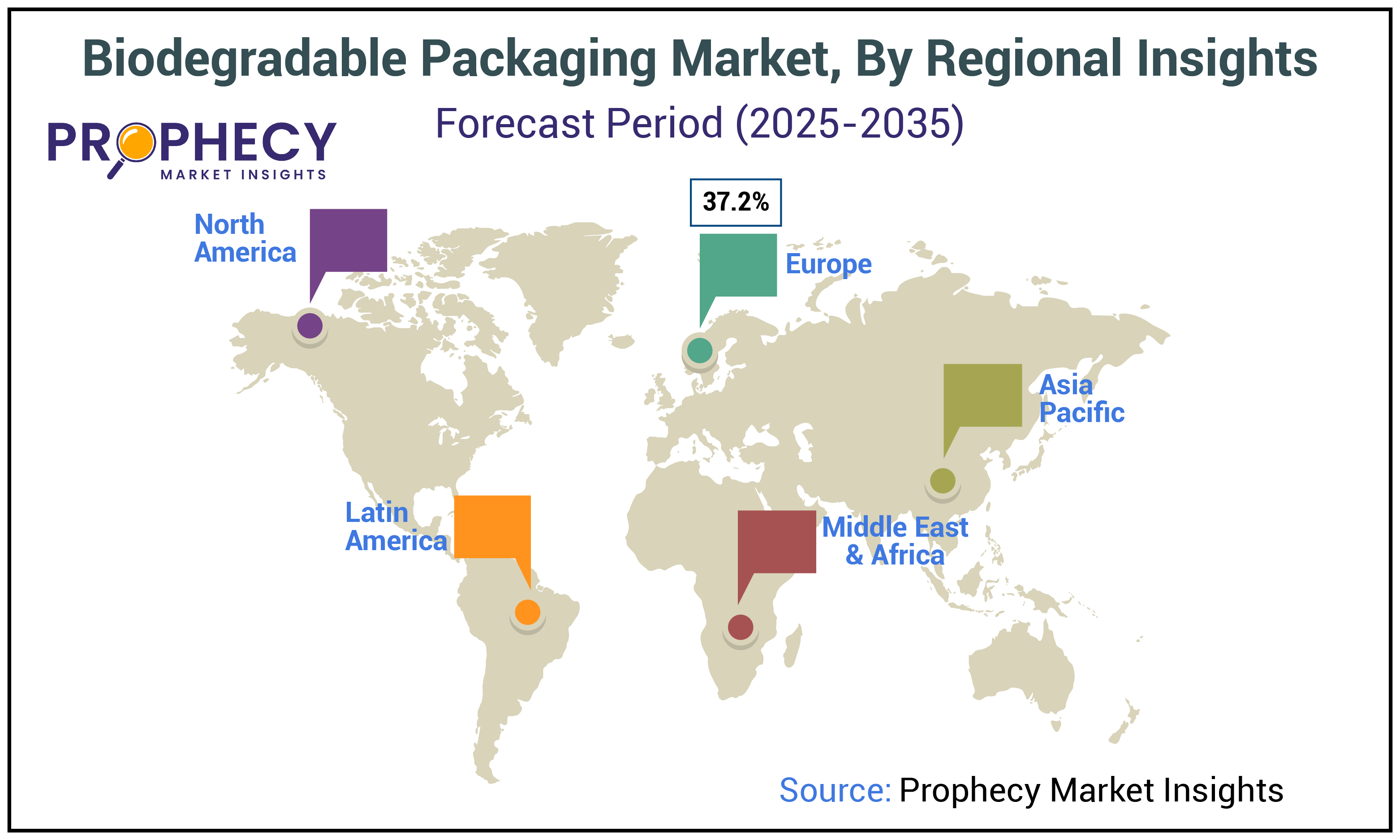
Europe: This region is at the forefront of the biodegradable packaging market with 37.2% market share due to regulatory pressure, government support, and active consumers with a general awareness of sustainability. The regional industry has developed through the promotion of compostable packaging through bans on single-use plastics and financial support for innovations in green practices through supportive governments such as Germany, France, and the Netherlands which have encouraged the implementation of biodegradable packaging across all sectors.
- Germany Biodegradable Packaging Market Insights:
Germany's growth in the European biodegradable packaging market is fueled by the government-authorized position in the market. The more developed recycling systems in Europe and Germany showcase the developing systems of recycling and the growth of awareness around eco-friendly packaging.
North America: This region has the second biggest biodegradable packaging market share, supported by the growing need for sustainable packaging in food, cosmetics, and e-commerce. The rise of regulatory interventions in U.S. and Canada as well as corporate sustainability targets continue to stir support for biodegradable packaging solutions, especially new innovations in biodegradable plastics and use of PLA and paper, have encouraged widespread increases.
- U.S. Biodegradable Packaging Market Insights:
Germany is one of the countries that leads North America in total value. Demand for biodegradable packaging alternatives are rising in segments including food, cosmetics, and e-commerce packaging. Federal and state policies are driving demand for biodegradable packaging and corporate sustainability policies using toward this change from plastics to compostable alternatives.
Asia Pacific: This region comes in third position in target market growth supported by rising environmental awareness concerns and continuous industrial development. China's growing concerns about plastic waste in addition to India's new government policy along with Japan's push for disposable biodegradable packaging supports the trend. Market growth is further supported by a growing retail and food sector, along with increasing awareness among urban consumers.
- China Biodegradable Packaging Market Insights:
China is the largest part of the Asia Pacific biodegradable packaging industry, and has the population carrying demand from eco-friendly products. China has also grown up around packaging so with the external potential to bring about regulatory policies dealing with the growing, growing reasonably awareness of changing consumer demand towards going mainstream towards biodegradable.
Biodegradable Packaging Market Report Scope:
|
Attribute |
Details |
|
Market Size 2025 |
USD 17.6 Billion |
|
Projected Market Size 2035 |
USD 38.6 Billion |
|
CAGR Growth Rate |
9.0% (2025-2035) |
|
Base year for estimation |
2024 |
|
Forecast period |
2025 – 2035 |
|
Market representation |
Revenue in USD Billion & CAGR from 2025 to 2035 |
|
Regional scope |
North America - U.S. and Canada Europe – Germany, U.K., France, Russia, Italy, Spain, Netherlands, and Rest of Europe Asia Pacific – China, India, Japan, Australia, Indonesia, Malaysia, South Korea, and Rest of Asia-Pacific Latin America - Brazil, Mexico, Argentina, and Rest of Latin America Middle East & Africa – GCC, Israel, South Africa, and Rest of Middle East & Africa |
|
Report coverage |
Revenue forecast, company share, competitive landscape, growth factors, and trends |
Segmentation:
By Product Type:
- Films & Liners
- Bags & Pouches
- Boxes & Containers
- Bottles & Jars
- Trays
- Labels & Tapes
- Others
Packaging Type:
- Rigid
- Flexible
- Material
- Cellulose-based
- Starch-based
- Paper-based
- Polylactic Acid (PLA)
- Others
Techniques:
- Modified Atmosphere Packaging (MAP)
- Smart Packaging
- Nano-Packaging
- Active Packaging
- Others
End-User:
- Food & Beverages
- Personal Care & Cosmetics
- Pharmaceuticals
- Homecare
- Others
By Region:
- North America
- U.S.
- Canada
- Europe
- Germany
- U.K.
- France
- Russia
- Italy
- Spain
- Netherlands
- Rest of Europe
- Asia Pacific
- China
- India
- Japan
- Australia
- Indonesia
- Malaysia
- South Korea
- Rest of Asia Pacific
- Latin America
- Brazil
- Mexico
- Argentina
- Rest of Latin America
- Middle East & Africa
- GCC
- Israel
- South Africa
- Rest of Middle East & Africa
Biodegradable Packaging Market Competitive Landscape & Key Players
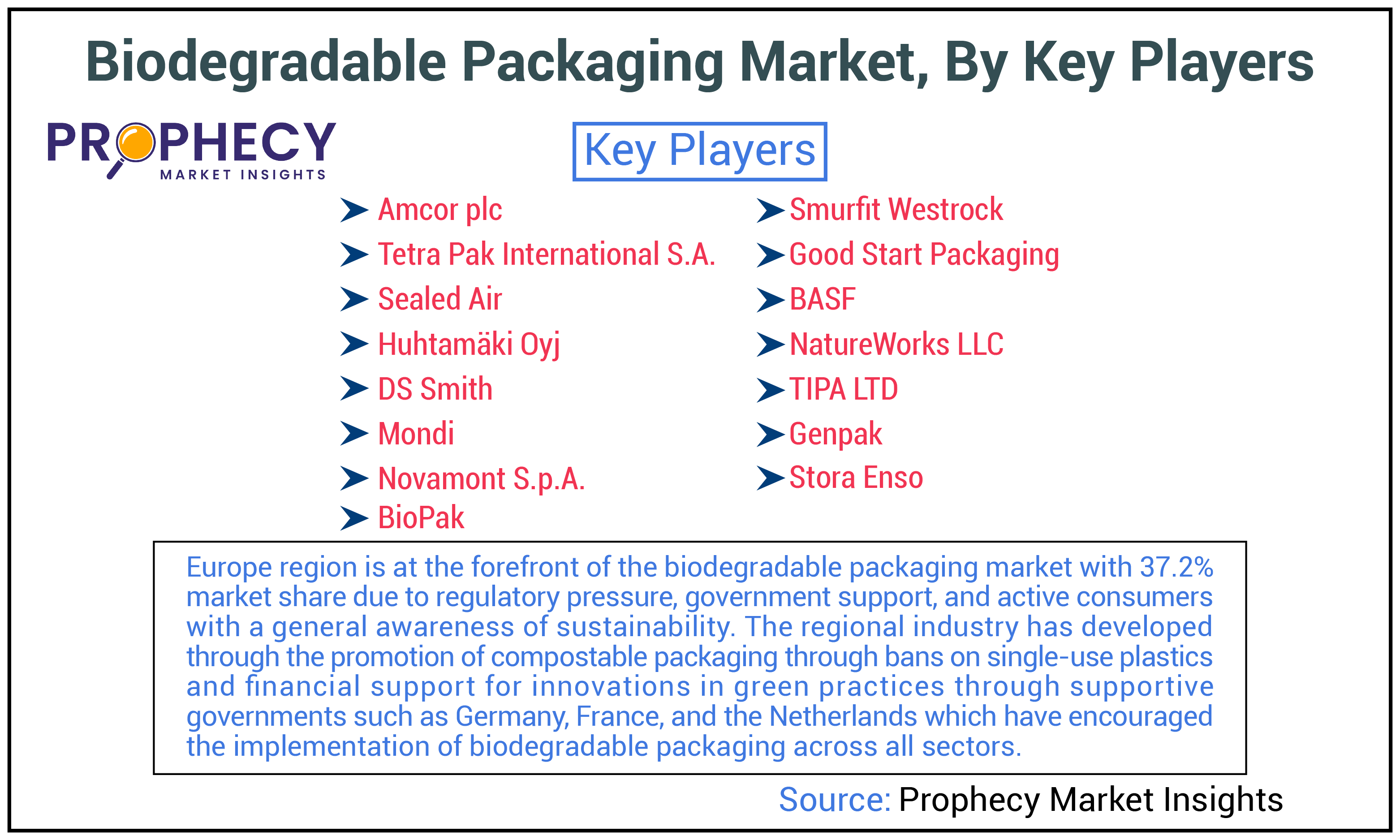
The prominent players operating in the market include, Amcor plc, Tetra Pak International S.A., Sealed Air, Huhtamäki Oyj, DS Smith, Mondi, Novamont S.p.A., BioPak, and others. With rapid advancements in the biodegradable packaging domain, competition is fierce, and players are developing new products, expanding their portfolios through mergers, and addressing sustainable objectives to grab market share. Major players continue to invest in R&D to develop new materials, add to their eco-friendly product line, and improve recyclability.
Biodegradable Packaging Market Companies:
- Amcor plc
- Tetra Pak International S.A.
- Sealed Air
- Huhtamäki Oyj
- DS Smith
- Mondi
- Novamont S.p.A.
- BioPak
- Smurfit Westrock
- Good Start Packaging
- BASF
- NatureWorks LLC
- TIPA LTD
- Genpak
- Stora Enso
View an Additional List of Companies in the Biodegradable Packaging Market
Biodegradable Packaging Market Recent News
- In June 2025, Amcor's AmFiber Performance Paper completed recycling trials in Brazil's mixed-paper corridor, signifying a success in developing circular packaging solutions and confirming its commitment to sustainable packaging. It demonstrated real-world recyclability and helped reduce landfill waste while contributing to the global goal of making all packaging recyclable, reusable, or compostable by 2025.
- In February 2025, DS Smith and International Paper combined forces, creating worldwide champions of sustainable packaging solutions. More specifically to the merger, geographic presence within EMEA and North America got enhanced, increased innovation capacity, and somehow the synergy must work to speed up the development of green and biodegradable packaging in multiple end-use industries.
Analyst View:
The biodegradable packaging market is seeing substantial growth as a result of the growing awareness of environmental issues, stronger government regulations against single-use plastics, and stronger demand from consumers for more sustainable options. The market is also seeing new applications and new uses of bio-based materials for commercial use and increasing rates of compostable packaging, particularly in food and e-commerce. With manufacturing technologies and recycling infrastructure improving, biodegradable packaging is seeing ever more improved performance, scale and redesign.
There are also significant, and many unique, opportunities to continue to grow applications in retail, logistics and healthcare. The market goes forward with continuing challenges of the high production costs of biodegradable packaging, the very few commercial composting facilities and the supply chain altogether. Nonetheless, the market has positives to look forward to, with government policies continuing to become supportive and leveraging development all around the world to increase the uptake of biodegradable packaging.
More Related Reports
Biodegradable Films Market
Biodegradable Plastic Market
Sustainable Plastic Packaging Market
Returnable Packaging Market
Beverage Carton Packaging Machinery Market
Biodegradable Packaging Market Company Profile
|
Company Name |
Amcor plc |
|
Headquarter |
Zürich, Switzerland |
|
CEO |
Peter Konieczny |
|
Employee Count |
41,000 Employees |
Biodegradable Packaging Market Highlights
FAQs
Biodegradable packaging market size was valued at USD 17.6 Billion in 2025 and is expected to reach USD 38.6 Billion by 2035 growing at a CAGR of 9.0%.
Product type, packaging type, techniques, end-user, and region are the segmentation for the biodegradable packaging market.
North America, Asia Pacific, Europe, Latin America, and the Middle East & Africa. Europe is expected to dominate the market.
The prominent players operating in the market include, Amcor plc, Tetra Pak International S.A., Sealed Air, Huhtamäki Oyj, DS Smith, Mondi, Novamont S.p.A., BioPak, Smurfit Westrock, Good Start Packaging, BASF, NatureWorks LLC, TIPA LTD, Genpak, and Stora Enso