3D Printing Construction Market Overview
- By 2035, 3D printing construction market size is contemplated to enlarge at a valuation of USD 20.72 Billion.
- In 2024, the 3D printing construction market valuation was USD 8.1 Billion.
- 3D printing construction market is developing at a CAGR of 8.3%.
Construction via 3D printing simply describes the use of additive manufacturing techniques to build structures using materials such as concrete, composites, and metal layer by layer. Alternative creation generally provides faster, cheaper and more environmentally friendly building solutions for housing, commercial and infrastructure projects. Compared to conventional constructs, it typically provides better design flexibility, offers lower labor risk, and minimizes material wastage.
The growing demand for affordable housing, labor shortage, and speed of construction no doubt support an increase in the 3D printing construction market. Governments are continuing to support the shift to sustainable infrastructure (although not exclusively through 3D construction applications), and advances in digital technology and materials will better facilitate this transition and the uptake of robots. Additionally, continued urbanization and advancements in supporting smart city development can be expected to continue to stimulate uptake globally.
Regardless, it would be an understatement to say that 3D printing construction is not about to disrupt the construction industry with automated building on demand. Future visions of 3D printing construction include the establishment of a habitat on Mars, the production of disaster-relief shelters, and the construction of a physically sustainable city. While there may be some skepticism, continued technology maturation, increased material compatibility, regulatory support, and fully digital technologies will lead to the scalable adoption of 3D construction across developed and developing markets.
Recession Risk & Tariff Analysis:
- During economic downturns, construction budgets are probably to also be decreased, or postponed, which then influences the decision to invest in technology based on their uncertainty about the return on investment from, for example, 3D printing. Additionally, there might be other scenarios where start-up costs for new technologies that are not becoming prevalent yet at scale, may still be high. Construction stakeholders may show a reluctance to invest in undesired technologies in a downturn.
- Tariffs that are imposed on foreign raw materials or components or components for 3D printing technology are probably raising costs and limits international co-operation with 3D printing technology. Countries that have a dependence on foreign hardware or manufactured materials are mostly dealing with the increased operational and production costs associated with tariffs. In addition, trade sanction can have further lift costs and impair supply chains, delay or focus in timing project execution and implementation of construction technologies worldwide.
Impact of Generative AI on 3D Printing Construction Market:
- Generative AI allows architects and engineers to generate highly efficient, innovative, and complex building design approaches that utilize consistently and presented site conditions and material limitations. Additionally, in additive manufacturing construction, these efficiencies lead to reduced materials usage, efficiencies in project planning and speed in manufacture, resulting in a much improved and more efficient sustainable construction project, in terms of overall efficiency and sustainability.
- As Generative AI produces efficiencies within the construction workflow from conceptual building design to real-time printing instructions it can automate a decision-making process, thereby eliminating most manual inputs. As a result, fewer opportunities for human error occur, timelines in project delivery are reduced with better coordination of software with the printing or manufacturing hardware used, therefore paving the way for intelligent, even autonomous construction to take place.
3D Printing Construction Market Drivers & Restraints
Key Drivers:
Demand for Sustainable and Affordable Housing is Changing the Dynamics of the Market
The 3D printing construction market is seeing significant expansion due to the increased demand for sustainable and economical housing solutions. 3D printing provides quicker building processes that conserve resources, while simultaneously having less impact on the environment. It also lends itself to modular designs and ultimately lowers construction costs, especially with regards to low income and emergency housing projects around the world. Governments and private developers are also beginning to utilize this innovative process for fast urban growth and green infrastructure approaches.
- For instance, according to the International Energy Agency (IEA), building sector is responsible for just about 36% of global energy use and contributes approximately 39% of energy-related CO? emissions. The IEA supports sustainable construction, and relies on new and upcoming technologies such as 3D printing to help reduce emissions and support energy efficient building practices.
Restraints:
High Initial Investment and Regulatory Uncertainty Disrupt Market Growth:
A primary barrier to broad acceptance in the 3D printing construction sector is the initial expense connected with the equipment, materials, and labor force needed to use this technology. Added to this, the inability to set standardized building codes and unclear regulatory definition in certain jurisdictions also may slow broader application; all of these considerations give some pause to municipalities and construction companies when making a full commitment to this technology, especially if the target demographic is in a developing country with little knowledge of the type of infrastructure, or there are budget constraints that do not provide value in the event of a trial project using informal or unproven building materials.
- Counterbalance Statements: Even with high barriers to entry, 3D printing is cost-efficient due to reduced labor costs, reduced time to complete production, and scrap material. Ongoing pilot projects and clearer standards will promote wider adoption and investment across geographies and across different sectors, as global regulatory authorities adapt to evolving technology.
Opportunities & Trends:
Integration of Smart Materials and AI in 3D Printing Construction Driving Opportunities
Merging smart materials with AI-enabled Design systems is a major opportunity in the 3D printing construction sector. The combination of smart materials and AI opens doors to facilitate the development of smart and sustainable infrastructures and the potential to attract investments in new urban developments. As futuristic urban projects and 3D printing technologies gain traction in the residential and industrial markets, it is vital to raise awareness about advancements and sustainable projects being done in additive manufacturing and 3D printing.
3D Printing Construction Market Segmentations & Regional Insights
Method, material type, printing technology, end-user and region are the divisions of the 3D printing construction market.
By Method:
Based on the method, the 3D printing construction market is divided into extrusion, power bonding, additive welding, others. Extrusion method leads the 3D printing construction market share. The significant potential for customization with the extrusion-based 3D printing technology allows developers to create unique architectural concepts while not requiring a price increase. The versatility of the technology and organic forms which could take time, if not overly costly, have shifted to create using a printed system.
Powder bonding fits well in a second place in the market due to its accuracy, as well as producing complex architectural designs. Powder bonding uses bonding agents with powdered materials, being either polymers, or reactive chemicals to hold things together. Powder bonding is great for producing complex, detailed features such as façade elements and even complex structural supports.
By Material Type:
Based on material type, the market is segmented into concrete, metal, composite, and others. Concrete segment is dominating in 3D printing construction market share. The industry is expanding due to the growing need for quick building solutions. Conventional building techniques can be labor-intensive and higher labor expenses. The building process is greatly accelerated by 3D printing concrete, which makes it possible to create structures and components more quickly.
Composite segment comes second. The market is expanding due to the growing use of composites in 3D printing and the integration of smart technologies into construction processes. Over time, smart composites that can integrate sensors and monitoring systems offer useful information about the performance of structures. The usage of smart building technology is becoming more and more important in the construction sector.
By Printing Technology:
Based on printing technology, the market is segmented into robotic arm, extrusion, gantry-based 3D printing, and sand 3D printing. Gantry-based 3D printing is the most popular technology in 3D printing construction market size due to its ability to scale and accuracy of construction. A gantry-based system is a stationary-frame system, allowing the device to provide precision and accuracy when constructing an entire building that is large. It is the preferred method in construction due to its convenience and speed, allowing you to use heavy construction material as concrete.
Robotic arm 3D printing ranks second primarily for its flexibility and ability to adapt to complex construction tasks. The movement of a robotic arm is multidirectional allowing for complex geometries and unique curves when constructing. The robotic arm 3D printer is small and programmable, which allows it to be used on site or off site for construction in urban or tight spaces.
By End-user:
Building, infrastructure are end-user of the 3d printing construction market. The building segment is the largest sector of the 3D printing construction market share in terms of consumption, amounts of 3D printed materials, and growth rate due to the growing demands for inexpensive housing and sustainability. In both residential and commercial building projects, 3D printing provides an unprecedented speed of construction, together with a savings of labor and material, affordability, and ease of modification.
Infrastructure is the second largest segment of the 3D printing construction sector due to increasing applications for 3D printing of bridges, walkways, public amenities, and other government-based, or municipality projects. 3D printing provides expedition, affordability and design flexibility, furthermore, it contributes to sustainable construction by minimizing waste and by increasing the life of infrastructure assets.
Regional Insights:
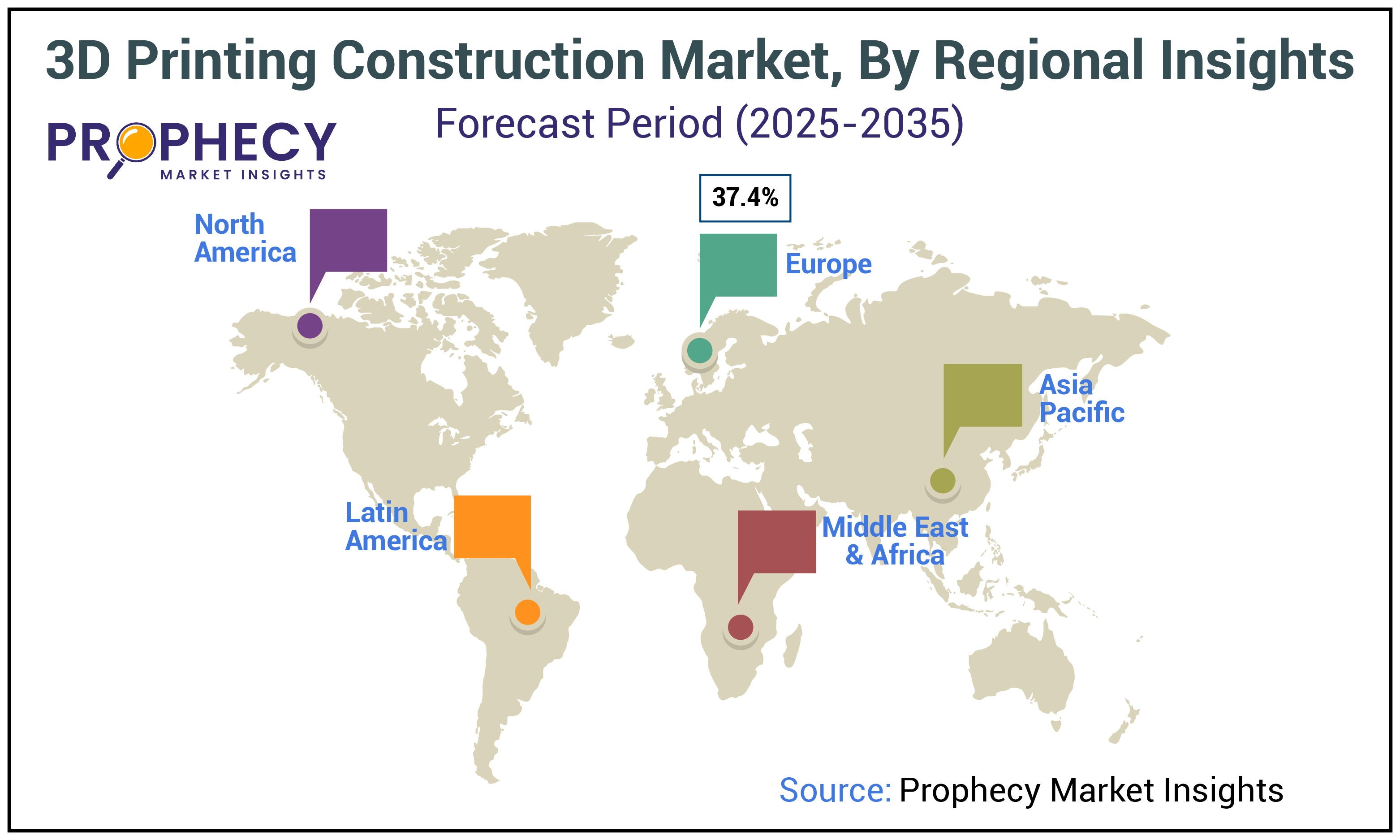
Geographically, the 3D printing construction market is studied across North America, Europe, Asia Pacific, Latin America, and the Middle East & Africa.
Europe: This region is the leader of the global 3D construction market with 37.4% share due to strong government support and a high level of interest in sustainable construction. The Netherlands and Germany are leading the way with large scale 3D printed buildings and structural advancements, while also promoting eco-friendly materials and innovative solutions in the building and infrastructure sector.
- Netherlands 3D Printing Construction Market Insights:
The Netherlands is ahead of its European competitors when it comes to 3D printing in the construction sector, which it owes to a strong culture of innovation, as well as an early embrace of additive manufacturing technology in architecture. Other European countries are well behind in this field, however, notable projects include 3D-printed bridges and homes that demonstrate how the Netherlands positions itself at the frontier of sustainable construction, helped in part by supportive government policies and academic research.
Asia Pacific: The second market is Asia Pacific where the drive toward urbanization, population growth and investment into smart cities has created a burgeoning industry. Countries such as Japan and China have introduced 3D printing to the construction industry to provide a viable solution to lack of housing and improvements in the speed of construction while maintaining low-cost, scalable and eco-friendly building methods.
- China 3D Printing Construction Market Insights:
In the Asia Pacific region, China is by far the leader in 3D printing and appears to be integrating it into residential and commercial construction at multiple scales. Chinese companies have already successfully produced multi-story 3D printed buildings. China is carved out in this domain as a leading country in construction technology and inventive scalability.
North America: This region is third in market growth due to technological advancements and the demand for effective and cost-efficient construction solutions. The U.S. ranks first in market growth, having several start-ups and academic institutions that are investing in 3D printing technologies. The promise of sustainable infrastructure and disaster-resolved housing also encourages regional market growth, as part of larger government goals.
- U.S. 3D Printing Construction Market Insights:
In North American construction, the U.S. ranks first for 3D printing activities, driven by technological innovation capital, venture capital, and research institutions. The focus of 3D printing construction in the United States is on sustainable and affordable housing, disaster relief shelters, and military infrastructure. Small to large construction projects has capacity for institutional, national, or international infrastructural investment, and is identified by other government departments to help leverage regulatory initiatives.
3D Printing Construction Market Report Scope:
|
Attribute |
Details |
|
Market Size 2025 |
USD 8.7 Billion |
|
Projected Market Size 2035 |
USD 20.72 Billion |
|
CAGR Growth Rate |
8.3% (2025-2035) |
|
Base year for estimation |
2024 |
|
Forecast period |
2025 – 2035 |
|
Market representation |
Revenue in USD Billion & CAGR from 2025 to 2035 |
|
Regional scope |
North America - U.S. and Canada Europe – Germany, U.K., France, Russia, Italy, Spain, Netherlands, and Rest of Europe Asia Pacific – China, India, Japan, Australia, Indonesia, Malaysia, South Korea, and Rest of Asia-Pacific Latin America - Brazil, Mexico, Argentina, and Rest of Latin America Middle East & Africa – GCC, Israel, South Africa, and Rest of Middle East & Africa |
|
Report coverage |
Revenue forecast, company share, competitive landscape, growth factors, and trends |
Segmentation:
By Method:
- Extrusion
- Power Bonding
- Additive Welding
- Others
By Material Type:
- Concrete
- Metal
- Composite
- Others
By Printing Technology:
- Robotic Arm
- Extrusion
- Gantry-Based 3D Printing
- Sand 3D Printing
By End-user:
- Building
- Infrastructure
By Region
- North America
- U.S.
- Canada
- Europe
- Germany
- U.K.
- France
- Russia
- Italy
- Spain
- Netherlands
- Rest of Europe
- Asia Pacific
- China
- India
- Japan
- Australia
- Indonesia
- Malaysia
- South Korea
- Rest of Asia Pacific
- Latin America
- Brazil
- Mexico
- Argentina
- Rest of Latin America
- Middle East & Africa
- GCC
- Israel
- South Africa
- Rest of Middle East & Africa
3D Printing Construction Market Competitive Landscape & Key Players
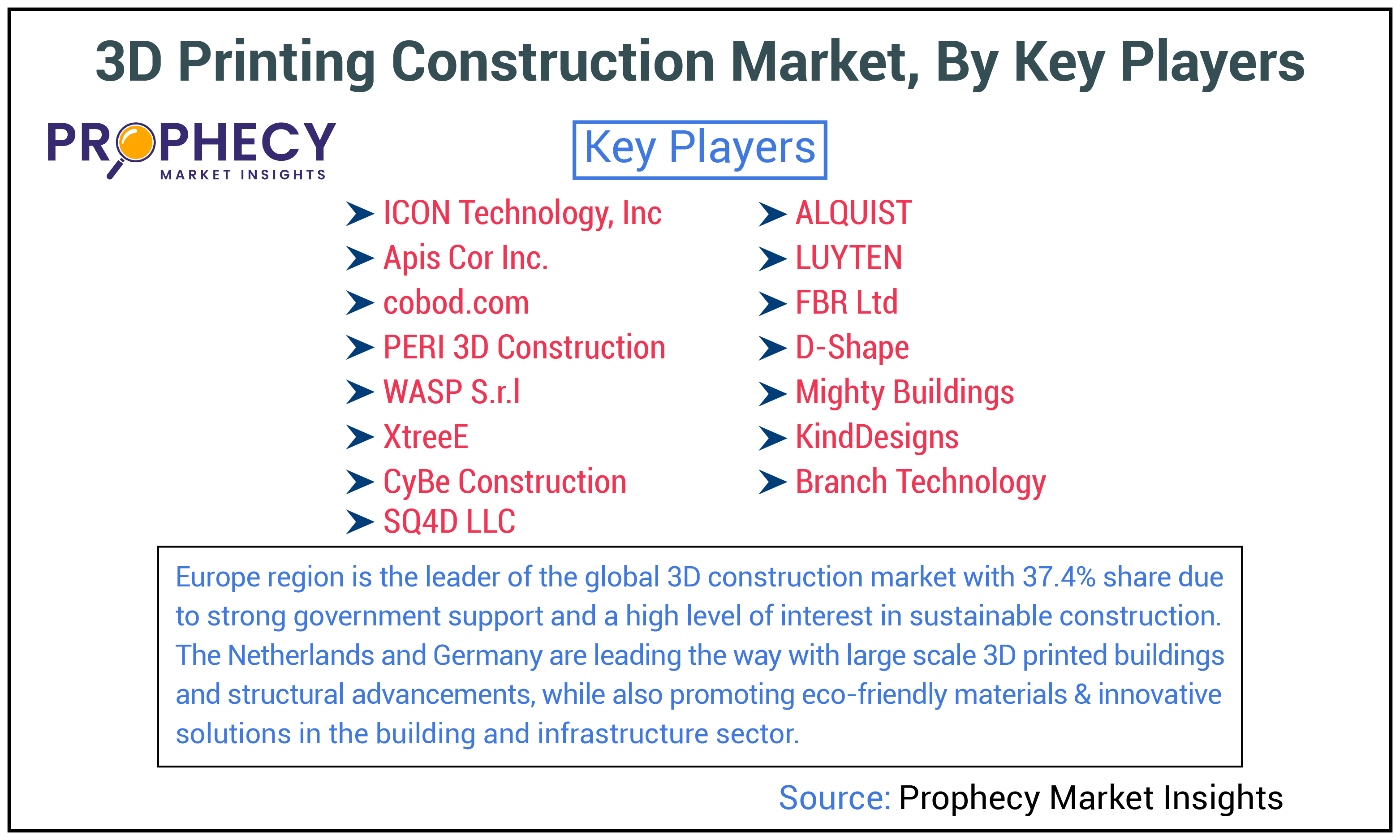
The prominent players operating in the market include, ICON Technology, Inc, Apis Cor Inc., cobod.com, PERI 3D Construction, WASP S.r.l, XtreeE, CyBe Construction, SQ4D LLC, and others. Rapid urbanization, sustainability objectives, and innovation are driving the fiercely competitive 3D printing construction sector. Proprietary technology, material innovations, and project scalability are ways that businesses set themselves apart. Key growth initiatives include regional development and strategic partnerships with governments and real estate developers. Competitiveness is also shaped by R&D expenditures and regulatory compliance.
3D Printing Construction Market Companies:
- ICON Technology, Inc
- Apis Cor Inc.
- cobod.com
- PERI 3D Construction
- WASP S.r.l
- XtreeE
- CyBe Construction
- SQ4D LLC
- ALQUIST
- LUYTEN
- FBR Ltd
- D-Shape
- Mighty Buildings
- KindDesigns
- Branch Technology
View an Additional List of Companies in the 3D Printing Construction Market
3D Printing Construction Market Recent News
- In March 2024, ICON Technology, Inc., which specializes in advanced construction technologies and large-scale 3D printing, announced an entirely new suite of products and innovations to help automate the construction process further. As part of that announcement, they revealed a revolutionary new robotic printer that allows for multi-story construction, a digital catalog, a low-carbon building material featuring ready-to-build home designs for over sixty homes, and an AI Architect to help with home design and build.
- In June 2023, XtreeE announced the global launch of three new connected 3D printing units via partner companies in Switzerland, the United States, and Japan. This brings the total of deployed 3D printing units to twelve. For context, this project is part of XtreeE's plan to have a global network of more than 50 3D printing units by 2025.
Analyst View:
The construction industry of 3D printing is a fast-emerging market as more individuals embrace opportunities to build sustainable, affordable, and more efficiently. There are many active trends in the industry; including the exploration of smart materials in construction, the increasing use of artificial intelligence (AI) in construction practices, and the automation of building and design practices. Some of the most significant current successes include completed large-scale builds and increasing government funding.
There are many exciting opportunities for 3D printing construction, especially with the world’s growing population and housing issues (especially in developing countries) and the declining state of infrastructure that many places are facing. One of the biggest constraints to the market will be the capital expenditure involved with starting up; including limited regulations around the use of 3D printing in construction or prototyping dispositions and the nature and complexity of these emergent technologies. Addressing the limitations of the field will be critical to achieve a level of broad-scale adoption of 3D printing as a new and innovative construction method.
More Related Reports
3D Printed Service Market
Metal 3D Printer Market
3D Microfluidic Cell Culture Market
3D Motion Capture System Market
3D Printing Medical Devices Market
3D Printing Construction Market Company Profile
|
Company Name |
LUYTEN |
|
Headquarter |
Melbourne, Australia |
|
CEO |
Ahmed Mahil |
|
Employee Count |
50 Employees |
3D Printing Construction Market Highlights
FAQs
3D printing construction market size was valued at USD 8.7 Billion in 2025 and is expected to reach USD 20.72 Billion by 2035 growing at a CAGR of 8.3%.
Method, material type, printing technology, end-user, and region are the segmentation for the 3D printing construction market.
North America, Asia Pacific, Europe, Latin America, and the Middle East & Africa. Europe is expected to dominate the market.
The prominent players operating in the market include, ICON Technology, Inc, Apis Cor Inc., cobod.com, PERI 3D Construction, WASP S.r.l, XtreeE, CyBe Construction, SQ4D LLC, ALQUIST, LUYTEN, FBR Ltd, D-Shape, Mighty Buildings, KindDesigns, and Branch Technology